


Payment processing for tool suppliers and hardware wholesalers
Payment processing for tool suppliers and hardware wholesalers covers the three ways contractors and trade buyers pay you: paid-now card sales at the trade counter, charges to trade accounts settled later by invoice or statement, and phone or remote orders paid before a worker collects them. We price every account on interchange-plus, month to month.

- PCI DSS Level 1
- SOC 2 Type II
- All major cards: Visa, Mastercard, Amex, Discover, UnionPay, Diners Club & PIN Debit
- Interchange-plus available
- Specialist onboarding support
How tool and hardware suppliers get paid
Tool and hardware suppliers get paid by the contractors, maintenance departments and trade businesses they sell to. B2B tool supply payments split between paid-now sales at the trade counter and account charges invoiced later, with phone orders, special-order deposits and returns around them. Hardware stores selling to homeowners will find their consumer checkout under Retail.
Paid-now sales at the trade counter
A tradesperson or crew member picks up blades, anchors or a replacement drill and pays before leaving, by tapping or inserting a card on the countertop terminal. If a buyer asks to put the ticket on the employer's account instead, it moves to the account. Finance gets the ticket number, card type and any job name entered.
Contractor trade-account charges
Approved contractors sign for tickets on their trade account, often under a job sub-account or PO, and pay from an invoice or monthly statement on the terms you agreed, by emailed payment link, phone or bank payment. If a payment comes in short or a ticket is disputed, the rest stays open. Finance needs the tickets each payment clears.
Phone and remote orders
A contractor's office manager or owner phones or emails an order for will-call pickup or job-site delivery and pays before it leaves your branch, by payment link or through the Virtual Terminal. If the payer is not on the account, or a card fails address checks, staff ask for another payer or card. Each payment is tied to an order number.
Special-order deposits and balances
When a contractor special-orders a non-stock item, such as a magnetic drill press or matching cordless kits for a crew, you take a deposit when it is ordered and the balance when it arrives, at the counter or by payment link. Cancellations follow your written special-order terms. One special-order number links the deposit, the balance and your purchase order to the manufacturer.
Returns and account credits
Contractors bring back unused tools when a job wraps up, wrong-size bits and damaged deliveries. Each approved return becomes either a card refund or a credit on the trade account, never both for the same amount. Restocking fees follow your written policy, and finance links each return slip to the original ticket or invoice.
How do contractors pay at the trade counter and on account?
Contractors pay at the trade counter in one of two ways: a paid-now sale on the countertop terminal, or a charge to a trade account that you invoice later. Trade counter card payments close the ticket on the spot; account charges become industrial tool invoice payments collected by link, phone or bank payment. Mark every ticket as one or the other, and capture the job or PO reference before the buyer leaves.
How a counter ticket gets paid
Staff ring the ticket in your POS or ERP. On a paid-now sale, the buyer taps or inserts a card on the countertop terminal and takes a printed receipt. On an account sale, staff check that the account is open and the buyer is authorized, and the buyer signs the charge ticket instead. Put the ticket number and job reference on both kinds of ticket.
Set up buyer lists and reference rules first
Ask each contractor for a written list of employees who may charge to the account, and whether tickets need a PO, a job name or both. Flag those rules where counter staff see them before ringing the sale, and note any reference a purchasing-card program requires. A buyer who is not on the list can still pay now by card.
Declines, credit holds and mixed tickets
If a card declines, ask for another card or, for an authorized buyer, move the ticket to the account; do not keep re-running the same card. If the account is on credit hold, send the contractor's office a payment link for the overdue invoices while the crew waits. When one ticket is part card, part account, record the parts separately so only the account portion reaches the statement.
A framing crew lead, two kinds of sale
Say a framing crew lead picks up nail-gun fasteners and two saw blades for job 2214, then adds a cordless drill for personal use. The fasteners and blades go on the contractor's account under job 2214; the crew lead taps a personal card for the drill as a separate paid-now ticket. The month-end statement lists only the job 2214 ticket.
How do phone orders and authorized pickups get paid?
Phone and remote orders are paid before the tools leave your branch: the contractor's office pays by payment link, or reads a card number to staff who key it into the Virtual Terminal, and the counter releases the order only to the person named on it. High-value tools are easy to resell, so keep the payer, the order and the person collecting on record.
How a remote order gets paid
The office manager or owner phones or emails the order, and staff build it in your order system. Staff then send a payment link by email or SMS to the payer on the account, or key the card into the Virtual Terminal while the payer is on the line, with AVS and CVV checks. The payer gets an emailed receipt, and the order is marked ready for pickup or dispatch.
Know your payers, pickup names and card consent first
Send payment requests only to authorized payers on the account, and write on each order which employee or driver will collect it. A link sent to a known email address is safer than keying a card read out by an unfamiliar caller. For weekly reorders, store a card in the Secure Card Vault only after the contractor signs an authorization saying which orders it covers and how to withdraw it.
Fraud signals, backorders and partial pickups
Treat a first-time caller who wants high-value tool kits collected same-day by a third party as a warning sign: send a payment link, with 3D Secure where applicable, call back on a number already on file, and hold the release if details do not match. If part of an order is backordered, charge only what is released, or refund the difference, and keep open lines on the same order.
A plumbing owner pays from the job site
Say a plumbing contractor's owner calls from a job site to order a press tool kit and fittings for job 88. The counter sends a payment link to the owner's email on file, the owner pays from a phone, and staff note that the apprentice listed on the account will collect. The apprentice shows identification, and staff record who released the order.
RapidCents products for tool and hardware suppliers
These products cover both sides of a tool supplier's receivables: Countertop Terminals for paid-now counter tickets, the Virtual Terminal for phone orders with staff permissions and an audit log, Payment Links for account invoices and remote orders with job or PO references, and Reporting to reconcile settlements, fees and refunds to your ledger.
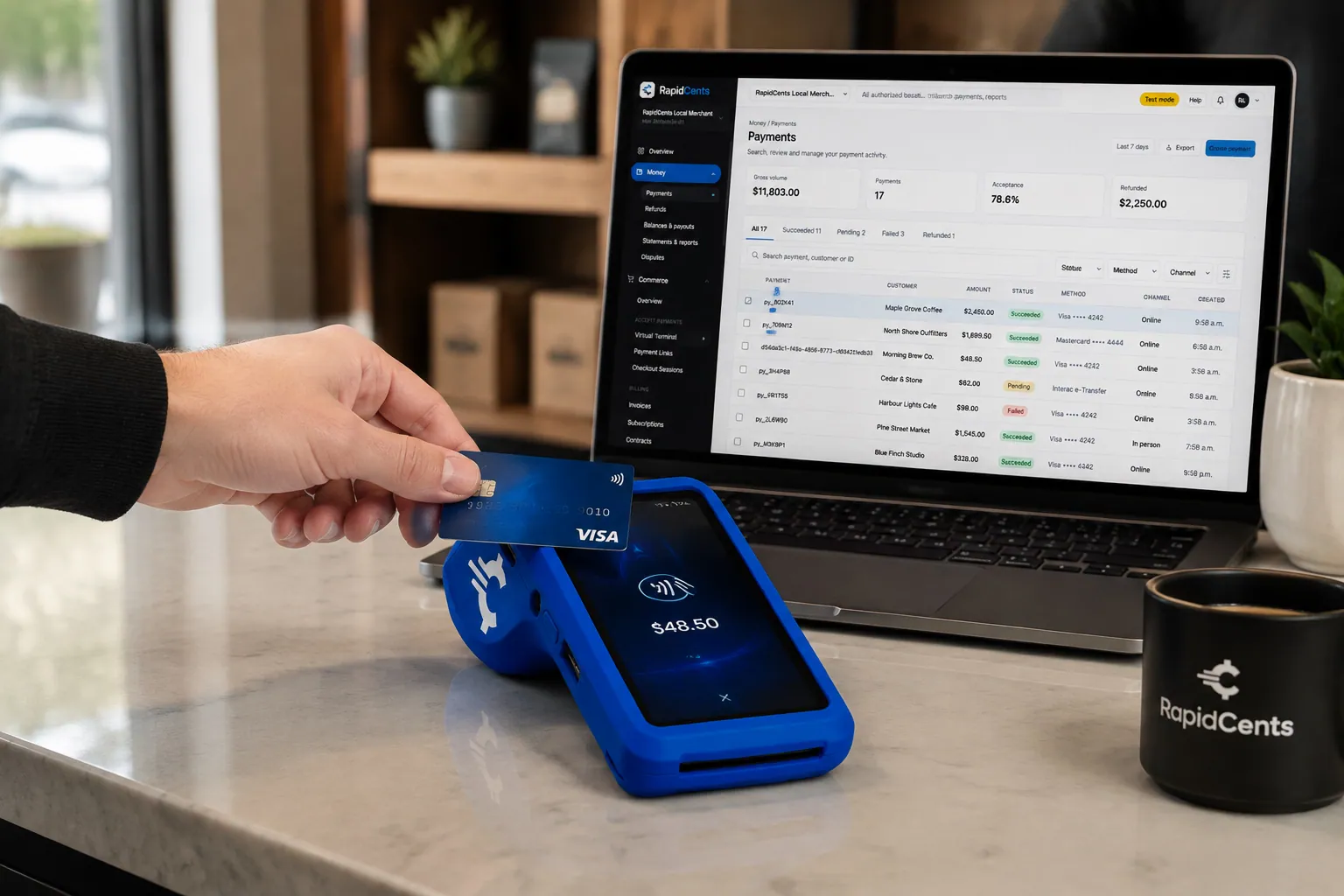
A fixed RapidCents countertop terminal taking card payments at the till, with settlement visible on the dashboard. Countertop Terminals
RapidCents countertop terminals sit at retail counters, restaurant hosts and reception desks where speed and…
Explore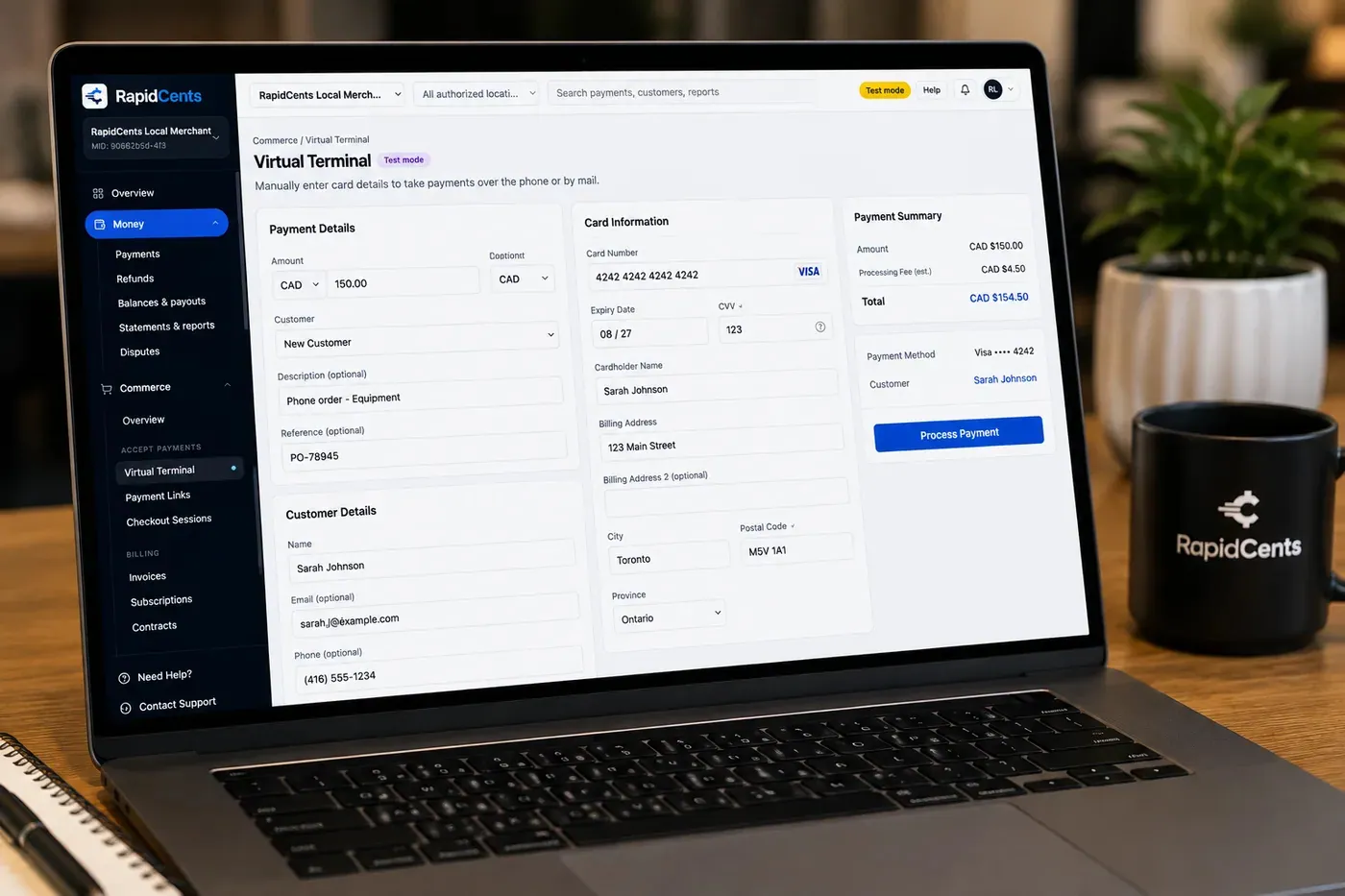
The RapidCents virtual terminal: payment details, card number, expiry and CVV keyed by hand on the left, with a payment summary on the right showing the amount, the estimated processing fee and a Process Payment button. Virtual Terminal
The RapidCents virtual terminal lets authorized staff enter mail-order and telephone-order payments through a…
Explore
The RapidCents payment links screen listing created links with their amount, status, click count and whether they have been paid, beside a phone showing the branded page a customer opens to pay $2,500.00. Payment Links
RapidCents payment links let staff generate branded pay-by-link URLs for invoices, deposits, balances and…
Explore
A merchant reviews RapidCents reports for volume, mix and payouts, with the terminal that took the sales on the desk. Reporting
RapidCents reporting delivers customizable transaction, settlement and fee reports with CSV and PDF export…
Explore


How are returned tools refunded or credited?
Returned tools are refunded or credited the way the original sale was settled: a card refund when the tool was paid for at the counter or by link, a credit note when it was charged to a trade account. Approve the return under your written policy, reverse only the approved amount, and keep the original ticket, invoice and job reference attached so the contractor's statement and your ledger agree.
How a return is processed
The contractor brings the tool and ticket number, or staff look up the sale by account, date or job. Staff inspect the tool, approve the return amount and follow the route the sale set: a refund to the card that paid, through the processor that took the payment, or a credit note against the account invoice. Record the original ticket number on the refund or credit note.
Write the return policy before the first dispute
Print return windows, restocking fees, non-returnable special orders and the rules for opened blades, bits and abrasives on tickets and invoices. Decide who may approve a return and who may issue the refund, and set Virtual Terminal role permissions to match. A policy the contractor saw at purchase is also your evidence if a refund amount is disputed.
Warranty claims, other cards and chargebacks
A defective tool under warranty may be repaired or exchanged under the manufacturer's terms, which is not a refund. If a contractor wants the refund on a different card, or the sale is past your return window, follow your written policy, such as an account credit, rather than refunding a card that did not pay. If a charge is disputed, Disputes and Chargeback Protection tracks the evidence deadline.
Two returns, two routes
Say a contractor returns an unused rotary hammer and a sealed box of anchors after a job ends. The hammer was tapped at the counter six weeks earlier, so staff refund that card against the original ticket, less the policy's restocking fee. The anchors were charged to job 31, so they become a credit note on that invoice and appear on the next statement; the card refund does not.
What drives card processing costs for a tool supplier?
Tool distributor credit card processing costs depend mainly on which cards contractors pay with, how each card is taken and how sales split between small counter tickets and large account payments. We price every account on interchange-plus: interchange on each ticket or account payment, set by the card networks, passes through at cost, plus the RapidCents markup in your Fee Schedule and fees for equipment or services, if applicable. There is no fixed term; agreements run month to month.
Counter debit versus account purchasing cards
A tradesperson paying a small counter ticket by debit card and a facilities department paying a month of tickets by purchasing card sit in very different interchange categories. Debit cards generally carry lower interchange than business, rewards and purchasing cards, so track which cards counter buyers and account payers use across several months.
Tapped at the counter versus keyed or paid by link
Cards tapped or inserted at the countertop terminal are card-present payments, which generally carry lower interchange than phone orders keyed into the Virtual Terminal or payments made by link. Keying a card while the buyer stands at the counter generally costs more and adds risk, so have staff ask for a tap or insert. Your counter, phone and link split is a main figure to compare.
Large balances, enhanced data and bank payments
Interchange generally grows with the sale amount, so a few large statement or special-order payments by card can outweigh many counter tickets. Where the card and your setup support it, some purchasing cards can carry a tool order's PO, tax and line items as Level 2 or Level 3 data. For a balance above a card or account limit, agree a bank payment or documented staged payments, never a split charge.
Returns, chargebacks and what to bring to Fee Check
Card refunds on returned tools and chargebacks on disputed tickets add cost and staff time. Bring two or three recent statements, your counter, phone and link split, your average counter ticket and account payment, and your refund and chargeback counts to Fee Check, which reads an uploaded statement and shows interchange separately from markup. Check card network rules and applicable laws before adding a surcharge to account statements.
Will your distribution ERP and accounting software work with RapidCents?
RapidCents integrates with many major business platforms through APPIE and RapidBridge, so most suppliers keep the ERP and accounting software they run today. The link takes one of a few forms: a RapidBridge connection, an API integration, payment links sent outside the software, or a settlement export imported later. Your RapidCents representative walks you through the right option for your vendor and version.
Epicor Prophet 21
Epicor Prophet 21 is a distribution ERP, so if you run it, your sales orders, invoices and contractor receivables likely live there. RapidCents integrates with many major platforms through APPIE and RapidBridge, and the right option depends on your Prophet 21 version and how your installation takes payments. Tell your RapidCents representative which one you run, and they will show you how counter sales, account payments and cards on file connect to it.
NetSuite and SAP Business One
NetSuite and SAP import settlement files from RapidCents, so counter sales, account payments, fees and refunds reach either system through a scheduled import rather than in real time. Your representative helps you match the template to your NetSuite edition or SAP Business One version, so account, invoice and job references arrive the way your receivables team applies cash.
Dynamics 365 Business Central and Acumatica
RapidBridge works with Dynamics 365 Business Central and Acumatica, so a card payment can post against the invoice you already have open without changing your software. If you prefer a lighter setup, a payment link carrying the ERP invoice number with the receipt recorded in the ERP works too, as does a settlement export imported on a schedule.
QuickBooks Online and Xero
If your counter sales and account receipts end up in QuickBooks Online or Xero, RapidCents connects settled transactions, fees and refunds to both. Agree with your accountant how paid-now tickets, account payments and return credits should post, so the trade-account ledger and the bank deposit tell the same story.
Counter POS and your web store
If counter staff ring tickets in a separate POS, APPIE lets that POS drive your RapidCents terminals, so your team keeps the system they know. A standalone countertop terminal also works, with staff recording the payment against the ticket. Contractors ordering through your web store can pay through Hosted Checkout or the Payment Gateway API, and your representative maps out the steps for your platform.
Payment options for tool and hardware suppliers by country
Which payment options a tool and hardware supplier can offer contractors depends on the country of its merchant account; RapidCents serves merchants in Canada and the United States. Major cards such as Visa, Mastercard and American Express work at the counter, by phone and by payment link, while debit options, the bank-payment method and settlement currency follow the account's country.
Cards across counter, phone and link
Contractors can pay counter tickets on a terminal, phone orders through the Virtual Terminal and account invoices through a payment link. Card brands, debit options and transaction limits follow the country of your merchant account.
Bank payments for statements and large balances
Bank payments suit trade-account statements and special-order balances because they are not tied to a card's credit limit. Which bank-payment method you can offer, what authorization a contractor signs and which currency you settle in all follow the country where your merchant account is held; ask about International Payments if you sell across borders.
How do you switch processors with open accounts and pending returns?
Switching processors as a tool supplier starts with an inventory of what the old processor still holds: contractor cards on file, unpaid invoices with old payment links, special-order deposits and recent card sales that may come back as returns. Test at one counter first, keep the old account open while its refunds and disputes run out, and reconcile settlements to your ledger daily until a month closes cleanly.
Stored cards and open payment links
For each contractor with a card on file, note the authorization they signed and which orders it covers. Card tokens move to a new processor only if both providers agree, so plan to collect fresh authorizations from contractors who reorder by stored card. Reissue each unpaid invoice's payment link from RapidCents and cancel the old link.
Move one counter, then each branch
Once your account is approved, install countertop terminals at one counter and set Virtual Terminal roles for who may key cards, refund and void. Run a test sale, a refund, a phone order and a payment link carrying a job reference, and check each record in your reports and ERP import before moving the next counter. With several branches, Multi-Location can give each one its own merchant ID and roll-up reporting.
Keep the old account open until its items close
Returns of tools paid on the old account are normally refunded through the old processor, and disputes on old payments arrive there too. Keep it open until outstanding special orders close and the dispute period on recent sales has passed, so no contractor is refunded or charged through the wrong system.
Reconcile settlements and tell contractors
Match each settlement to the counter tickets, invoices and deposits inside it using RapidCents transaction, settlement and fee reports, exported as CSV or PDF or in formats for accounting import. Tell each contractor's office about the new receipt format and the business name that will appear on card statements, so a familiar tool purchase is not disputed as an unknown charge.
Payment questions from tool and hardware suppliers
What is the best payment processor for tool and hardware suppliers?
The best payment processor for a tool and hardware supplier is the one that fits both your trade counter and your contractor accounts, so judge hardware wholesaler merchant services on that split. Look for countertop terminals, invoice payment links that carry job and PO references, a virtual terminal with staff permissions for phone orders, and refunds traceable to the original sale. We price every account on interchange-plus, so interchange and your markup are shown separately, and Fee Check reads your current statement so you can compare quotes on the same basis. Your RapidCents representative will show you how payment data reaches your ERP.
How much does credit card processing cost for tool distributors?
On interchange-plus pricing, what a tool distributor pays depends on card mix, how each card is taken and order size, not one advertised number. With RapidCents, each counter sale and account payment costs interchange, passed through at cost, plus the markup in your Fee Schedule, along with fees for equipment or services, if applicable. Purchasing and rewards cards generally cost more to accept than debit cards, and keyed phone orders more than tapped counter sales. Upload a recent statement and Fee Check shows your interchange and markup separately.
Can a distribution ERP like Epicor Prophet 21 use a different payment processor?
In most cases, yes. RapidCents integrates with many major platforms through APPIE and RapidBridge, so most suppliers keep the ERP they run today. The right option depends on your ERP vendor and version, whether that is a RapidBridge connection, an API integration, or payments taken by link and recorded afterwards. Tell your RapidCents representative whether you run Epicor Prophet 21, Dynamics 365 Business Central, Acumatica or another system, and they will walk you through it. NetSuite and SAP import settlement files from RapidCents.
How can tool and hardware suppliers switch processors without losing payment history?
Export your transaction, refund and dispute history from the old processor, and keep that account open until its open items close. List every contractor card on file with its authorization, plus special-order deposits and recent card sales, since refunds on those normally go back through the processor that took the payment. Moving stored cards needs both processors to agree, so expect some contractors to authorize a card again. Job, PO and account history stays in your ERP throughout.
Which payment options are available to tool and hardware suppliers in Canada and the United States?
Tool and hardware suppliers in Canada and the United States can generally offer contractors card payments at the counter, by phone and by invoice link, plus a bank-payment option for trade-account statements, but the exact methods depend on the merchant account's country. Debit options, the bank-payment method, the authorization a contractor signs and the settlement currency differ between the two countries, so your RapidCents representative will set out the options that apply to you.
Can a contractor pay at the counter and settle account invoices later?
Yes, as long as the two are recorded as separate payment events. A counter ticket paid by card closes when the card is approved; a ticket charged to the contractor's trade account becomes an invoice or statement line the office pays later by link, phone or bank payment. Mark each ticket as paid now or on account, and apply later payments to the invoices they clear. Paying by card settles an invoice; it does not change your net terms or make them financing.
How are returned tools refunded against an old invoice?
Find the original sale, then refund or credit only the approved return amount. If the tool was paid by card, refund that same card through the processor that took the payment, noting the original ticket number. If it was charged to a trade account, issue a credit note against the original invoice so the contractor's statement shows the same adjustment as your ledger. Never do both for one amount, and apply restocking fees only as your written return policy sets out.
Can a business purchasing card carry a job or PO reference?
Yes. A purchasing card payment taken through a payment link can carry a job or PO reference. The link's custom reference fields hold a job name, PO number or account code, and your RapidCents representative will show you how they appear on receipts, exports and your accounting import. Whether enhanced Level 2 or Level 3 data reaches the card network depends on the card, your setup and network rules; a reference field alone does not qualify a payment for it.
Can a business owner pay remotely before a worker collects tools?
Yes. Send the owner, or another payer the account lists, a payment link tied to the order, or take the card by phone through the Virtual Terminal. Once the payment is approved, write on the order who may collect it, and have counter staff check that person's identification against the order before releasing anything. Keep the paid order, the pickup name and the release record together, because they are your evidence if the card payment is disputed later.
Will every commercial-card payment have a lower rate?
No. What a commercial or purchasing card costs to accept depends on the card, how it is taken, your merchant setup and the network rules that apply. Some commercial-card categories recognize Level 2 or Level 3 data where the card and your setup support it, but many business cards still carry higher interchange than consumer debit. Check what your own commercial-card transactions cost on recent statements rather than assuming a discount.
What MCC is used for tool and hardware suppliers?
MCC 5072, which covers hardware, equipment and supplies, is commonly associated with tool and hardware wholesalers. RapidCents sets the merchant category when you open a tool supply merchant account, based on what you actually sell and who you sell to. If you also run a retail counter open to homeowners, a repair shop or a rental desk, mention it during onboarding so the review reflects your whole business.
Related trade supplier pages
Industrial MRO, safety and PPE, electrical, plumbing and HVAC supply pages share these counter, account and return workflows, and the B2B & Wholesale hub covers distributor payments across categories. Hardware stores selling to homeowners should read the Retail page, which is written for consumer checkout.
B2B & Wholesale
Collect net-terms invoices by payment link with the PO number attached, take commercial…
Industrial MRO Suppliers
Get paid by the plants, mills and maintenance contractors you supply, from a breakdown…
Safety & PPE Suppliers
Collect site-level PPE orders, bulk uniform deposits and repeat replenishment from the…
Plumbing Supply Wholesalers
Collect counter sales, special-order fixture deposits and trade-account statements from…
Electrical Supply Wholesalers
Collect from electrical contractors and facility buyers at the will-call counter, by…
HVAC Supply Distributors
Collect furnace and condenser deposits, trade counter sales and contractor statement…
Dental Suppliers
From monthly consumables reorders to chair and imaging deposits, collect what clinics…
Veterinary Suppliers
Get invoices, standing orders and equipment deposits paid by the veterinary practices…
Take the next step
Review payments for your tool supply business
Upload a recent processing statement to Fee Check to see interchange separated from markup across your counter tickets, phone orders and account payments. Then bring your counter-to-account split, typical ticket sizes, return volume and ERP to a conversation with your RapidCents representative about how your trade counter and contractor accounts get paid.
- No obligation
- Payment specialists, not a call centre
- Secure statement upload



