


Boat dealer payment processing for deposits and balances
Boat dealer payment processing from RapidCents lets a dealership take holding deposits, delivery balances, parts and service counter sales and seasonal storage payments in person, by phone or by payment link. We price every account on interchange-plus, month to month, and we integrate with many major platforms through APPIE and RapidBridge.

- PCI DSS Level 1
- SOC 2 Type II
- All major cards: Visa, Mastercard, Amex, Discover, UnionPay, Diners Club & PIN Debit
- Interchange-plus available
- Specialist onboarding support
How boat dealers get paid
Marine dealer credit card processing covers four main jobs: holding deposits on a boat order, delivery balances at handover, parts and service counter sales, and seasonal storage or winterization invoices. Each runs on its own timing, so you set each one up separately.
Holding deposits
A buyer commits to a specific hull and you take a holding deposit by terminal, payment link or virtual terminal. The signed order sets the refund terms. Finance gets a receipt tied to the stock number or order number, so the deposit can be applied at delivery.
Delivery balances
At handover the buyer pays the remaining balance against the final invoice, after rigging, commissioning and add-ons are totalled. You take it by payment link, bank payment or card, within the ticket limits on your account. Finance matches it to the deposit and the invoice.
Parts and service counter
A boater walks into the ship store or service desk for parts or a repair order. Staff take the sale on a countertop terminal and tie it to the work order. Your report separates parts from service once your departments are mapped.
Seasonal storage and winterization
Owners buying in the fall often add storage, shrink wrap or winterization. You invoice with a payment link, or set up a recurring schedule if the owner authorizes it. The record shows what was storage, what was service and what remains open.
How do boat dealers take holding deposits on a boat order?
Boat dealers take boat deposit payments by tying a payment to a signed order for a specific hull, engine and trailer package. Send the order and collect the deposit in one flow with Contracts & eSignatures, or send a payment link. The signed terms set what is refundable.
How the deposit runs
The salesperson prepares the order with the stock number, options and refund terms, then sends it for signature. The buyer signs and pays the deposit by payment link, or in the showroom on a countertop terminal. The receipt carries the order number.
What to set up first
Agree the deposit terms in writing before you take money: what the deposit holds, what is refundable, what happens if a survey or the buyer's own financing falls through, and when the offer lapses. To keep a card for the balance, get the buyer's separate authorization.
A $2,500 pontoon deposit, then an engine change
Say a buyer reserves a 24-foot pontoon with a $2,500 deposit sent as a payment link. A sea trial changes the engine choice, so the order is amended and signed again. If the buyer cancels within the agreed terms, you refund to the same card and note the order number.
How do boat dealers collect the delivery balance?
Boat dealers collect the delivery balance by issuing the final invoice at handover, then sending a payment link or taking payment at the desk. Whether a card can carry the whole amount depends on the ticket limits on your account, and your RapidCents representative gives you those limits before you promise buyers anything.
How the balance runs
Add commissioning, rigging, registration paperwork and accessories to the final invoice, subtract the deposit, and send the balance as a payment link or take it at the desk. The buyer receives a receipt, and your office closes the order against stock.
What to set up first
Settle how a full boat will be paid before handover day. Many buyers pay part by card and part by bank payment from their own bank. Document how the balance is split on the invoice.
A $48,000 balance split across card and bank
Say a $48,000 balance is due at handover. The buyer pays part by card within your ticket limit and the rest by bank payment. If the card is declined, delivery waits until another method clears. A refund after delivery follows your written terms.
RapidCents products for boat dealers
Contracts & eSignatures, Payment Links, Countertop Terminals and Bank Payments cover the dealer's main jobs: signed orders with deposits, remote balances, the parts counter and larger invoices paid from a bank account.
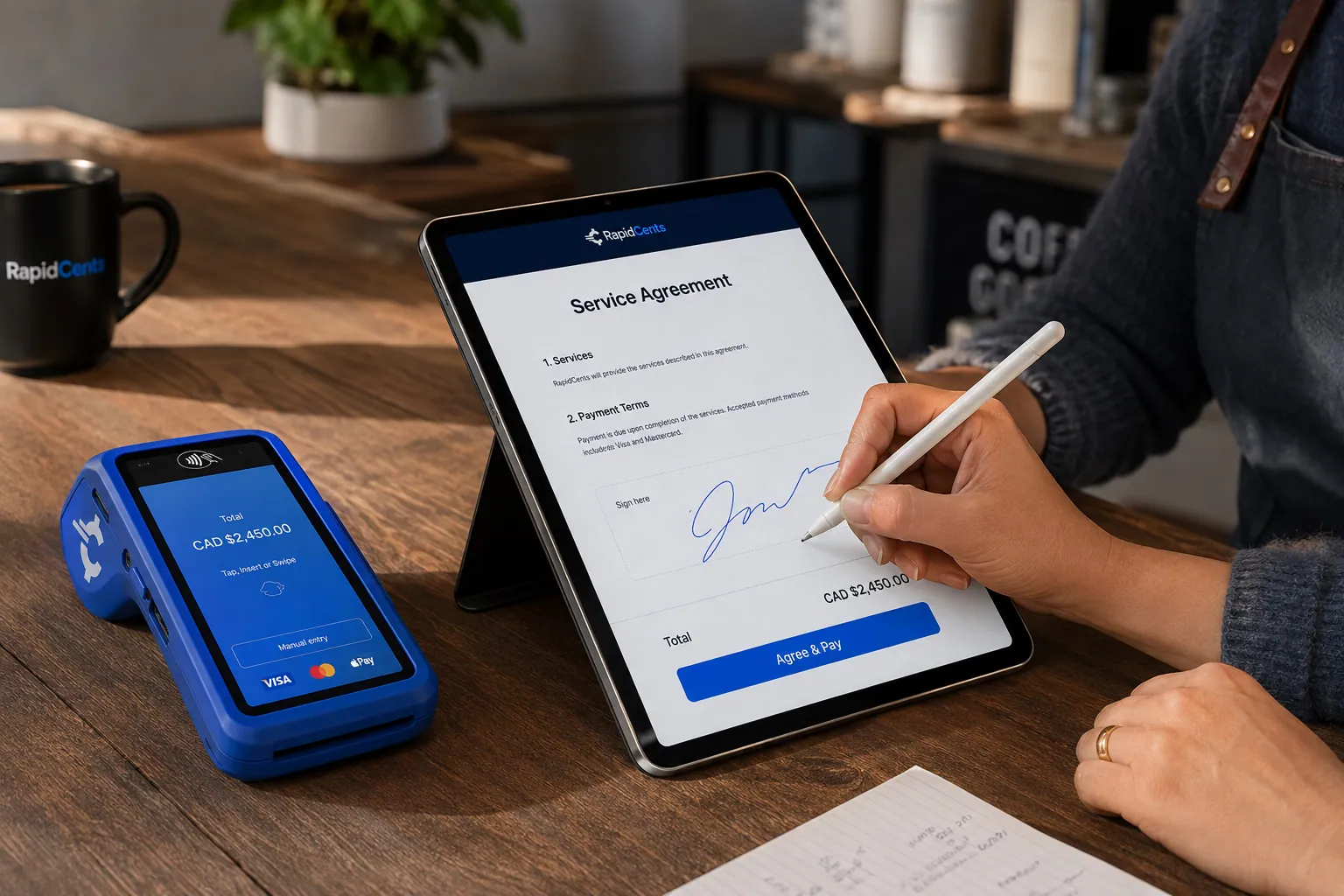
A merchant sends a RapidCents contract for e-signature with payment attached, terminal ready for an in-person counterpart. Contracts & eSignatures
Quotes, service agreements and enrolment forms usually end in a payment. Send the document, capture the…
Explore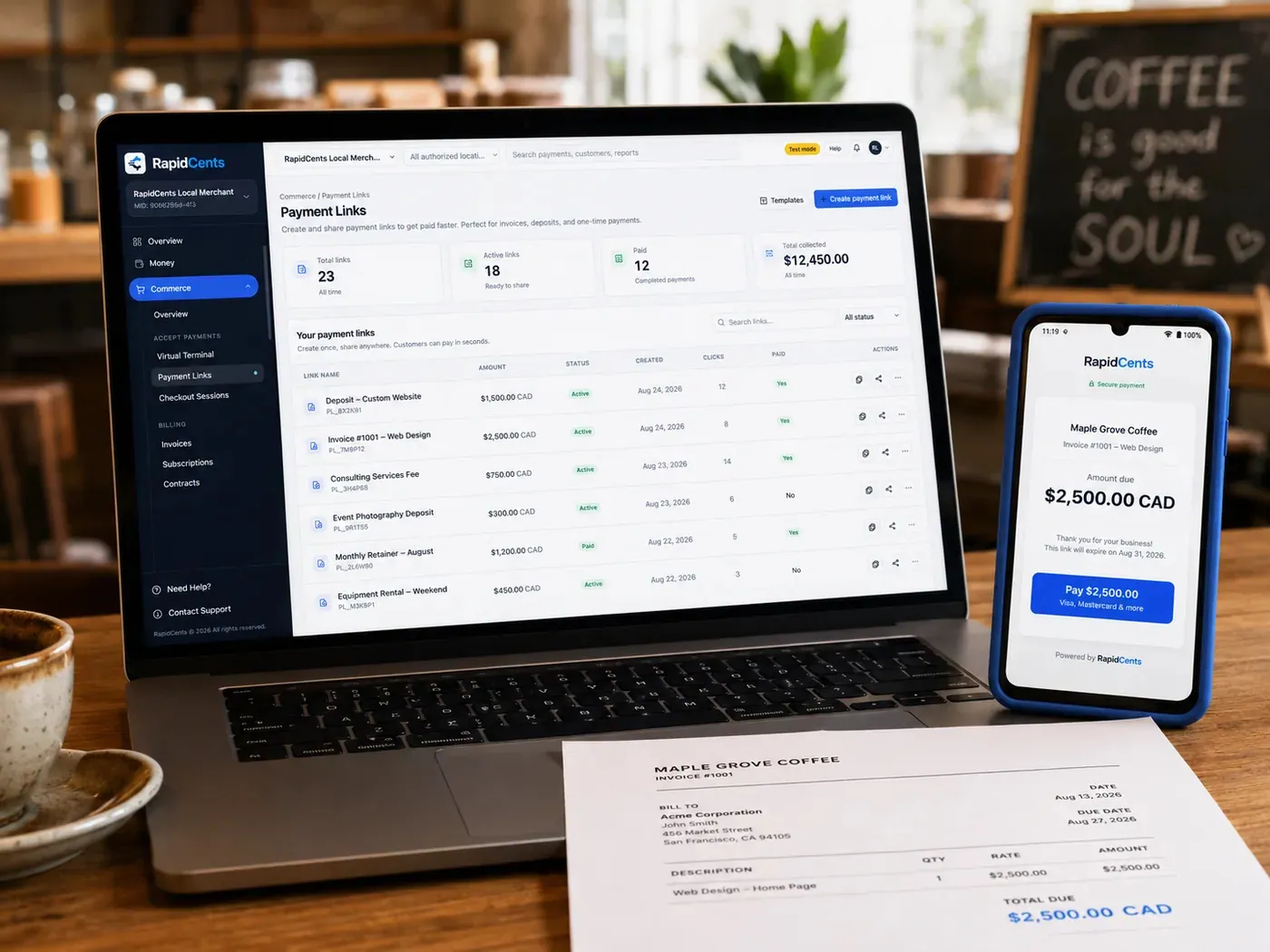
The RapidCents payment links screen listing created links with their amount, status, click count and whether they have been paid, beside a phone showing the branded page a customer opens to pay $2,500.00. Payment Links
RapidCents payment links let staff generate branded pay-by-link URLs for invoices, deposits, balances and…
Explore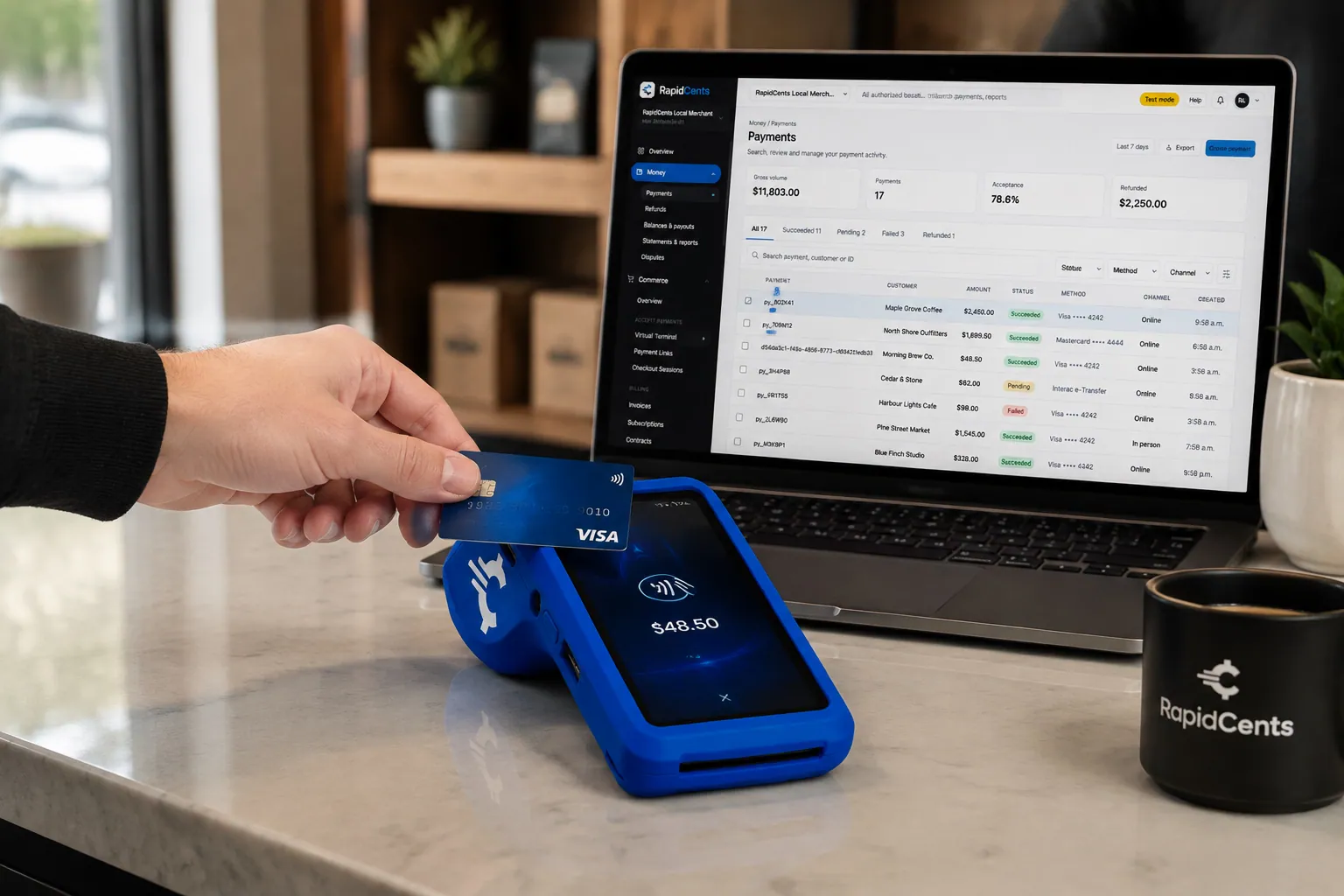
A fixed RapidCents countertop terminal taking card payments at the till, with settlement visible on the dashboard. Countertop Terminals
RapidCents countertop terminals sit at retail counters, restaurant hosts and reception desks where speed and…
Explore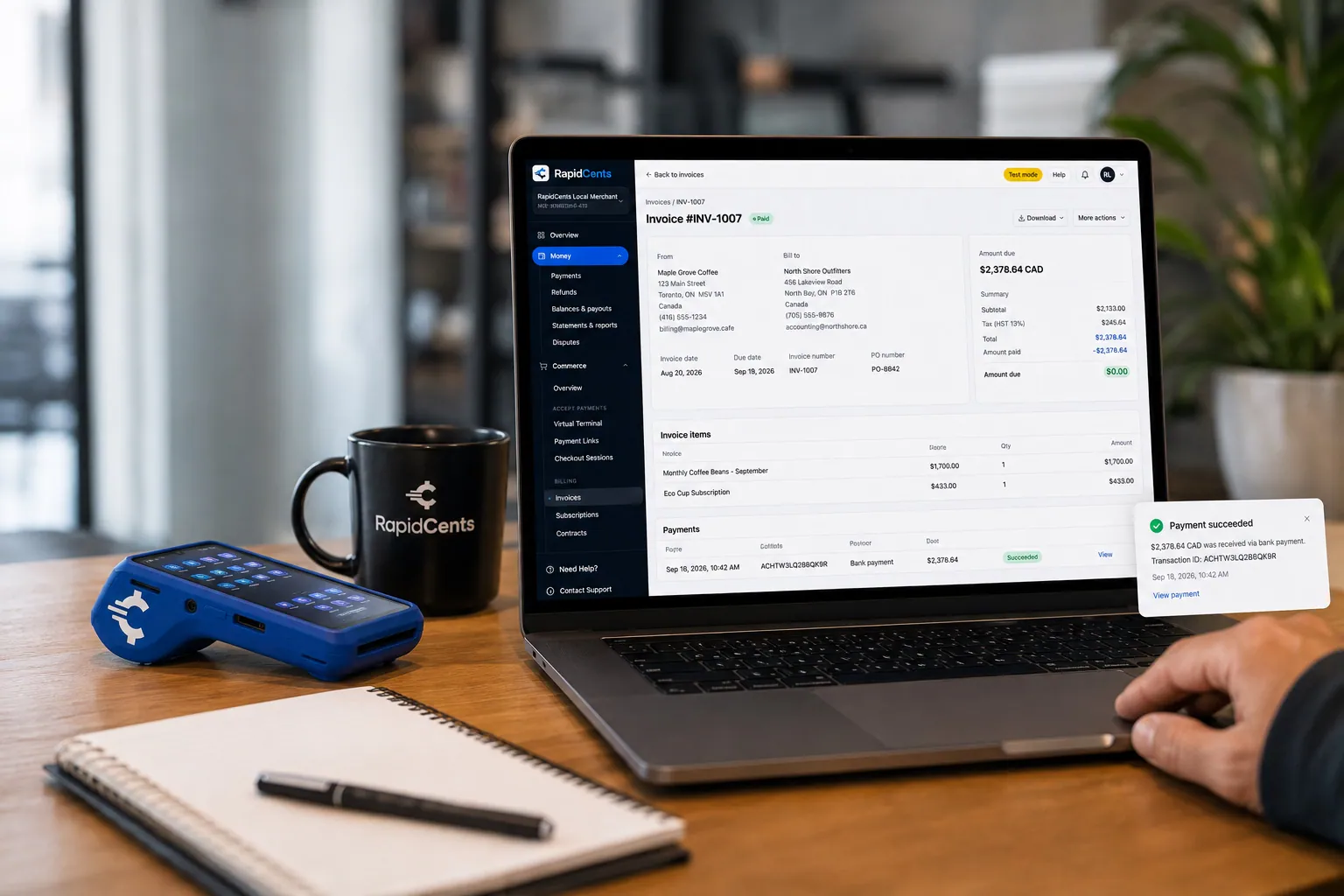
A merchant invoices a customer for bank debit through RapidCents, with card terminal capture available on the same desk. Bank Transfer / Bank Payments
Bank payments suit recurring and high-value invoices where card fees are the wrong tool. Collect directly…
Explore


How do boat dealers run parts, service and storage payments?
Boat dealers run parts, service and storage payments by taking each sale at the counter or by payment link and tagging it to a department and work order. Reports then separate the ship store, the service shop and storage, so one terminal does not blur your departments.
How the counter runs
Counter staff ring parts sales on a countertop terminal. Service advisors close a repair order with a payment link or at the desk once the work order is signed off. Each payment carries a work order or invoice number in the custom reference field.
What to set up first
Decide your department map before go-live: parts, service, storage and boat sales. Your RapidCents representative shows you how reporting separates departments on your account. For storage, keep a card only with the owner's authorization covering amount, timing and cancellation.
An outboard winterized with a month of storage
Say an owner drops off an outboard for winterization and adds a month of indoor storage. The advisor sends one payment link for the work order and a second invoice for storage. If the owner disputes the storage line, the signed work order and the invoice are your evidence.
How do you compare fees for a boat dealership?
Boat dealership merchant services cost depends on your card mix, your average ticket and how cards are taken. We price on interchange-plus: interchange passes through at cost, with your RapidCents markup in your Fee Schedule and fees for equipment or services, if applicable. Pricing is month to month with no fixed term.
What drives interchange
Interchange is set by the card networks and varies with card type: debit, credit, premium rewards or commercial cards. It also varies with how the card is taken, since a tapped or inserted card differs from a keyed or online one. A parts counter and a large deposit can look very different.
What to bring
Bring recent processing statements, your split between showroom, counter and remote payments, average ticket by department, and your refund and chargeback volume. Include the largest deposit you take. These show where cost comes from and which lines to question.
Compare with Fee Check
Upload a statement to Fee Check to see interchange shown separately from markup. Then compare it with your Fee Schedule and any equipment or service fees. A dealer with a few large tickets and many small parts sales should look at each type on its own.
Which software works with boat dealer payments?
RapidCents integrates with many major platforms through APPIE and RapidBridge, so most dealers keep the software they run today. The right option depends on your software vendor and version, and your RapidCents representative will walk you through it.
Dealer and marina management software
Dealers often run dealer management or marina software for inventory, work orders and invoices. Tell your RapidCents representative which system and version you use, and they will show you how payments, receipts and work orders connect to it.
QuickBooks Online and Xero
RapidCents connects settled transactions, fees and refunds to QuickBooks Online and Xero, so your books match your deposits. Map parts, service, storage and boat sales to their own accounts before go-live.
SAP and NetSuite
Larger dealer groups on SAP or NetSuite import settlement files rather than a live connector. Your RapidCents representative provides the file, shows how deposits, fees and refunds post, and helps you decide who owns the mapping.
Payment options for boat dealers by country
RapidCents serves merchants in Canada and the United States. The payment methods, bank-payment options and settlement currency a boat dealer uses depend on the country of the merchant account, and your RapidCents representative lays them out for yours.
Cards at the counter
Credit and debit cards cover the showroom, parts counter and service desk. Card types, debit networks and ticket limits depend on your account and your country. Ask your RapidCents representative what applies before you quote a buyer.
Bank payments and currency
Bank-payment options for balances and storage plans differ by country, as does the currency you are settled in. Rules for deposits and registration also differ, so check them with your advisor.
How do you switch boat dealer payment processing?
Boat dealers switch by listing what is open, testing the new flow before live traffic moves, and reconciling deposits to the ledger. Plan the move outside boat-show and spring delivery weeks, and do not assume stored cards move on their own.
Inventory what is open
List open deposits, unpaid invoices, storage schedules, stored cards with their authorizations, and refunds in progress. Note which orders await delivery. Token portability needs agreement from both providers, so ask early rather than assume.
Test, then run in parallel
Once your account is approved, run a test sale, a refund and a deposit payment link on the new setup before moving counter traffic. Keep the old processor active for open items until they close. Map payment references to stock numbers and work orders.
Reconcile deposits
Match each bank deposit to settled transactions, fees and refunds in the reports, then to your ledger. Do this for the first few settlement periods before you close the old account. Your RapidCents representative stays with you through those first periods.
Payment questions from boat dealers
What is the best payment processor for a boat dealership?
The best processor is the one that fits your deposits, balances, parts counter and storage at the ticket sizes you take. Compare written quotes on interchange-plus pricing, the markup in your Fee Schedule, ticket limits, dispute handling, department reporting and software compatibility. Fee Check lets you compare a statement on the same basis.
How much does credit card processing cost for boat dealers?
It depends on your card mix, ticket size and how cards are taken, so no single figure applies. We price on interchange-plus: interchange at cost, your markup in your Fee Schedule, and fees for equipment or services if applicable, month to month with no fixed term. Upload a statement to Fee Check to see interchange separately from markup.
Can my dealer management software use RapidCents for payments?
In most cases, yes. RapidCents integrates with many major platforms through APPIE and RapidBridge. Some products bundle a processor, while others accept a payment link, an export or a connection. Tell your RapidCents representative which system and version you run, and they will walk you through the right option.
How can a boat dealer switch processors without losing payment history?
Export your reports and list open deposits, unpaid invoices, storage schedules and stored cards before you move. Token portability needs agreement from both providers, so ask early. Test a sale, a refund and a deposit on the new setup, run in parallel for open items, then reconcile deposits to your ledger.
Which payment options are available to boat dealers by country?
It depends on the country of your merchant account. RapidCents serves merchants in Canada and the United States, and card types, bank-payment options, ticket limits and settlement currency vary by account. Your RapidCents representative sets up the methods that fit your dealership, and your advisor can speak to local deposit and registration rules.
Can I take a boat-order deposit?
Yes. Boat deposit payments should link to signed terms that say what the deposit holds and when it is refundable. RapidCents Payment Links and Contracts & eSignatures let you send the order, capture the signature and collect the deposit together. Put the stock number on the payment so the deposit applies at delivery.
Can the entire boat purchase be paid by card?
Sometimes. Whether a card can carry a full boat purchase depends on the ticket limits on your account and the buyer's own card limit. Many dealers take a deposit by card and the balance by bank payment. Your RapidCents representative tells you your limits, so you can quote a buyer with confidence.
How should a boat dealer bill seasonal storage and winterization?
Invoice storage and winterization separately from the boat sale, using a payment link or a recurring schedule the owner authorizes. A recurring plan needs agreement on amount, timing and cancellation, and a stored card needs the owner's authorization. Slip fees are a marina workflow, covered under Marinas.
What happens to a deposit if a boat order is cancelled?
It follows your signed terms. If the terms make the deposit refundable, you refund to the original card or bank payment and record the order number. If part is kept, say so in the order before you collect. A dispute is answered with the signed terms, the invoice and the delivery record.
What MCC is used for boat dealers?
MCC 5551 is commonly associated with boat dealers. Your RapidCents representative sets the right merchant category during onboarding, based on what your business actually sells, such as boats, parts, service or storage. A mixed dealership should describe every department when it applies.
Related industries
Marinas, powersports and RV dealers, and car dealerships share high-ticket deposits, delivery balances and service counters. Marinas also cover slip fees and fuel docks, a separate workflow from boat sales.
Marinas
Collect seasonal slip fees, fuel dock sales, storage invoices and transient booking…
Powersports & RV Dealers
Collect holding deposits on units, ring parts and service tickets, and bill winter…
Car Dealerships
Take holding deposits by payment link, ring service and parts tickets on terminals, and…
Nonprofits & Charities
Take one-time and monthly gifts online, sell event tickets by link and reconcile deposits…
Education
Take enrollment deposits online, run tuition installments on schedules families authorize…
Government
Take permit fees, counter payments and mailed-in payments from residents, then trace…
Events & Ticketing
Sell advance tickets online, take cards at the gate and concession stand, and give…
Membership Clubs
RapidCents collects membership dues on a schedule, takes event fees and guest passes by…
Take the next step
Review your dealership's processing costs
Upload a recent statement to Fee Check and see interchange separated from markup, based on the mix of deposits, balances and parts sales you actually run.
- No obligation
- Payment specialists, not a call centre
- Secure statement upload



