


Payment processing for powersports and RV dealers
Powersports dealer payment processing means taking card payments across the unit desk, the parts counter, the service lane and the storage yard. RapidCents sends payment links for holding deposits, runs Payment Terminals at the counters, invoices repair orders and bills seasonal storage with Recurring Payments, all on interchange-plus pricing, month to month.

- PCI DSS Level 1
- SOC 2 Type II
- All major cards: Visa, Mastercard, Amex, Discover, UnionPay, Diners Club & PIN Debit
- Interchange-plus available
- Specialist onboarding support
How powersports and RV dealers get paid
Powersports and RV dealers get paid through four jobs: a holding deposit on a unit, the balance at delivery, parts and service tickets, and recurring storage bills. Each has a different payer, trigger and record, so each gets its own RapidCents product.
Holding deposit on a unit
A shopper reserving a side-by-side or travel trailer for spring pays a holding deposit. The salesperson sends a payment link by text or email once the deal sheet names the unit and the deposit terms. The receipt goes to the sales manager and the office.
Balance at delivery
The buyer returns to pick up the unit and settles the balance, often split between a card and another form of payment. The finance office takes the card on a terminal or phone, and the receipt carries the deal number so the controller can match it.
Parts and service tickets
Riders buy gear and parts at the counter, while advisors close repair orders when the technician finishes. Terminals take the tap or chip, and invoices go out by link for owners who pick up later. Each ticket carries its repair order number.
Seasonal storage
Owners who store a camper, snowmobile or jet ski over the off-season agree to a monthly storage charge. Recurring Payments bills the saved card on the agreed day, and the storage manager sees each success or decline in the report.
Holding deposits on high value units
Send the holding deposit as a payment link tied to one unit, after the customer agrees to the deposit terms in writing. The link records the amount, the card used and the time, so the sales manager can match it to the deal and the stock number.
How the deposit runs
The salesperson confirms the stock number, the deposit amount and the refund terms, then sends a Payment Link by SMS or email. Powersports vehicle deposit payments then happen without a trip to the showroom. The shopper pays from a phone, and the receipt returns to both sides.
What to set up first
Write the deposit agreement before the link goes out: is the deposit refundable if financing falls through, if the unit is sold, or if the shipment is late? Contracts & eSignatures can capture the signature. A deposit is a payment toward the unit, not permission to charge the card later.
A $1,000 deposit on a spring travel trailer
Say a shopper orders a travel trailer for spring delivery and pays a $1,000 holding deposit by link. If the floorplan changes, the office refunds the same card and notes the reason on the deal. A large unit may exceed purchase card limits, so split the balance across tender types at delivery.
Parts and service department collections
Take RV parts counter payments and powersports service department payments on a terminal, and invoice repair orders for customers who pick up later. Every payment carries the repair order or ticket number so the department closes out cleanly each day.
Counter and service lane
Payment Terminals take chip and contactless at the parts counter, and a mobile terminal or Tap to Pay can take the payment in the lot beside a unit. Service advisors close the repair order, collect the card and hand over a receipt that matches the order.
Added work, adjustments and returns
Get the customer's go-ahead for added work before it goes on the ticket, and keep that go-ahead with the repair order. A part returned after the sale is refunded to the original card, and a warranty job paid by a manufacturer is a separate record from the customer's own payment.
A camper with a leaking slide-out
Say a customer drops off a camper with a leaking slide-out. The advisor sends the agreed estimate by link as an invoice, and the owner pays by phone before pickup. The parts manager rings accessories on the counter terminal, and the department totals both channels at close.
RapidCents products for powersports and RV dealers
These products cover the unit desk, the counters and the storage lot: terminals for the parts and service counters, payment links for deposits, invoices for repair work and recurring billing for storage.
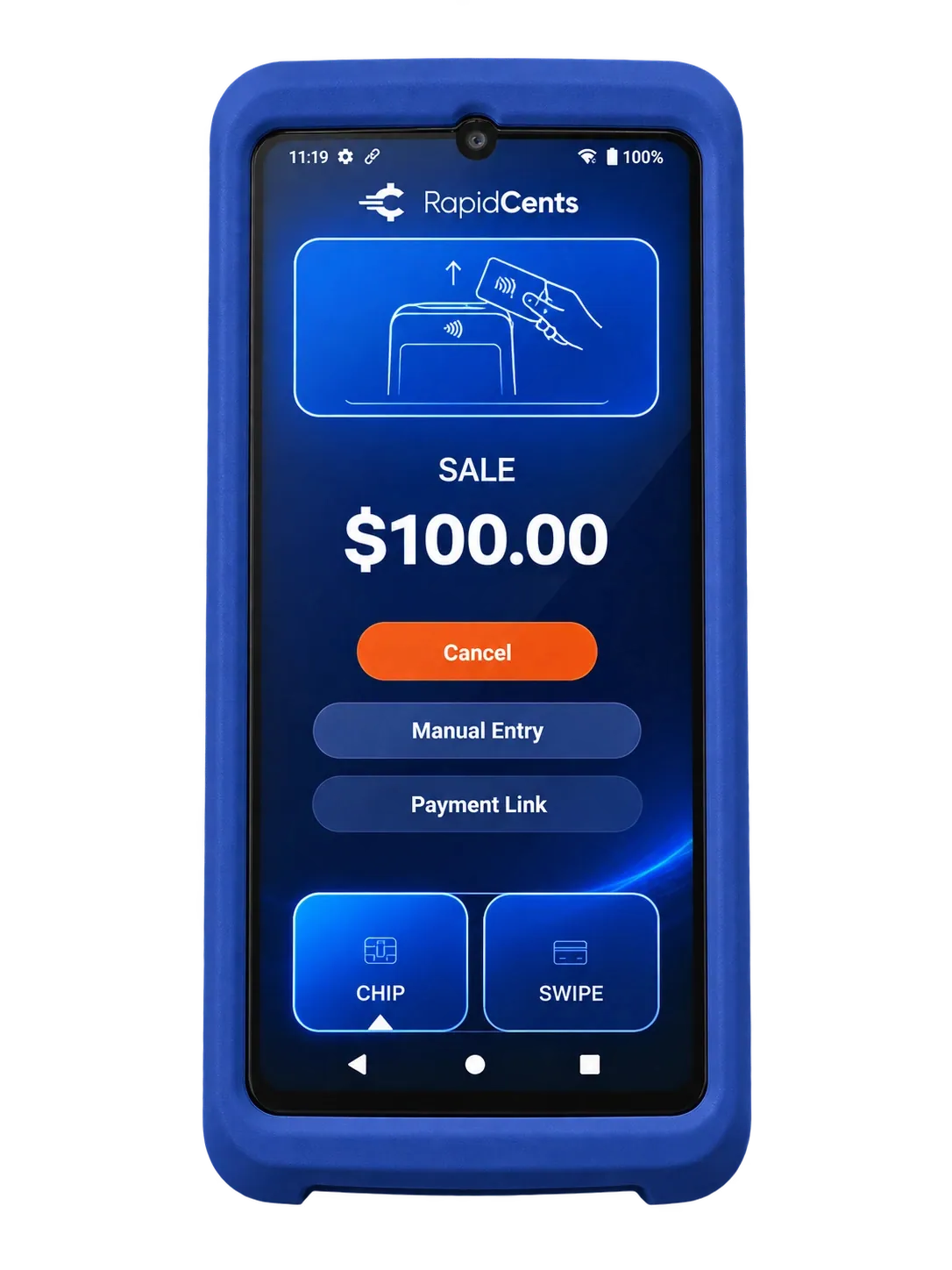
The RapidCents Rivo Go standing upright in its blue silicone case, showing the full-touch sale screen a customer reads across the counter. Payment Terminals
RapidCents payment terminals cover countertop, mobile and smart form factors so you can accept chip…
Explore
The RapidCents payment links screen listing created links with their amount, status, click count and whether they have been paid, beside a phone showing the branded page a customer opens to pay $2,500.00. Payment Links
RapidCents payment links let staff generate branded pay-by-link URLs for invoices, deposits, balances and…
Explore
The RapidCents invoices screen: outstanding, overdue, paid and draft totals across the top, the invoice list below them, and a preview of one invoice on the right with its line items and a View & Record Payment button. Invoicing
RapidCents invoicing helps professional services, contractors and B2B suppliers create branded invoices…
Explore
The RapidCents recurring payments screen showing active subscriptions, monthly recurring revenue, failed payments and upcoming renewals, above a list of subscriptions with their plan, amount, frequency and next billing date. Recurring Payments
RapidCents recurring payments manage subscription plans, membership renewals and installment schedules with…
Explore


Seasonal storage recurring charges
Run powersports seasonal storage billing as a recurring charge only after the owner agrees to the amount, the timing and how to cancel. RapidCents Recurring Payments runs the schedule, retries declines and lets the storage manager see who has paid.
How the schedule runs
The owner signs a storage agreement, saves a card through a secure link and is billed on the agreed day each month. Account Updater can refresh an expired saved card where supported, and customers receive a notice before each charge.
Authorization and cancellation
A stored card needs the customer's authorization for this purpose, so say in writing what the charge is, when it recurs and how the owner ends it. Pause the schedule when the unit leaves for the season, and refund any month billed after cancellation.
Twenty units on a winter lot
Say a dealer stores twenty snowmobile and RV units from October through April at a monthly charge. One owner's card declines in January. The system retries, the manager sends a payment link for the missed month, and the record shows the original attempt and the later payment.
Compare processing fees and total operating cost
Your cost depends on your card mix and how cards are taken. We price every account on interchange-plus: interchange passes through at cost, you pay the RapidCents markup set out in your Fee Schedule, plus fees for equipment or services if applicable. It is month to month with no fixed term.
What drives the cost
Interchange varies with card type, such as debit, credit, premium or commercial, and with how the card is taken. A tapped or inserted card differs from one keyed in, and a phone deposit by link differs from a card swiped at the parts counter.
What to bring to compare
Bring recent processing statements, your card mix, average ticket by department, the split between counter, phone and link payments, and your refund and dispute volume. Unit sales and parts sales behave differently, so ask every provider to quote the whole mix in writing.
How to check a quote
Fee Check reads an uploaded processing statement and shows interchange separately from markup. Compare that with your Fee Schedule line by line, including equipment fees for terminals. Walk away from a quote that cannot separate the pass-through cost from the provider's share.
Lightspeed DMS and your other dealer software
A payment can arrive through a connected terminal, a payment link or a file, and your dealer management software shapes which one fits. RapidCents integrates with many major platforms through APPIE and RapidBridge, and your RapidCents representative walks you through the options for your system.
Lightspeed DMS
Lightspeed DMS is the powersports and RV dealer management system, distinct from Lightspeed Retail. RapidCents integrates with many major platforms through APPIE and RapidBridge, and your representative will show you which option fits your edition and country.
IDS, DX1, Dealer Spike and EverLogic
Each of these dealer systems handles deals, parts or web leads differently, and each has separate editions. The right option depends on your vendor and version. Tell your RapidCents representative which one you run, and they will show you whether a payment link, a connected terminal or a file export fits.
QuickBooks Online, Xero, SAP and NetSuite
RapidCents connects settled transactions, fees and refunds to QuickBooks Online and Xero. SAP and NetSuite import settlement files. Your representative will help you map each department's deposits to your chart of accounts so units, parts, service and storage post where they belong.
Payment options for powersports and RV dealers by country
RapidCents serves merchants in Canada and the United States. Which payment methods, bank-payment options and settlement currency a dealer gets depends on the country of the merchant account, and your RapidCents representative will walk you through what applies to yours.
Cards across both countries
Credit cards from the major networks are accepted in person, by link and by phone. Debit options differ by country, and your representative will show you which debit methods your terminals support.
Bank payments and currency
Bank-payment options for storage billing and settlement currency follow the country of your merchant account. Your representative will set them out before you build recurring schedules or advertise a method.
Setup, switching and reconciliation checklist
Once your account is approved, switch in an orderly sequence: list what you hold today, test a sale, a refund and a deposit, then move live traffic. Plan around your slow season if you can, and keep the old and new reports side by side until the deposits agree.
Inventory what you hold
List open holding deposits, saved storage cards and their agreements, unpaid invoices, refunds in progress and the terminals at every counter. Saved cards may not move between processors without both providers agreeing, so plan to ask owners to re-authorize if needed.
Test before you go live
Run a test sale at the parts counter, a refund, a payment link deposit and one storage charge on the new setup. Check that each receipt carries the deal, repair order or storage reference, and that your dealer management software shows the same amount.
Reconcile by department
Run old and new processing in parallel for a period if you can. Match each deposit to the ledger by department: units, parts, service and storage. Use Reporting for settlement and fee detail, and map references so your controller can trace every line.
Payment questions from powersports and RV dealers
How should powersports and RV dealers handle holding deposits on high value units?
Take the deposit as a payment link tied to one stock number, after the customer agrees to written terms. Record whether it is refundable, who can adjust it and when the balance is due. The receipt, the link record and the deal sheet should all show the same amount, which makes reconciliation and any refund straightforward.
How should dealers handle parts and service department collections?
Collect at the counter or service lane on a terminal, and send an invoice by link when the customer picks up later. Every payment carries the repair order or ticket number. Get the customer's go-ahead before adding work, refund returned parts to the original card, and keep warranty payments separate from customer payments.
How should dealers handle seasonal storage recurring charges?
Use Recurring Payments after the owner agrees in writing to the amount, timing and cancellation terms. A stored card needs the customer's authorization for that purpose. Pause the schedule when the unit leaves, let the system retry declines, and send a payment link for any missed month.
How do dealers handle purchase card limits and split tender?
Split the balance across more than one payment, for example part on a card and part by another method, and give each payment its own receipt tied to the deal number. A card limit can decline a large charge, so the customer can contact their card issuer or use a second method. Your RapidCents representative will walk you through split-tender handling at the finance desk.
Which payment options can a powersports or RV dealer offer?
A dealer can usually offer credit cards in person, by link and by phone, plus bank payments where they apply. Methods, bank-payment options and settlement currency depend on the country of your merchant account, and RapidCents serves merchants in Canada and the United States. Your RapidCents representative will walk you through which methods you can offer before you advertise them.
Which payment processor is best for powersports and RV dealers, and what should we compare?
The best fit depends on your channels, card mix and software, so compare written quotes. Check how holding deposits and counter sales are taken, whether interchange is shown separately from markup, equipment fees, reporting by department, support and how the provider fits your dealer system. Fee Check shows interchange apart from markup on your statement.
What fees should powersports and RV dealers expect for in-person and online card payments?
Expect interchange, which passes through at cost and varies with card type and how the card is taken, plus your RapidCents markup and any fees for equipment or services. We price on interchange-plus, with your markup in your Fee Schedule, month to month. Ask for a written quote based on your actual volume and channel mix.
Can we use RapidCents with Lightspeed DMS or IDS?
RapidCents integrates with many major platforms through APPIE and RapidBridge. The right option depends on your software vendor and version, whether you run Lightspeed DMS, IDS or another dealer system. Tell your RapidCents representative which system and edition you run, and they will walk you through how payments connect, whether by terminal, link or file.
How can dealers reduce payment disputes and protect stored card details?
Get clear written authorization and send a receipt for every deposit, keep refund terms visible, and limit staff access to saved cards. Payment Tokenization and the Secure Card Vault store card data without exposing it. Keep the deal, repair order and receipts together as evidence, though no provider can promise to win a dispute.
How can dealers switch payment providers without losing billing records?
List open deposits, saved storage cards, unpaid invoices and terminals first, then test a sale, a refund and a deposit before moving live traffic. Saved cards may need both providers to agree to move them, so you may need owners to re-authorize. Reconcile the first deposits to your ledger by department.
What MCC is used for powersports and RV dealers?
MCC 5571 is commonly associated with this type of business. We set the correct merchant category during onboarding, based on what your dealership actually sells, such as motorcycles, off-road vehicles, campers or parts and service. Tell your RapidCents contact about every department so the category fits your real activity.
Related industries
Dealers share deposits, service tickets and recurring billing with other vehicle and transportation businesses. Look at these related industries for similar counter, field and invoice workflows.
Taxi & Transportation
Take card fares and tips in the vehicle, reconcile each driver's takings by shift and…
Parking
Take cards at booths and event gates, let drivers pay by plate or QR code, and bill…
Towing & Roadside
Take release fees at the yard gate, card payments at the roadside and invoices for…
Automotive
Take the parts deposit, the phone-approved repair, the insurance deductible and the…
Car Wash
Single washes at the pay station, unlimited plans on monthly autopay and the renewals…
Car Dealerships
Take holding deposits by payment link, ring service and parts tickets on terminals, and…
Limousine & Charter
Take a booking deposit, adjust for wait time and gratuity, and capture the final fare…
Courier & Delivery
Bill business accounts on terms, take card payments from walk-in senders and collect from…
Take the next step
See what your dealership really pays to process cards
Upload a recent processing statement to Fee Check and see interchange separated from markup across your unit, parts, service and storage payments.
- No obligation
- Payment specialists, not a call centre
- Secure statement upload



