Acquiring foundation
Payment processing: cards, ACH and a statement you can audit
Payment processing is the authorization, capture, settlement and reporting of a sale — card or bank rail — between the merchant, the networks and the payer's bank. RapidCents runs all four on one account: terminals, gateway, virtual terminal, payment links, and ACH. Interchange and card brand assessments pass through at cost; the markup is separate. EMDR is total fees divided by volume. Pre-authorization versus capture, force post, void and refund are different steps, not synonyms. RTP and FedNow are real-time credit rails, not faster card sales.
- Interchange and card brand assessments pass through at cost
- EMDR from the statement — Fee Check, not a brochure rate
- ACH in the US, ACH and FedNow and RTP worldwide, on one account

- Acquiring partner
- PCI DSS Level 1 infrastructure
- SOC 2 Type II
- Interchange-plus statements
- Dedicated merchant support
Who it's for
Growing retailers
Stores adding online checkout or a second location need one processor for every channel.
Service businesses
Contractors and clinics collect deposits in the field and balances by phone without switching providers.
Finance teams
Controllers reconcile deposits against POS and e-commerce exports from a single reporting hub.
Core capabilities
Multi-channel authorization
Route in-person, online, keyed and bank-rail transactions through one merchant account.
Interchange-plus statements
Pass-through interchange and card brand assessments, plus a disclosed RapidCents markup, line by line.
Authorization lifecycle
Sale, pre-authorization then capture, incremental auth, force post, void and refund — each is a different network step.
Bank rails beside cards
ACH in the United States; ACH and PAD worldwide; real-time credit on RTP, FedNow or FedNow and RTP. Flat cost, not a card percentage.
Settlement reconciliation
Match batch totals to bank deposits with location and channel filters, cards and bank debits in one view.
Refund and void controls
Issue full or partial refunds with role-based permissions. Void before settlement; refund after.
Next-day funding
Eligible merchants receive deposits on a predictable schedule with the fee breakdown on the same report.
The terms, each on the page that owns them
- Interchange and card brand feesInterchange, assessments, authorization and cross-border fees: the schedule the network publishes, not the processor.
- Effective rate, EMDR and Fee CheckEffective merchant discount rate is total fees divided by volume. Fee Check computes it from your statement.
- ACH, RTP and FedNowUS bank debits run on ACH. Same-day and real-time credit use RTP and FedNow. All of them sit beside card volume on one account.
- Virtual terminal, keyed entry and force postMOTO keyed sales, pre-authorization then capture, and force post when the authorization already happened offline.
- Payment gatewayThe software layer that carries an authorization from a website, app or virtual terminal onto the card networks.
- Terminals and PIN debitChip, tap and PIN debit at the counter — the card-present channel, cheaper than a keyed or online sale.
- TokenizationSwap a card number for a token your systems can store, so repeat billing works without keeping PAN in PCI scope.
- Payment glossaryEvery statement term — interchange, assessment, batch, capture, chargeback — defined the way it appears on a bill.
What a card payment actually costs
Interchange, paid to the issuer
The largest line on most statements, and the one no processor can discount. Interchange is set by the card networks and paid to the bank that issued the customer's card. Visa, Mastercard, Amex and Discover each publish a schedule by card product, merchant category and how the card was presented. The interchange-plus page names those schedules and links the primary sources.
Assessment and other card brand fees
The network's own charge for carrying the transaction: an assessment on volume, a flat authorization or network-access fee, plus cross-border, currency conversion and card-not-present add-ons when they apply. Like interchange, assessments are published and identical at every processor. They are not a RapidCents markup.
The processor markup — the only negotiated line
Interchange-plus states this separately, as a percentage, a per-item amount, or both. Bundled, flat-rate and tiered quotes hide it inside one blended number, which is why two providers quoting '2.5%' are rarely quoting the same thing. Compare markup, not the headline rate.
Avoidable network penalties
Integrity, misuse and downgrade fees fire when a sale misses the network's own rules: an authorization not captured in time, a missing AVS match, a batch left open. They are configuration, not pricing, and they are the fees most worth chasing on a statement.
What moves the category on one sale
Card product (debit vs standard credit vs rewards vs commercial), card-present vs card-not-present, merchant category code, whether the card is domestic, and whether Level 2 or Level 3 data went with a commercial card. The same $100 can land in three different interchange buckets.
Effective rate, EMDR and the discount fee
Effective merchant discount rate (EMDR)
Total processing cost divided by total processed volume, for one period, expressed as a percentage. It is also called effective rate or, loosely, merchant discount rate. The formula is the only honest comparison between two providers, because it folds interchange, assessments, markup, per-item fees, monthly fees, PCI, gateway and chargeback fees into one number.
Discount fee is not a discount
On a statement, 'discount fee' is the merchant's cost of accepting the card — historically a single blended percentage taken off the deposit. On interchange-plus it should unpack into interchange + assessment + markup. If the line still arrives as one percentage, the statement is bundled even if the sales deck said otherwise.
Quoted rate vs effective rate
A quote usually describes one qualified card-present sale. EMDR is the average of every card you actually took: rewards, commercial, foreign, keyed and online, plus the fixed fees that do not care about volume. Fee Check starts from the statement you already have, not from a brochure rate.
Nothing in the formula is a RapidCents rate
Interchange schedules change on the networks' timetable. This page does not publish a number that would go stale. For the current tables, use the primary sources on the interchange-plus page; for your number, run Fee Check or send a statement.
Authorization, pre-auth, capture and force post
Sale — authorize and capture together
A retail tap or an e-commerce charge that is captured immediately. The issuer holds the amount and the capture is sent in the same flow, then the batch settles. This is the default for a known final total.
Pre-authorization, then capture
Used when the final amount is not known yet: a bar tab, a hotel incidental hold, a pump, a rental deposit. The issuer holds an estimated amount; later you capture the actual total, within network rules. An uncaptured pre-auth expires and the hold releases. Restaurants capture after tip adjust; many online merchants capture at shipment.
Incremental authorization
When a pre-auth is no longer enough — the tab grew, the stay extended — a second authorization is added against the same card rather than opening a new sale. Missing this step is a common source of downgrade fees and of captures that exceed the original hold.
Force post, voice auth and offline
A force post (sometimes 'force capture' or 'force sale') submits a capture against an approval code that was obtained outside the normal online path: a voice-authorized sale when the network was down, a store-and-forward ticket, or a delayed close. It is not a way to charge a card that was declined. The virtual terminal is where keyed MOTO and many force posts are entered.
Void versus refund
A void cancels an authorization before it settles, so no money moves and no interchange is earned. A refund is a new transaction after settlement, with its own network cost. Closing the batch on time is what keeps voids available; once the batch has gone, the only reversal is a refund.
Card-present, keyed, MOTO and Level 2 / 3 data
Card-present vs card-not-present
A tap, chip or swipe at a terminal is card-present: the chip or NFC cryptogram proves the card was there, so interchange is lower. Online checkout, payment links, the virtual terminal and any keyed sale are card-not-present (CNP). Same card, same dollar, different network category — which is why a blended quote that ignores mix is not a forecast.
Keyed entry and MOTO
Mail-order / telephone-order (MOTO) is a keyed CNP sale: the number is typed, not read. It is the highest-interchange everyday path short of a commercial card, and it is the path most likely to fire AVS, CVV and downgrade fees when those checks are skipped. The virtual terminal is where RapidCents keyed and MOTO sales are entered.
PIN debit is still a card rail
A PIN debit at the terminal (PIN debit worldwide; Visa, Mastercard or a PIN-debit network in the US) is not ACH or ACH. It has its own interchange or flat network fee. Quoting 'debit' as one rate is how a bundled statement hides that PIN debit, signature debit and a bank pull are three prices.
Level 2 and Level 3 data
Commercial and purchasing cards qualify for lower interchange when the sale carries tax, invoice and line-item detail. Missing that data is one of the quiet reasons a B2B merchant's EMDR sits above the quote. MCC (merchant category code), assigned at underwriting, is the other silent lever: the wrong MCC can price every sale in the wrong bucket.
Batch, settlement, funding and chargebacks
Authorization is not money yet
The issuer holds the amount; funds move when the capture is batched and the batch settles. Closing the batch on time is what keeps next-day funding on schedule. An open batch delays every sale in it, card and otherwise.
Funding vs settlement
Settlement is the network clearing the captured sale. Funding is RapidCents depositing the net to your bank. They are consecutive, not identical: interchange, assessments, markup, chargebacks and ACH returns all hit the deposit, which is why the statement and the bank line rarely match dollar-for-dollar without the fee file.
Chargeback is not a refund
A refund is the merchant reversing a settled sale. A chargeback is the issuer pulling the funds after a dispute, plus a network fee. Representment is the evidence path. Prevention (descriptor, receipt, 3-D Secure, AVS) is cheaper than fighting. Chargeback protection is the product page for that workflow.
PCI is scope, not a line item to hide
Tokenization and hosted checkout keep PAN out of merchant systems so a PCI DSS assessment stays a short questionnaire. A 'PCI non-compliance fee' on a competitor statement is usually a penalty for skipping that work, not a network cost. RapidCents standard plans do not hide one.
Bank rails in the United States
ACH, the everyday US bank debit
The Automated Clearing House moves money between US bank accounts in batches, typically next-day or same-day, as a debit pull or a credit push. It is the rail for invoices, rent, payroll and B2B where a card percentage is the wrong tool. Same-day ACH is faster; it is still not instant. RapidCents collects ACH on the same merchant account as cards.
RTP and FedNow — the real-time credit rails
RTP is The Clearing House's Real-Time Payments network. FedNow is the Federal Reserve's instant rail. Both are 24/7 credit pushes with immediate finality — the US counterparts to the country's FedNow and RTP. They are not ACH, and they are not a card authorization. A 'real-time payment' on a checkout is usually one of these two, not a faster Visa sale.
Wires are still a third thing
A domestic or international wire is a bank instruction outside ACH and RTP, used for large, one-off transfers. It does not reverse like an ACH debit and it does not belong in card settlement reporting. If a buyer wants to pay a deposit by wire, that is a different operations path from ACH invoicing.
PIN debit versus ACH
A PIN debit at the terminal is still a card network transaction, routed through Visa, Mastercard or a PIN-debit network, with interchange (and, for larger issuers, Regulation II). ACH never uses a card number. Quoting them as one 'debit rate' is how a blended statement hides two prices.
How it works
Apply and complete merchant underwriting with RapidCents.
Configure terminals, gateway, virtual terminal and ACH or ACH.
Authorize as a sale, a pre-auth then capture, or a force post when needed.
Batches settle; card deposits and bank-rail credits hit the same report.
Read interchange, assessments and EMDR on the statement, or run Fee Check.
Common processing workflows
Retail counter sale
Chip, tap or swipe at checkout with automatic tip and receipt — authorize and capture together.
Pre-auth then capture
Open a bar tab, hotel hold or pump estimate, then capture the final total within network rules.
Keyed MOTO and force post
Phone and mail orders through the virtual terminal; force post a voice-authorized sale when the network was down.
E-commerce capture at ship
Authorize online, capture when the order ships, void what never left the warehouse.
Invoice on a bank rail
Collect a high-value invoice by ACH (US) or ACH / PAD () instead of putting it on a commercial card.
End-of-day close
Review batch totals, resolve exceptions, confirm expected deposit and the EMDR for the day.
Dashboard and reporting
Transactions, deposits and exceptions visible in the RapidCents merchant dashboard.
Try it, edit values and click buttons
Merchant dashboard
- Today
- $4,218
- Deposits
- $12,482
- Disputes
- 2 open
- In-person
- $842
- Online
- $1,104
- Virtual terminal
- $392
Demonstration data only
Integrations
QuickBooks Online
Sync settled transactions and fees for automated bookkeeping.
Shopify
Native checkout and payout reconciliation for e-commerce merchants.
Major POS partners
Certified integrations reduce double entry at the register.
Works with Payment Processing
Capabilities on the same account, so the parts below connect without a second integration or a second contract.
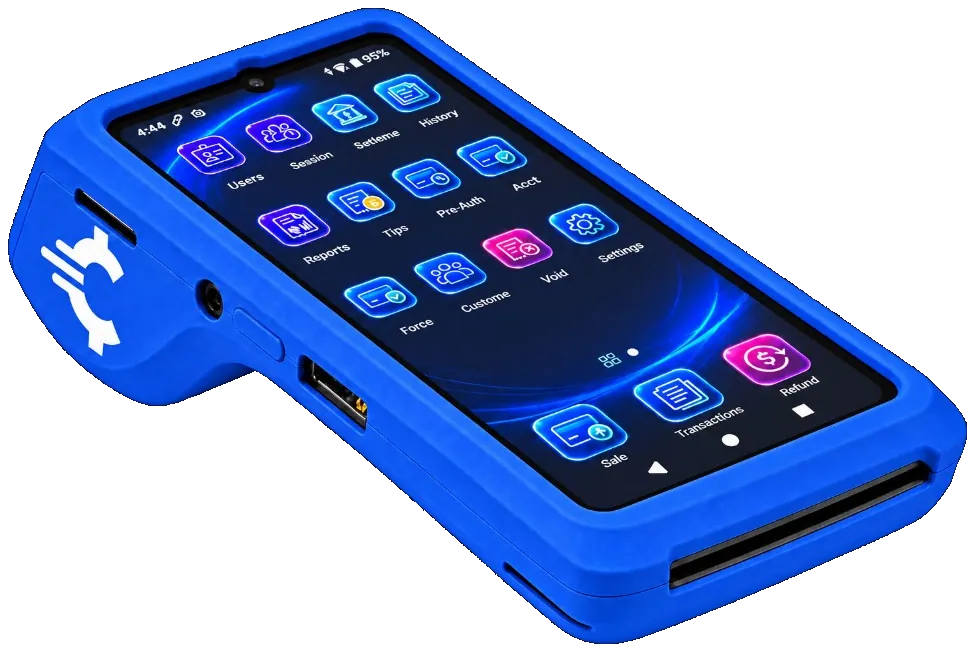
The RapidCents Rivo Go on a counter, the flagship of the Rivo line of countertop, mobile and compact card terminals. Payment terminals
Countertop, mobile and smart terminals for tap, chip and swipe at the counter.
Explore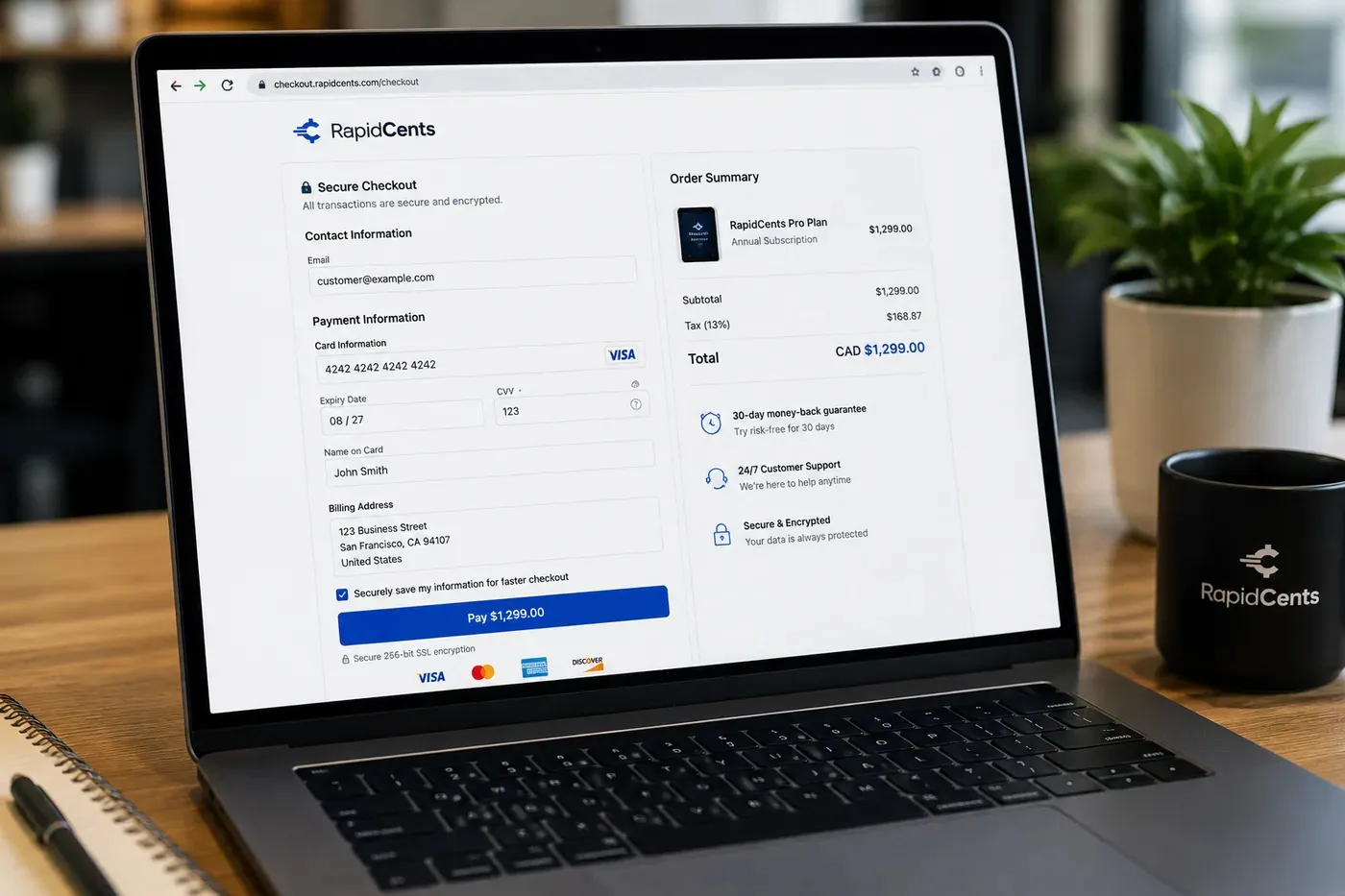
A RapidCents hosted checkout page at checkout.rapidcents.com, with the order summary and totals on the left and the card fields on the right, footed by SSL and PCI DSS assurances. Hosted checkout
A branded payment page RapidCents hosts, which keeps card data off your servers.
Explore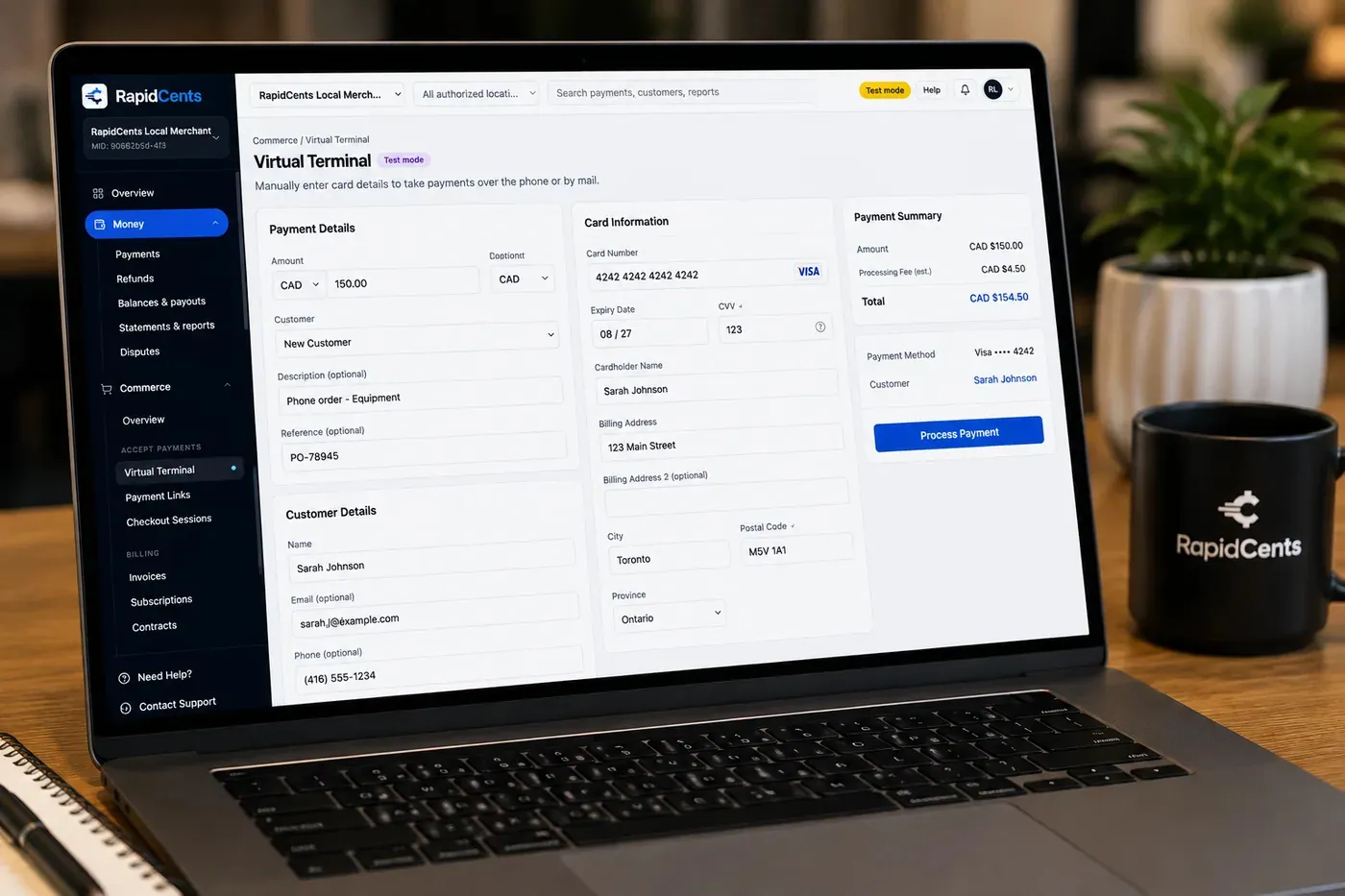
The RapidCents virtual terminal: payment details, card number, expiry and CVV keyed by hand on the left, with a payment summary on the right showing the amount, the estimated processing fee and a Process Payment button. Virtual Terminal
Key a card into a browser for phone, mail and back-office orders.
Explore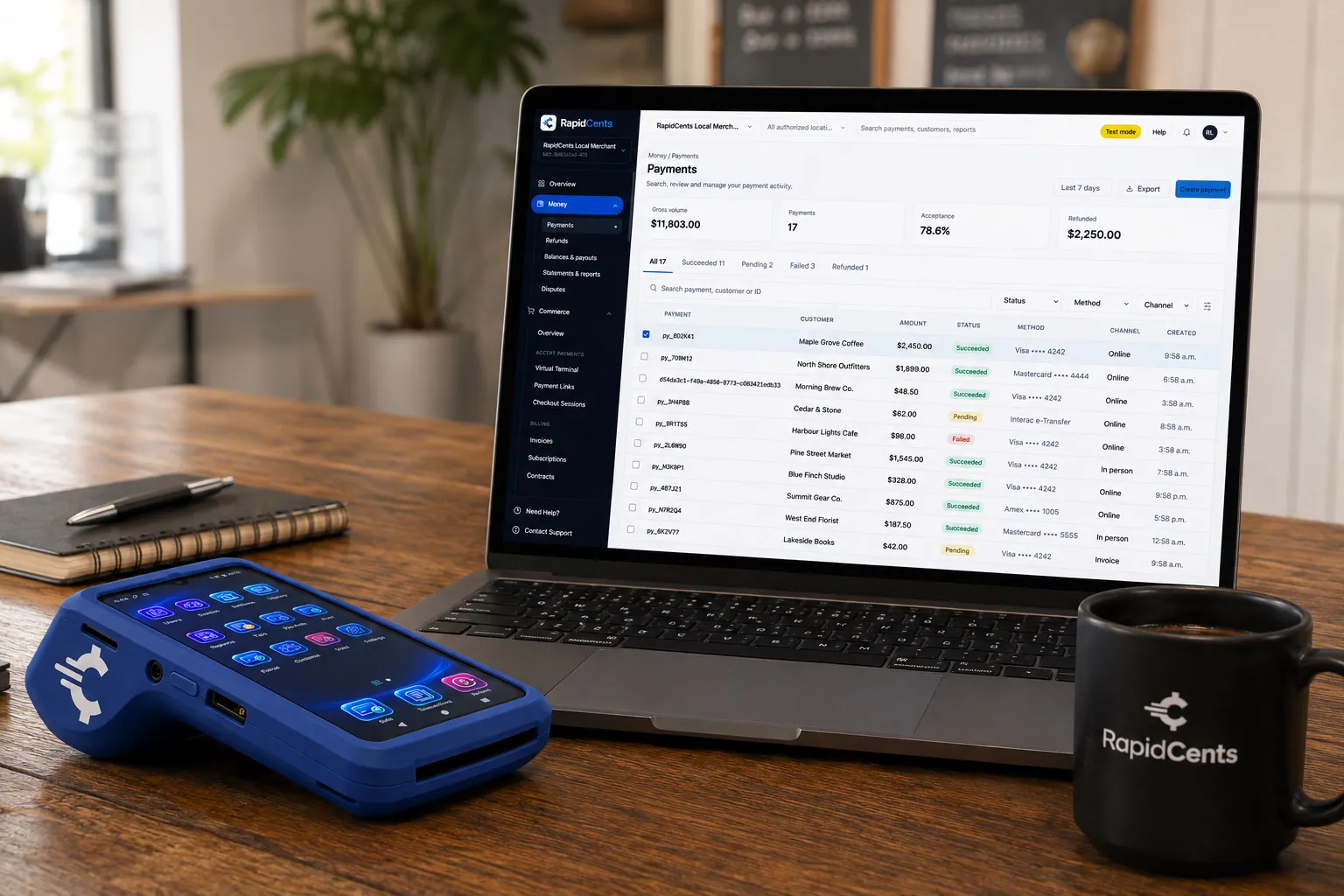
A payment-gateway integration desk: API response on screen, RapidCents terminal ready for a test sale. Payment gateway
The authorization layer every online RapidCents payment runs through.
Explore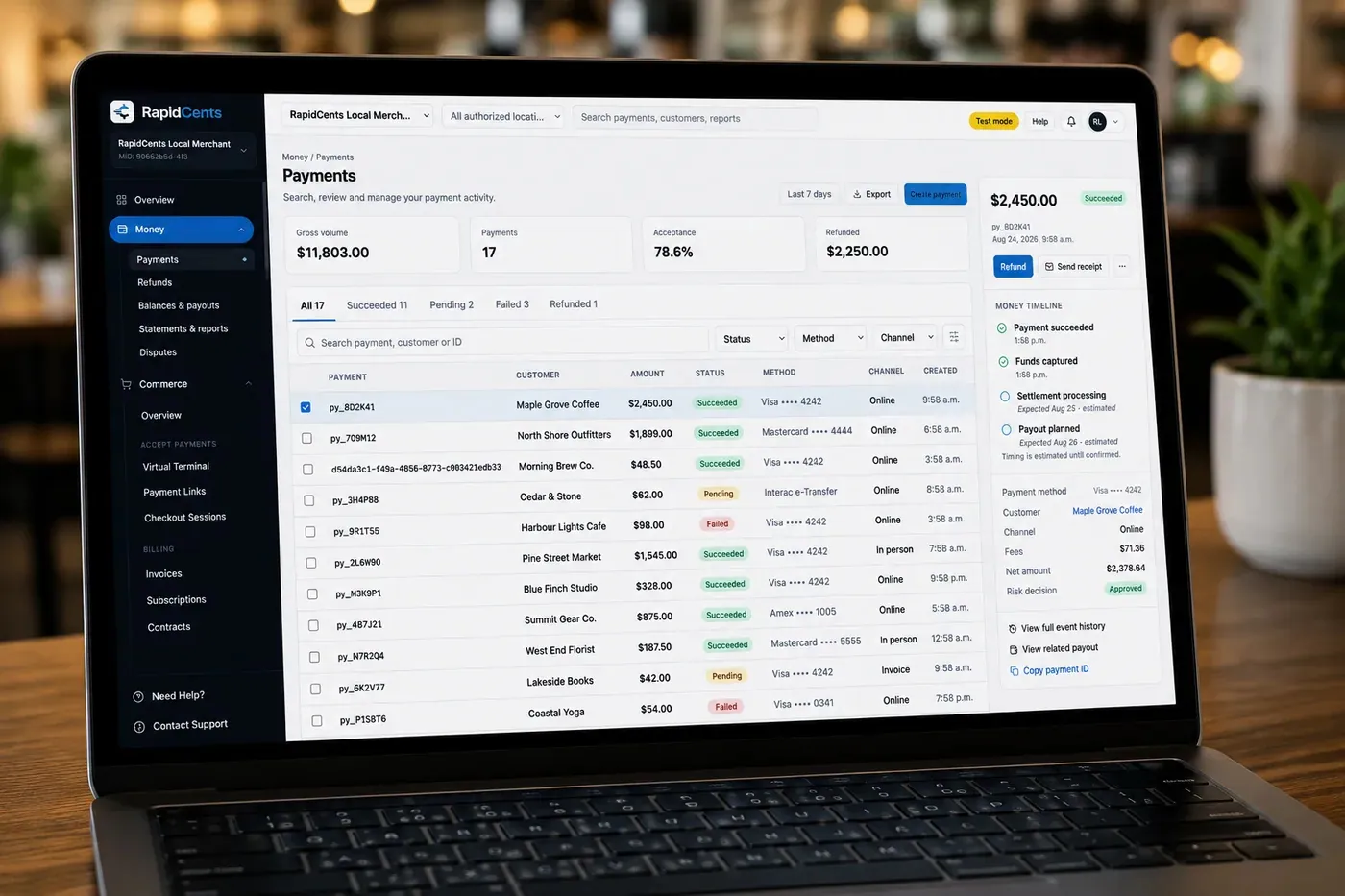
The RapidCents payments screen: gross volume, payment count, acceptance rate and refunds across the top, a filterable transaction list below, and a money timeline on the right tracing one payment from capture to planned payout. Merchant dashboard
Transactions, deposits, refunds and disputes across every channel in one place.
Explore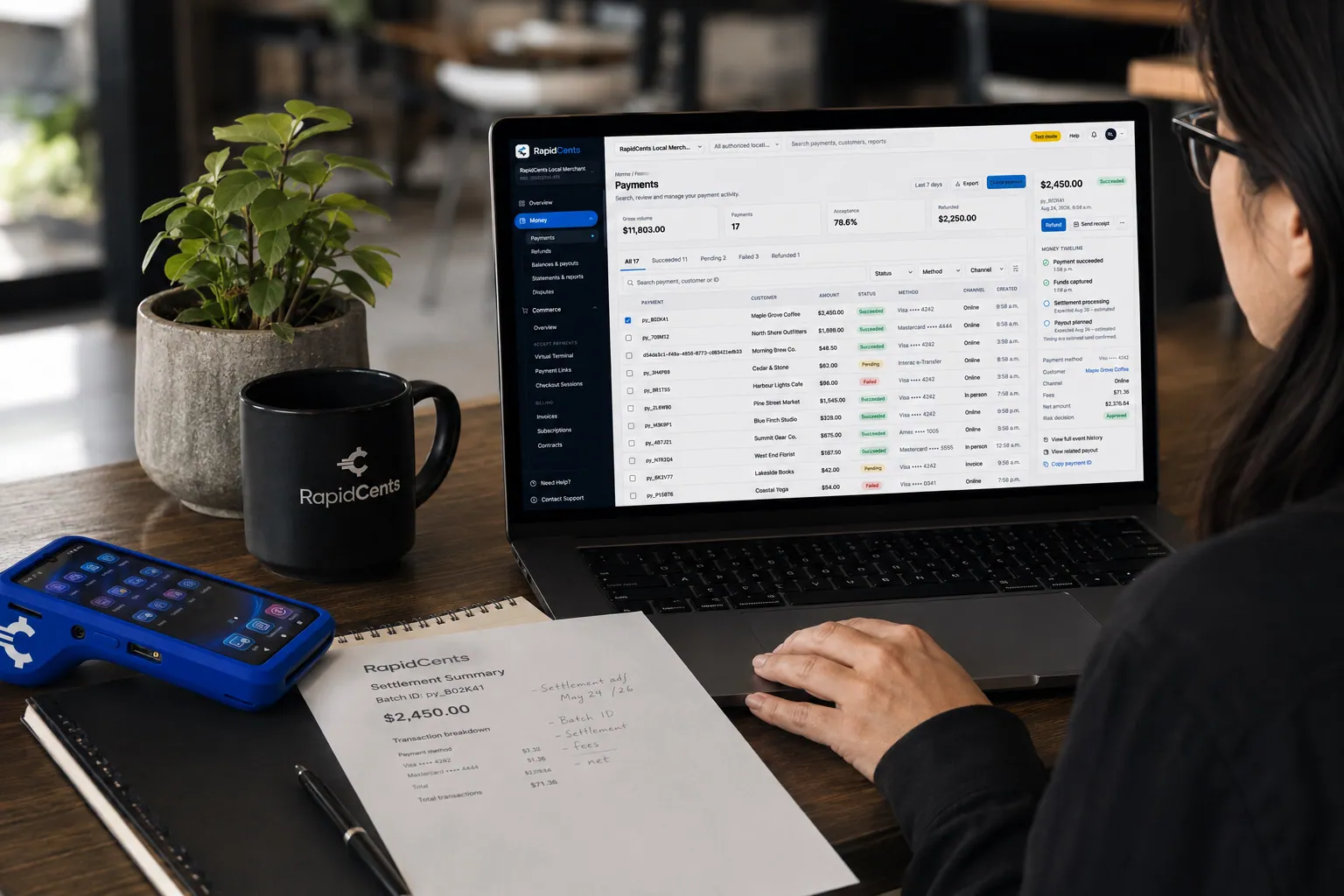
A merchant reviews RapidCents reports for volume, mix and payouts, with the terminal that took the sales on the desk. Reporting and reconciliation
Deposit-level detail that ties settlements back to the transactions behind them.
Explore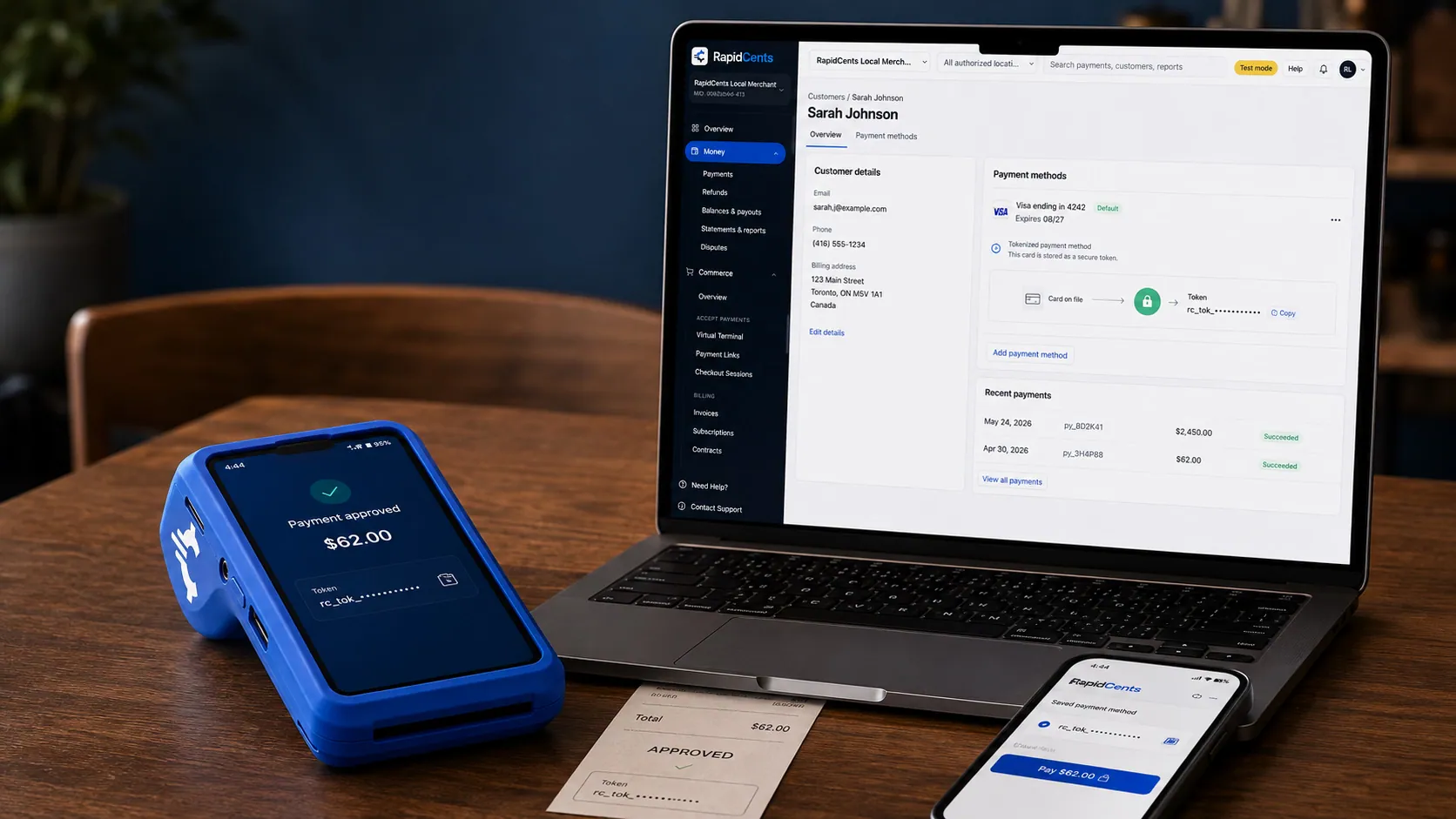
A stored RapidCents token stands in for the card number, with the terminal that captured the original credential beside it. Tokenization
Card numbers are replaced by a token, so nothing reusable is stored in your systems.
Explore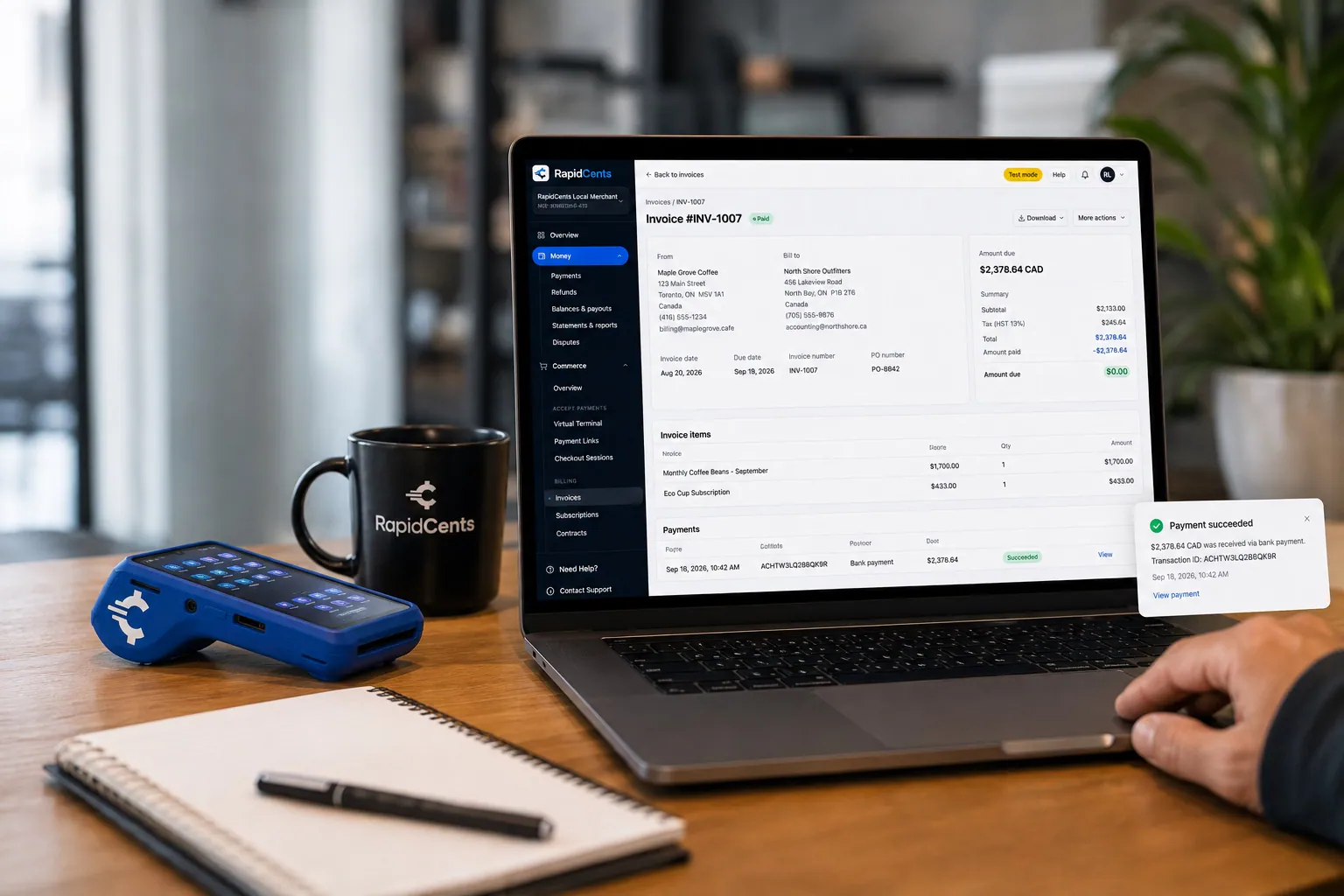
A merchant invoices a customer for bank debit through RapidCents, with card terminal capture available on the same desk. Bank payments
Pull funds straight from a bank account for larger or repeating amounts.
Explore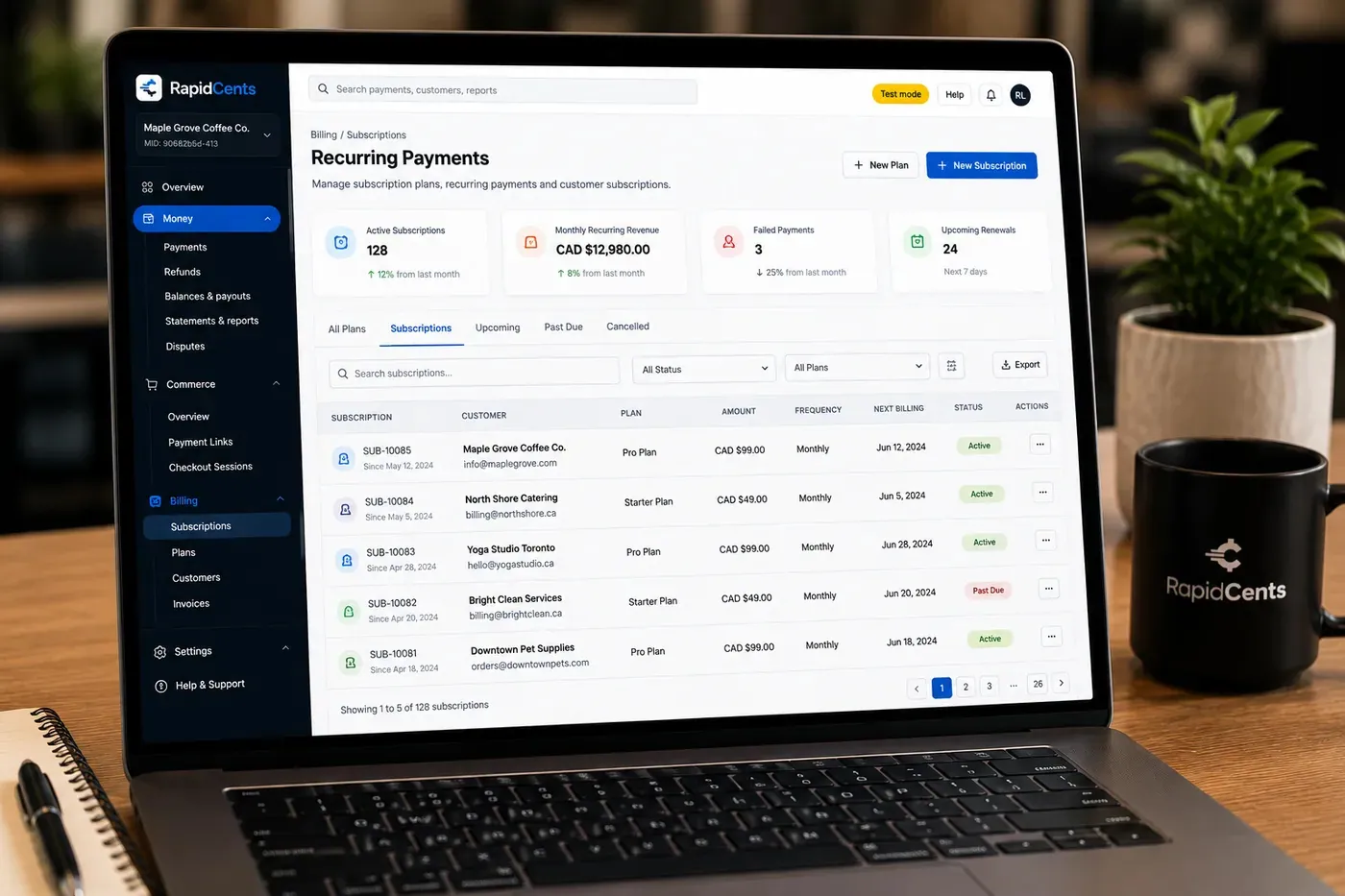
The RapidCents recurring payments screen showing active subscriptions, monthly recurring revenue, failed payments and upcoming renewals, above a list of subscriptions with their plan, amount, frequency and next billing date. Recurring payments
Schedules, subscriptions and instalments billed from a stored credential.
Explore


Security
PCI-compliant vault
Card data tokenized at capture to reduce merchant PCI scope.
Fraud monitoring
Velocity checks and AVS/CVV screening on card-not-present flows.
Role-based access
Limit refunds, voids and reporting exports by staff role.
Implementation
Discovery call
Map your channels, volume and integration requirements.
Underwriting
Submit business details and receive approval typically within days.
Channel setup
Deploy terminals, gateway credentials or virtual terminal access.
Go-live support
Test transactions and training for front-line staff.
Pricing
Interchange-plus, read as EMDR
Pay pass-through interchange and card brand assessments plus a disclosed RapidCents markup. Effective merchant discount rate is total fees over volume — Fee Check computes it from a statement. No hidden PCI non-compliance fees on standard plans.
Questions about Payment Processing
Do you support both in-person and online?
Yes. One merchant account covers terminals, gateway, payment links, virtual terminal, and ACH or ACH, with unified reporting.
How fast is funding?
Eligible merchants typically receive next-business-day deposits after batch settlement. Cutoff times and holidays apply. Bank-rail credits (ACH, ACH, RTP, FedNow and RTP) follow the rail's own clearing, not card interchange.
Can I keep my existing POS?
In many cases yes. We integrate with certified POS partners or provide standalone terminals. The processor still prices card-present, keyed and CNP differently because the networks do.
What cards and rails are accepted?
Visa, Mastercard, American Express and PIN debit where supported, plus ACH in the United States and ACH / PAD worldwide. Real-time credit uses RTP, FedNow or FedNow and RTP depending on the country.
What is the difference between a payment processor and a payment gateway?
The processor moves the transaction between the card networks and the banks and settles the money to your account. The gateway is the software layer that carries the request from a website or an application into that network. RapidCents provides both under one merchant account, so a gateway integration and a countertop terminal report and settle together.
How is interchange-plus pricing different from bundled pricing?
Bundled or flat-rate pricing quotes one blended number that hides what the card networks charged. Interchange-plus passes interchange and card brand assessments through at cost and shows a disclosed RapidCents markup on top, line by line on the statement. It makes the cost of each card type visible, which matters most once your card mix stops being uniform.
What is the difference between interchange and an assessment?
Interchange is paid to the bank that issued the customer's card. An assessment (a card brand fee) is paid to the network — Visa, Mastercard, Amex or Discover — for carrying the transaction. Both are published schedules, identical at every processor. Neither is the RapidCents markup. The interchange-plus page names the schedules and links the primary sources.
What is EMDR, and how is it different from the discount fee?
Effective merchant discount rate (EMDR) is total processing cost divided by processed volume for a period. Discount fee on a statement is the merchant's cost of accepting the card — historically one blended percentage taken off the deposit. On interchange-plus that line should unpack into interchange + assessment + markup. If it still arrives as one percentage, the statement is bundled. Fee Check computes EMDR from the statement you already have.
What is the difference between a sale, a pre-auth and a force post?
A sale authorizes and captures together, used when the total is known. A pre-authorization holds an estimate (bar tab, hotel, pump) and is captured later for the actual amount, or expires and releases. A force post captures against an approval code obtained outside the online path — voice auth when the network was down, or store-and-forward. It is not a way to charge a declined card. The virtual terminal is where keyed MOTO and many force posts are entered.
Is ACH the same as ACH, and where do RTP and FedNow and RTP fit?
ACH is the United States Automated Clearing House. worldwide the equivalent pull is an ACH debit, often a ACH debit (PAD) under the domestic payments association. Calling a debit 'ACH' is a US label on a rail. RTP (The Clearing House) and FedNow (Federal Reserve) are US real-time credit pushes; FedNow and RTP is the counterpart. None of them is a card authorization, and none of them prices as a percentage of interchange.
Who decides whether a card payment is approved?
The bank that issued the customer's card. RapidCents submits the authorization and shows the issuer's response on the terminal or in the API, so staff can complete the sale with another card, another method, or a quick AVS correction. Every outcome is searchable in the dashboard alongside approvals.
Do I need separate merchant accounts for my store and my website?
No. One RapidCents merchant account covers terminals, gateway, payment links, the virtual terminal and ACH or ACH, and every channel reports into the same dashboard. Card-present, keyed and card-not-present transactions still price differently because the networks treat them differently, but reconciliation and funding stay in one place.
Related products
A payment-gateway integration desk: API response on screen, RapidCents terminal ready for a test sale. Payment Gateway
The RapidCents payment gateway exposes REST endpoints for authorize, capture, void, refund and…
ExploreA merchant invoices a customer for bank debit through RapidCents, with card terminal capture available on the same desk. ACH / Bank Payments
Bank payments suit recurring and high-value invoices where card fees are the wrong tool. Collect…
ExploreThe RapidCents virtual terminal: payment details, card number, expiry and CVV keyed by hand on the left, with a payment summary on the right showing the amount, the estimated processing fee and a Process Payment button. Virtual Terminal
The RapidCents virtual terminal lets authorized staff enter mail-order and telephone-order payments…
Explore
Take the next step
Talk to a RapidCents specialist
RapidCents Fee Check reads a processing statement and shows interchange separately from the markup. Upload a statement for an instant breakdown, or open a merchant account and start accepting payments on one account.
- No obligation
- Payment specialists, not a call centre
- Secure statement upload