Automate subscriptions and installment billing
Recurring billing is four things rather than a repeated payment: a tokenized card, a schedule, a retry policy and a record of consent. Most of the revenue it loses goes to expired cards, not cancellations. RapidCents bills weekly, monthly, quarterly or custom intervals with trials and proration, retries failed cards on day 3, 7 and 14 with customer notifications, and refreshes reissued cards through Account Updater where the issuing bank participates. Every pause, change and cancellation is logged.
- Payment specialists
- Interchange-plus available
- Guided migration
- Post-launch support
Who this solution is for
Subscription and membership businesses
Monthly or annual plans where renewal is the revenue, and RapidCents reports which cycles still need a person so they are not mistaken for a cancelled customer.
Practices billing treatment plans
Clinics and practices spreading a course of treatment across visits, where the schedule is agreed once and then runs.
Businesses offering instalments
A larger purchase split into equal payments, collected on a schedule rather than chased.
Common challenges
Involuntary churn
Cards expire and get reissued. A renewal that fails for that reason cancels revenue nobody decided to cancel, and the customer usually does not know either.
Retries with no policy
Retrying immediately usually fails the same way. A retry schedule with notification is a different outcome from a retry loop.
Consent that was never recorded
A recurring charge has to be authorized, and the record of that authorization is what a dispute turns on.
The RapidCents approach
Define the plan: amount, interval, any trial or setup charge, and the proration rule for mid-cycle changes.
Capture the card and the consent at signup, through checkout or a payment link, so the credential is tokenized from the start.
Let the schedule run — the engine sets the next charge date and bills the stored token without anything being re-keyed.
Handle failure by policy: retries on day 3, 7 and 14 with notifications, and Account Updater refreshing cards where the issuer participates.
Export successful cycles to revenue reporting, and work the exceptions queue rather than the whole book.
Recommended capabilities
Flexible intervals
Weekly, monthly, quarterly or a custom cadence, with trial periods and setup charges handled as part of the plan.
Dunning retries
Failed cards retried on day 3, 7 and 14 with alerts, rather than immediately and repeatedly.
Account Updater
Expired and reissued cards refreshed automatically where the issuing bank participates, so the next cycle bills without contacting the customer.
Proration
Mid-cycle plan changes calculated as a credit against the next bill instead of a manual adjustment.
Consent and audit records
The recurring authorization is documented at signup, and every pause, change and cancellation is logged with the user who made it.
Related products
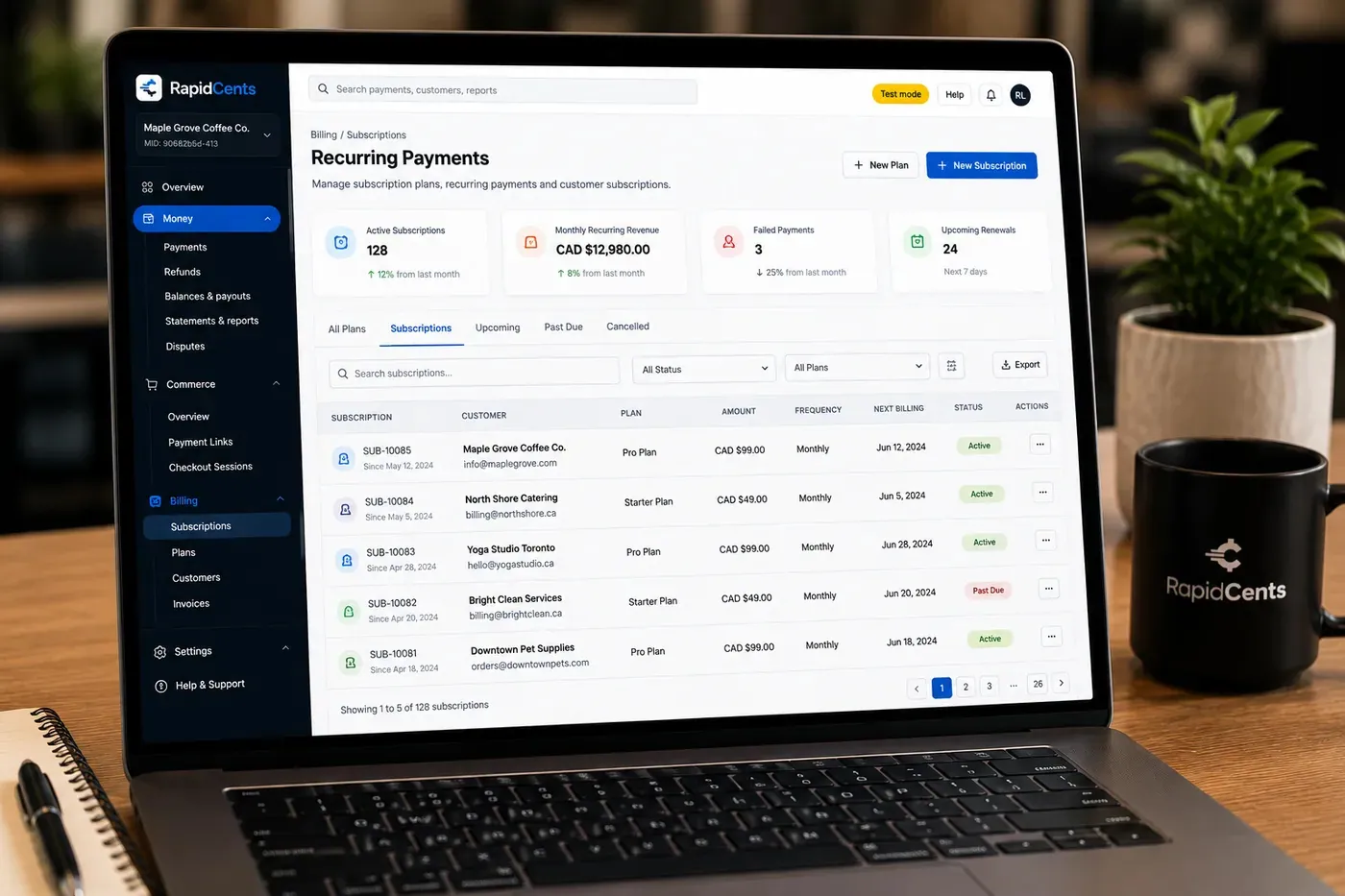
The RapidCents recurring payments screen showing active subscriptions, monthly recurring revenue, failed payments and upcoming renewals, above a list of subscriptions with their plan, amount, frequency and next billing date. Recurring Payments
RapidCents recurring payments manage subscription plans, membership renewals and installment schedules with…
Explore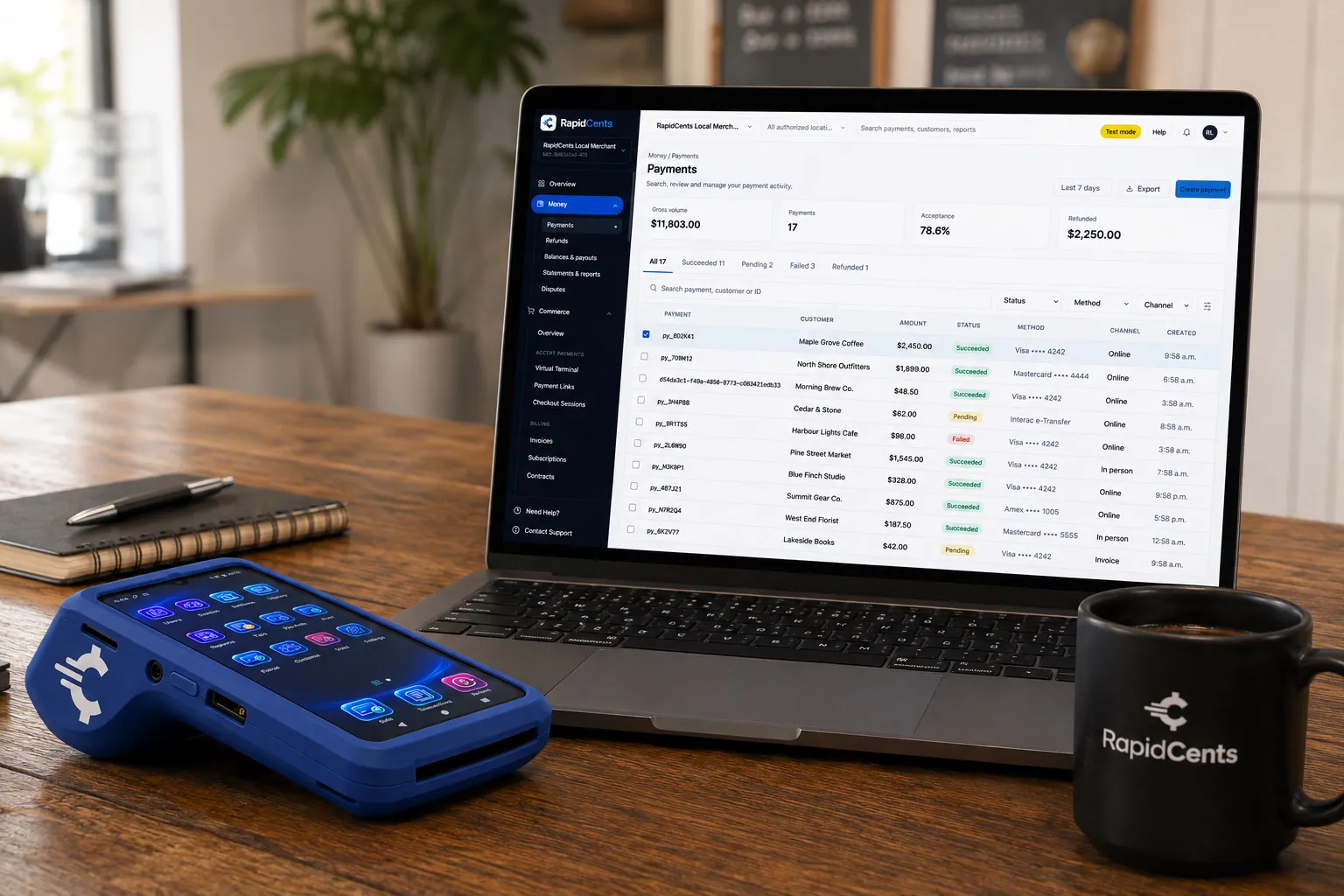
A payment-gateway integration desk: API response on screen, RapidCents terminal ready for a test sale. Payment Gateway
The RapidCents payment gateway exposes REST endpoints for authorize, capture, void, refund and tokenize…
Explore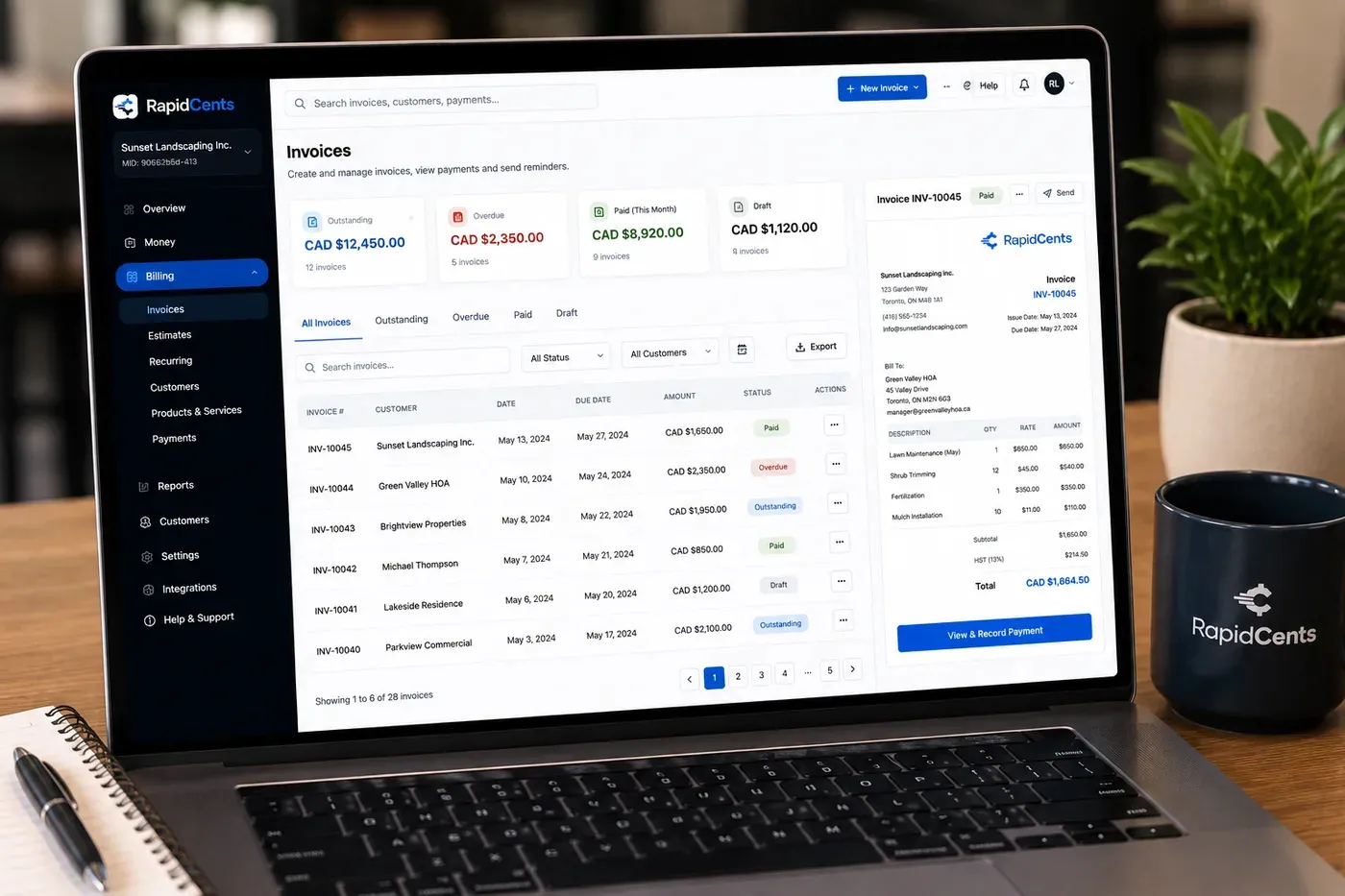
The RapidCents invoices screen: outstanding, overdue, paid and draft totals across the top, the invoice list below them, and a preview of one invoice on the right with its line items and a View & Record Payment button. Invoicing
RapidCents invoicing helps professional services, contractors and B2B suppliers create branded invoices…
Explore


Implementation approach
Plan design
Map what you sell to intervals, trials and retry policy. Most of the work is deciding the rules rather than configuring them.
Signup flow
Add the credential step to your checkout or payment link, so the card is vaulted at the moment the customer agrees.
Notification templates
Pre-charge notices and failed-payment emails written in your own words, because these are the messages customers actually read.
Reporting setup
Revenue exports configured for finance before the first cycle, so the first month closes normally.
What does not change
Your pricing and plan structure
Intervals, trials and amounts are yours. The engine bills what you define rather than imposing a plan model.
The customer payment experience
A stored card charged on schedule produces a receipt, not a checkout. Nothing asks the customer to act unless the payment fails.
The card data position
Cards are tokenized in the vault. Staff never see a full card number, before or after a subscription is created.
Frequently asked questions
Why do renewals fail when the customer has not cancelled?
Almost always because the card expired or was reissued after a loss or a compromise somewhere else. The customer usually has no idea a subscription depended on a card they replaced.
Does Account Updater fix every expired card?
No. It works where the issuing bank participates in the network updater service. Where it does not, the retry schedule and a notification to the customer are what recover the payment.
Can a customer be charged after they cancel?
Cancelling ends the schedule. Pausing keeps the plan and the token but skips cycles, which is a different action and is logged separately. Getting that distinction right matters, because confusing the two is a common source of disputes.
How is tax handled on a recurring charge?
Tax can be set as a fixed amount per plan, or passed from your own catalogue through the API where it varies by customer or jurisdiction.
What evidence matters if a subscriber disputes a renewal?
The recurring authorization captured at signup, the notification history and the transaction detail. Recurring billing attracts recognition disputes — a customer forgetting they subscribed — and documented consent plus a pre-charge notice is the answer to that.
Can an existing subscription book be moved over?
Schedules can be imported. The stored credentials behind them are the harder question and depend on the outgoing provider. Where tokens cannot be transferred, customers have to enter a card again, which is a communications exercise as much as a technical one.
What happens when a subscriber changes plan mid-cycle?
Proration handles it: the difference is calculated as a credit against the next bill rather than adjusted by hand. The plan definition holds the amount, the interval, any trial or setup charge and the proration rule, so an upgrade partway through a month does not become a manual invoice.
Who can create or change a subscription, and is it recorded?
Access follows the account roles, and every pause, change and cancellation is logged with the user who made it. Cards sit tokenized in the vault throughout, so staff never see a full card number before or after a subscription is created.
Take the next step
Talk to a RapidCents specialist
RapidCents Fee Check reads a processing statement and shows interchange separately from the markup. Upload a statement for an instant breakdown, or open a merchant account and start accepting payments on one account.
- No obligation
- Payment specialists, not a call centre
- Secure statement upload