


Payment processing for tutoring centres: packages and monthly plans
Payment processing for tutoring centres covers three jobs: selling prepaid lesson packages, billing monthly plans, and collecting top-ups or missed-lesson charges. RapidCents takes cards through Hosted Checkout, Payment Links and Recurring Payments, and keeps stored cards in Customer Profiles, with a reference on every payment you match to the student. Your scheduling software stays in place.

- PCI DSS Level 1
- SOC 2 Type II
- All major cards: Visa, Mastercard, Amex, Discover, UnionPay, Diners Club & PIN Debit
- Interchange-plus available
- Specialist onboarding support
How tutoring centres get paid
A tutoring centre sells hours before it delivers them, so most payments are prepaid packages, monthly plans, top-ups and the occasional charge under a missed-lesson policy. RapidCents has a product for each: Hosted Checkout, Recurring Payments, Payment Links and Customer Profiles.
Prepaid lesson packages
A parent buys a block of lessons before the first session. The trigger is enrollment, the payment is taken through Hosted Checkout or a Payment Link, and finance gets a receipt and a transaction reference that the administrator attaches to the student's package.
Monthly tutoring plans
A family agrees to a set number of lessons each month. Recurring Payments bills the stored card on the agreed date, retries a failed charge, and sends a notice first. If a family pauses a plan, a clear cancellation term keeps everyone on the same page.
Mid-term top-ups and invoices
When a student's hours run low, an administrator sends a Payment Link or a branded invoice by email or SMS. The parent pays on any device, and the paid invoice and its reference land in your reports for matching against the lesson balance.
Missed-lesson charges
Your written policy may allow a charge for a lesson cancelled late. Staff apply it to a stored card only where the parent authorized that use in advance. Each charge keeps a note of the lesson, the policy and the amount, which also helps when a family disputes it.
How does tutoring payment processing sell a prepaid lesson package?
Tutoring payment processing sells a package by sending the family to Hosted Checkout, taking the payment before the first lesson, and returning a reference your administrator attaches to the student. Prepaid lesson package payments then show as settled transactions in your reports, separate from the lessons used.
How the sale runs
The parent picks a package on your enrollment page, which redirects to Hosted Checkout styled with your logo. On success the family gets a receipt and your office gets the transaction reference. Staff add that reference to the student's record so the lesson balance and the payment can be matched later.
What to set up first
Write your package terms before launch: how many lessons, how long the credits stay valid, and what happens to unused lessons. Show those terms at checkout. If you want to keep the card for later top-ups, say so plainly and get the parent's authorization first.
Declines, refunds and disputes
A declined payment never becomes a package, so the administrator sends a Payment Link for another card. Refunds follow your stated terms, and used lessons are normally deducted first. If a family files a dispute, the package terms and attendance log are your evidence.
A $600 maths package, refunded after four lessons
Say a small centre sells a ten-lesson maths package for a $600 ticket. The parent pays online on Sunday, the administrator links the reference to the student on Monday, and after four lessons the family asks for a refund. The centre refunds the unused six lessons under its terms.
How do monthly tutoring payment plans and missed lesson payment policies work?
Monthly tutoring payment plans bill a stored card on an agreed date through Recurring Payments. Missed lesson payment policies add a second charge only where the parent authorized it. Both are collection schedules for lessons, not loans, and the lesson count stays in your scheduling software.
How the plan runs
At enrollment the parent agrees to the amount, billing date and cancellation terms, and the card is saved to a Customer Profile. Recurring Payments then bills each month, sends a notice before the charge, and records each result against the same student profile, so staff answer questions from one screen.
Authorization and policy terms
A stored card needs the parent's authorization for the specific use. List the recurring amount, the date, how to pause or cancel, and whether late cancellations can be charged. A missed-lesson charge outside those terms invites a dispute, so keep the signed or accepted wording on file.
When a charge fails
Automated retries and the account updater service reduce failures from expired cards, but some still fail. Your office then sends a Payment Link for the balance and pauses lessons only as your terms allow. Never charge a different card than the one the parent authorized.
A $320 plan and a missed March session
Say a family pays a $320 monthly plan for two lessons a week. In March the child misses a session without notice, and the written policy treats it as delivered. The centre applies no extra charge, because the plan already covered the lesson, and logs the note on the profile.
RapidCents products for tutoring centres
These products cover how a tutoring centre sells and collects: Hosted Checkout for packages, Recurring Payments for monthly plans, Payment Links for top-ups, and Customer Profiles to hold each family's stored card and history.

The RapidCents recurring payments screen showing active subscriptions, monthly recurring revenue, failed payments and upcoming renewals, above a list of subscriptions with their plan, amount, frequency and next billing date. Recurring Payments
RapidCents recurring payments manage subscription plans, membership renewals and installment schedules with…
Explore
The RapidCents payment links screen listing created links with their amount, status, click count and whether they have been paid, beside a phone showing the branded page a customer opens to pay $2,500.00. Payment Links
RapidCents payment links let staff generate branded pay-by-link URLs for invoices, deposits, balances and…
Explore
A RapidCents hosted checkout page at checkout.rapidcents.com, with the order summary and totals on the left and the card fields on the right, footed by SSL and PCI DSS assurances. Hosted Checkout
RapidCents hosted checkout delivers PCI-scoped payment pages you redirect customers to or embed via iframe…
Explore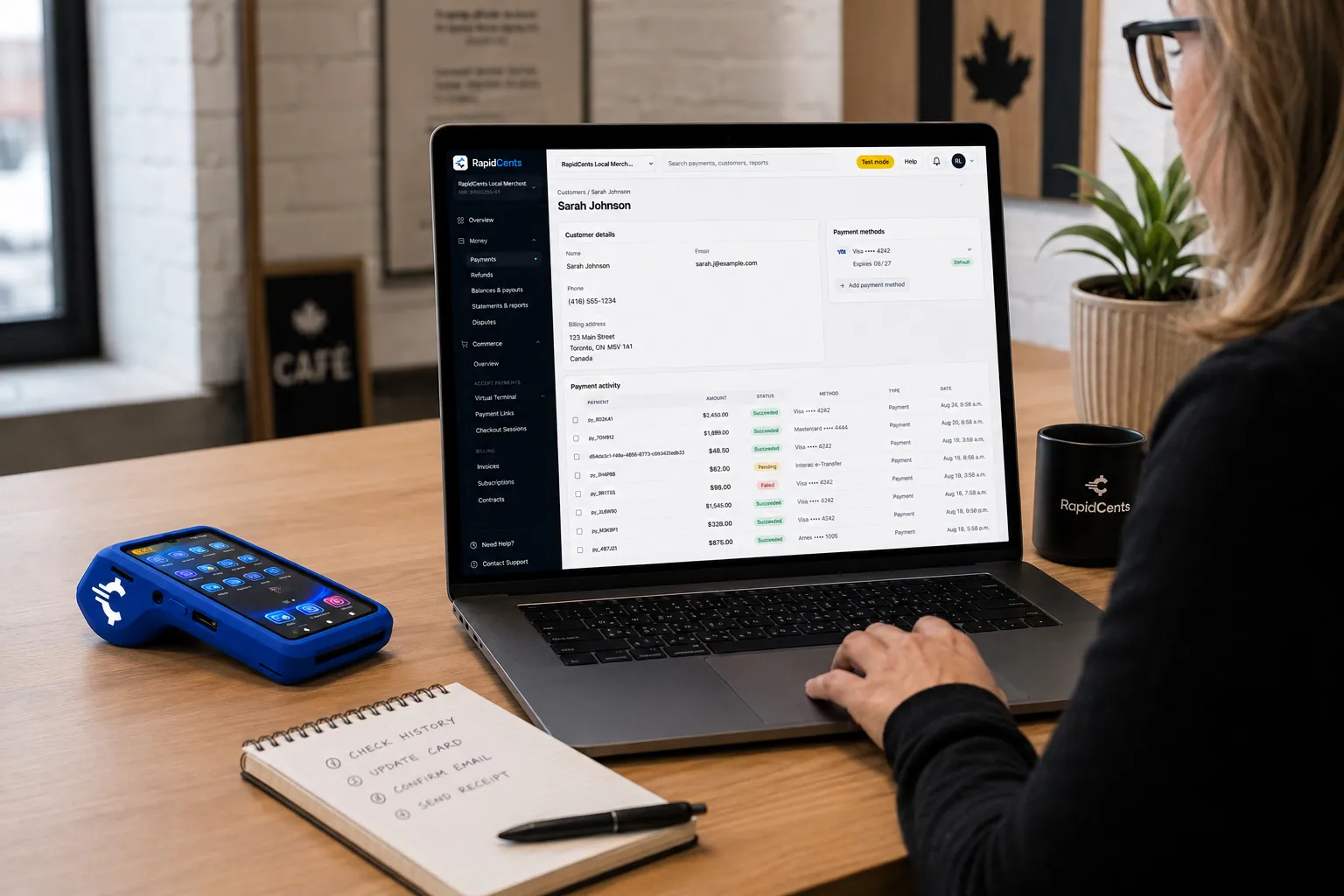
A RapidCents customer profile holds saved cards and invoices, so a return visit can be charged without re-keying the card. Customer Profiles
A customer profile ties together transactions, stored payment methods, subscriptions and disputes so staff…
Explore


How do tutoring invoice payment links track credits and siblings?
Tutoring invoice payment links collect a top-up or balance without a checkout page, and the paid reference is what you match to a student's lesson credits. RapidCents records the payment; your scheduling software or spreadsheet records how many lessons remain. Keep the two counts separate.
How a top-up link runs
When a student's lessons run low, the administrator creates a Payment Link or a branded invoice for a set amount and sends it by SMS or email. The parent pays on a phone. The paid status and reference appear in your reporting, ready to add to the student's credits.
Billing a parent for several children
One parent often pays for two or three students. Create one Customer Profile for the parent and name each child on the invoice lines, or send one link per child. This keeps a refund for one student from touching the other, and the receipt still matches each child's package.
Keeping credits apart from payments
A payment is money received. A lesson credit is a promise to teach. Record the reference in your lesson system when a payment clears, then reduce credits as sessions happen. Month-end reconciliation compares settled payments to credits sold, and the difference is lessons not yet delivered.
A $180 link for one of two children
Say a parent has two children, and one has three lessons left. The administrator sends a $180 link naming only that child. The parent pays the same evening, the reference is logged against the right student, and the sibling's package is untouched.
Compare fees using your real payment mix
What a tutoring centre pays depends on its card mix, ticket size and how cards are taken. We price every account on interchange-plus: interchange passes through at cost, you pay your RapidCents markup as set out in your Fee Schedule, plus fees for equipment or services where they apply. It is month to month, with no fixed term.
What drives your cost
Interchange varies by card type, such as debit, credit, premium or commercial, and by how the card is taken. Most tutoring payments are online or from a stored card, which is keyed or card-not-present rather than tapped. A package sold at the front desk on a terminal can price differently.
What to bring for a comparison
Gather two or three recent processing statements, your average package and monthly ticket, the split between online, stored-card and in-person payments, and your refund and dispute volume. A comparison on those numbers is fair. A comparison on a headline price alone is not.
Run Fee Check
Upload a statement to Fee Check and it separates interchange from markup, so you can see what each portion is. Then ask your RapidCents representative for the written quote, including any fees for equipment or services, and compare it against your Fee Schedule line by line.
TutorCruncher, your scheduling software and the payment data flow
Your scheduling software keeps the lessons, and RapidCents keeps the payments. RapidCents integrates with many major platforms through APPIE and RapidBridge. The right option depends on your software vendor and version, and your RapidCents representative will walk you through how payments, references and reports connect to it.
TutorCruncher
TutorCruncher manages tutors, clients, lesson reports and invoices. Tell your RapidCents representative which edition you run, and they will walk you through the option that fits it, so each paid reference is easy to match to the right invoice.
Teachworks, TutorBird, Tutorbase and Teach n Go
These platforms schedule lessons and bill families. RapidCents integrates with many major platforms through APPIE and RapidBridge, and your RapidCents representative will walk you through the option for your vendor and version. Payment Links and Reporting can always carry the payment while the software holds the lessons.
QuickBooks Online, Xero, SAP and NetSuite
RapidCents connects settled transactions, fees and refunds to QuickBooks Online and Xero, so your bookkeeper sees deposits, fees and refunds in the right accounts. SAP and NetSuite import settlement files through templates we provide.
Payment options for tutoring centres by country
RapidCents serves merchants in Canada and the United States. The payment methods, bank-payment options and settlement currency a tutoring centre can offer depend on the country of its merchant account, and your RapidCents representative will explain what applies to yours.
Cards come first
Major card brands cover most package, plan and top-up payments online and at the terminal. Debit options at the terminal differ by country, and your RapidCents representative will tell you which fit your account.
Bank payments and currency
Bank payments for monthly plans and the currency you settle in depend on your merchant account's country. Both need the parent's authorization, and your RapidCents representative will walk you through them before you offer them.
Switching, reconciliation and answers for buyers
Switching a tutoring centre's processor means moving stored cards, plans and open invoices without double billing a family. Once your account is approved, start with an inventory, test a sale, a refund and a top-up, then run both processors briefly before moving live traffic. Then reconcile each deposit to the lessons you sold.
Inventory before you move
List every stored card, active monthly plan, open invoice, pending refund and transaction reference. Note which parents authorized card use and for what. Both providers must agree before stored cards can move, so do not promise families that their plans carry over untouched.
Test, then run in parallel
Run a test package sale, a refund and a top-up link before you switch families. Keep the old plans running until the new schedules are confirmed, and tell parents the new billing date and business name. Avoid cutting over at the start of term, when most payments land.
Reconcile to lessons sold
Match each settlement to its transactions, fees and refunds in the Merchant Dashboard or a report export, then to the lessons credited. With QuickBooks Online or Xero connected, deposits, fees and refunds post to your books. Unmatched deposits usually trace to an unlogged reference.
Payment questions from tutoring centres
What is the best payment processor for tutoring centres?
There is no single best processor, because the right one depends on your packages, plans and software. Compare channels, total fees, scheduling software compatibility, support and reconciliation, and ask for written quotes. RapidCents offers Hosted Checkout, Recurring Payments, Payment Links and Customer Profiles, and Fee Check shows how your current statement compares.
How much does credit card processing cost for tutoring centres?
It depends on your card mix, ticket size and channels, so no honest figure applies to every centre. We price on interchange-plus: interchange at cost, your RapidCents markup in your Fee Schedule, and fees for equipment or services where they apply. Month to month, no fixed term. Upload a statement to Fee Check, then ask for a written quote.
Can TutorCruncher use a different payment processor?
RapidCents integrates with many major platforms through APPIE and RapidBridge, so most centres keep the scheduling software they run today. The exact option depends on your TutorCruncher edition and version. Tell your RapidCents representative which one you use, and they will show you how payments, references and reports connect to it.
How can tutoring centres switch processors without losing payment history?
Keep your records first: export transactions, open invoices, refunds and references from the old processor. Then list stored cards and parent authorizations, test a sale, refund and top-up with the new one, and run both briefly. Stored cards move only if both providers agree, so do not promise families a seamless transfer.
Which payment options are available to tutoring centres by country?
Tutoring centres can usually take major credit and debit cards, and some can offer bank payments, but options vary with the country of the merchant account. RapidCents serves merchants in Canada and the United States. Settlement currency, debit options and bank payments depend on your account, and your RapidCents representative will explain each one during onboarding.
How can we sell a prepaid lesson package?
Send the family to Hosted Checkout or a Payment Link with your package terms shown, take the payment before the first lesson, and attach the receipt reference to the student's record. Your scheduling software holds the lesson count. RapidCents holds the payment, refund and settlement record. Refunds follow your stated terms.
How can we charge a monthly tutoring plan?
Save the parent's card to a Customer Profile with their authorization, then set a Recurring Payments schedule for the agreed amount and date. The parent should know the cancellation terms and be told before each charge. A failed charge is retried, then followed by a Payment Link. This is a collection schedule, not financing.
How can we apply a missed lesson policy to a stored card?
Only charge a stored card for a missed lesson if the parent agreed in advance to that specific policy, including the amount and notice period. Record the lesson, the policy and the amount with each charge. If the parent did not authorize it, send a Payment Link instead, since an unauthorized charge invites a dispute.
How can we track lesson credits separately from payments?
Treat a payment as money received and a credit as a lesson still owed. Log the transaction reference in your scheduling software when a payment clears, then reduce credits as lessons are taught. At month end, compare settled payments to credits sold. RapidCents holds payment records and reports, while lesson counts stay in your system.
How can we bill a parent for several children?
Create one Customer Profile for the parent and name each child on the invoice line or send a separate Payment Link per child. This keeps a refund for one student from affecting the others. Make sure the parent's authorization covers the stored card for every child, and record each reference against the right student.
What MCC is used for tutoring centres?
MCC 8299 is commonly associated with tutoring centres and similar schools and educational services. Your RapidCents representative will set the correct merchant category code during onboarding, based on what your business actually sells. If you also sell products or run other services, tell them so the classification reflects your real activity.
Related industries
Summer camps, childcare, sports clubs and martial arts studios also sell prepaid blocks and monthly plans per child. The same recurring and top-up workflows apply to their own terms, so you can borrow the approach that fits.
Chambers of Commerce
Collect membership dues, event registrations and sponsorship invoices in one place, with…
Professional Associations
Take annual dues, exam fees, course registrations and employer invoices in one place…
Labour Unions
RapidCents helps union treasurers collect dues, initiation fees and arrears by card or…
Coworking Spaces
Bill desk memberships on a schedule, sell day passes online and charge meeting-room hours…
Subscription Boxes
Charge subscribers on your ship schedule, recover failed renewals before boxes are…
Religious Organizations
Take lobby giving, online gifts, recurring pledges and event fees on one account, with…
Sports Leagues & Clubs
RapidCents helps league administrators and club treasurers collect registration fees…
Summer Camps
Collect booking deposits, spread tuition across payments before the session, add canteen…
Take the next step
Review your tutoring centre's processing costs
Upload a recent statement to Fee Check to see interchange separated from markup, then compare it against your package, plan and top-up mix.
- No obligation
- Payment specialists, not a call centre
- Secure statement upload



