


Payment processing for freight and logistics companies
Payment processing for freight and logistics companies means collecting a freight bill after the load moves, taking a COD card payment before freight is released, and invoicing accessorial and fuel surcharge balances. RapidCents handles all three with Invoicing, Payment Links, the Virtual Terminal and Reporting, and your billing team matches every payment to the load.

- PCI DSS Level 1
- SOC 2 Type II
- All major cards: Visa, Mastercard, Amex, Discover, UnionPay, Diners Club & PIN Debit
- Interchange-plus available
- Specialist onboarding support
How freight and logistics companies get paid
Freight and logistics companies get paid through five jobs, from carrier invoice payment collection after delivery to COD payments at the dock. The others are accessorial and fuel surcharge balances, payments matched to records in your transportation management system (TMS), and large balances from repeat shippers. Each job has its own trigger and leaves your billing team a record to post.
Freight bills paid after delivery
The shipper's accounts payable pays once the load is delivered and an invoice carrying the bill of lading number arrives. Billing sends it from Invoicing with a payment link. If the shipper short-pays over a disputed charge, the open balance stays on the invoice. Finance gets the invoice status and the settlement report.
COD payments before release
The consignee pays on a collect or COD load before the driver releases the freight. The office sends a payment link by SMS or email, or keys the card on the Virtual Terminal. If the card declines at the dock, the freight stays on the truck until another card or payer turns up. Finance gets the transaction and the reference written on the bill of lading.
Accessorial and fuel surcharge balances
The shipper pays charges added after delivery, such as detention, lumper fees, a truck-ordered-not-used fee or a fuel surcharge adjustment. Billing issues a separate invoice linked to the original load and sends a payment link. If the shipper never agreed to a charge, billing holds it until the rate confirmation is checked. Finance gets its own invoice and payment record.
Payments matched to TMS records
Billing matches each settled payment to a load, invoice and customer in the TMS. The settlement report is the trigger. If a payment arrives with no load reference, or covers several loads, billing splits it by hand or by import. Finance gets a CSV or PDF settlement export to post from and keep.
Large balances from repeat shippers
A repeat shipper's finance team pays a month of invoices in one payment. Billing sends a payment link for a card payment, and where your account carries bank payments the shipper can pay that way instead. If a card limit declines a large amount, the shipper can pay in parts or by bank. Finance gets one payment to split across invoices.
How does freight invoice payment processing tie to a bill of lading?
Freight invoice payment processing ties to a bill of lading by putting the bill of lading number on the invoice, sending the shipper's accounts payable a payment link with it, and matching the settled payment to that reference. RapidCents Invoicing and Payment Links handle the collection; your TMS keeps the proof of delivery and the load record.
From delivery to paid invoice
Once the proof of delivery is in, billing creates an invoice in RapidCents Invoicing with the bill of lading, load or PRO number in the reference and a payment link on it. The shipper's accounts payable pays by card through the link and the invoice status updates to paid. Billing records the payment against the load in the TMS.
What to set up before the first invoice
Agree payment terms in the rate confirmation or customer agreement, including net days and whether cards are accepted. Pick one reference for every invoice and always put it in the same field. If your invoices are sold to a factoring company, read that agreement before adding a payment link, because the factor may require payment to its own account.
Short-pays, declines and disputes
A shipper may short-pay over a disputed accessorial, which leaves a balance to collect or write off. A declined card leaves the invoice unpaid, so billing resends the link. If a shipper later disputes the card charge, the RapidCents dispute tools raise an alert with the deadline and take evidence, such as the signed bill of lading and the rate confirmation.
A $3,200 truckload invoice, paid by link
Say a regional carrier delivers a truckload and invoices a $3,200 freight bill with the bill of lading number in the reference. The shipper's accounts payable pays the link. Billing opens the paid invoice, finds that reference on the load in the TMS, and marks the load paid.
How do logistics B2B payment links take a COD payment before release?
A logistics B2B payment link takes a COD payment before release when the office sends it to the consignee while the driver waits, and the driver releases the freight once the payment is approved. The office can also key the card on the Virtual Terminal. Set the terms first, so the consignee knows what the amount covers.
From dock to release
When a driver reports a collect or COD load at the dock, dispatch sends the consignee a RapidCents payment link by SMS or email, or shows its QR code. The consignee pays by card, and dispatch sees the approval before telling the driver to release. A driver with a supported phone can instead take a contactless card with Tap to Pay.
Set the terms and limit who takes cards
Print the COD or collect terms on the bill of lading and the rate confirmation, including what the amount covers. If it includes the value of goods you collect for the shipper, tell your RapidCents representative during onboarding and they will show you how it fits your account. Keep Virtual Terminal entry with office staff who have role permissions and an audit log, not drivers.
Declines, the wrong payer and refunds
If the card declines, hold the freight where your terms require payment first and ask for another card or for the consignee's accounts payable to pay. If the person at the dock is not the cardholder or cannot approve the spend, stop and call the account contact. A refund after a billing correction goes back to the original card.
A collect pallet shipment, paid at the dock
Say a less-than-truckload (LTL) carrier reaches a consignee's dock with four pallets on a collect bill of lading and a $640 freight bill. Dispatch texts a payment link to the dock contact, sees the approval, and the driver unloads. A decline keeps the pallets on the truck while the contact tries another card.
RapidCents products for freight and logistics companies
Invoicing, Payment Links, the Virtual Terminal and Reporting cover the freight billing cycle: invoice the shipper, send the link, key a COD card when needed and reconcile settlements. Your RapidCents representative will help you set up the ones your billing team uses most.

The RapidCents invoices screen: outstanding, overdue, paid and draft totals across the top, the invoice list below them, and a preview of one invoice on the right with its line items and a View & Record Payment button. Invoicing
RapidCents invoicing helps professional services, contractors and B2B suppliers create branded invoices…
Explore
The RapidCents payment links screen listing created links with their amount, status, click count and whether they have been paid, beside a phone showing the branded page a customer opens to pay $2,500.00. Payment Links
RapidCents payment links let staff generate branded pay-by-link URLs for invoices, deposits, balances and…
Explore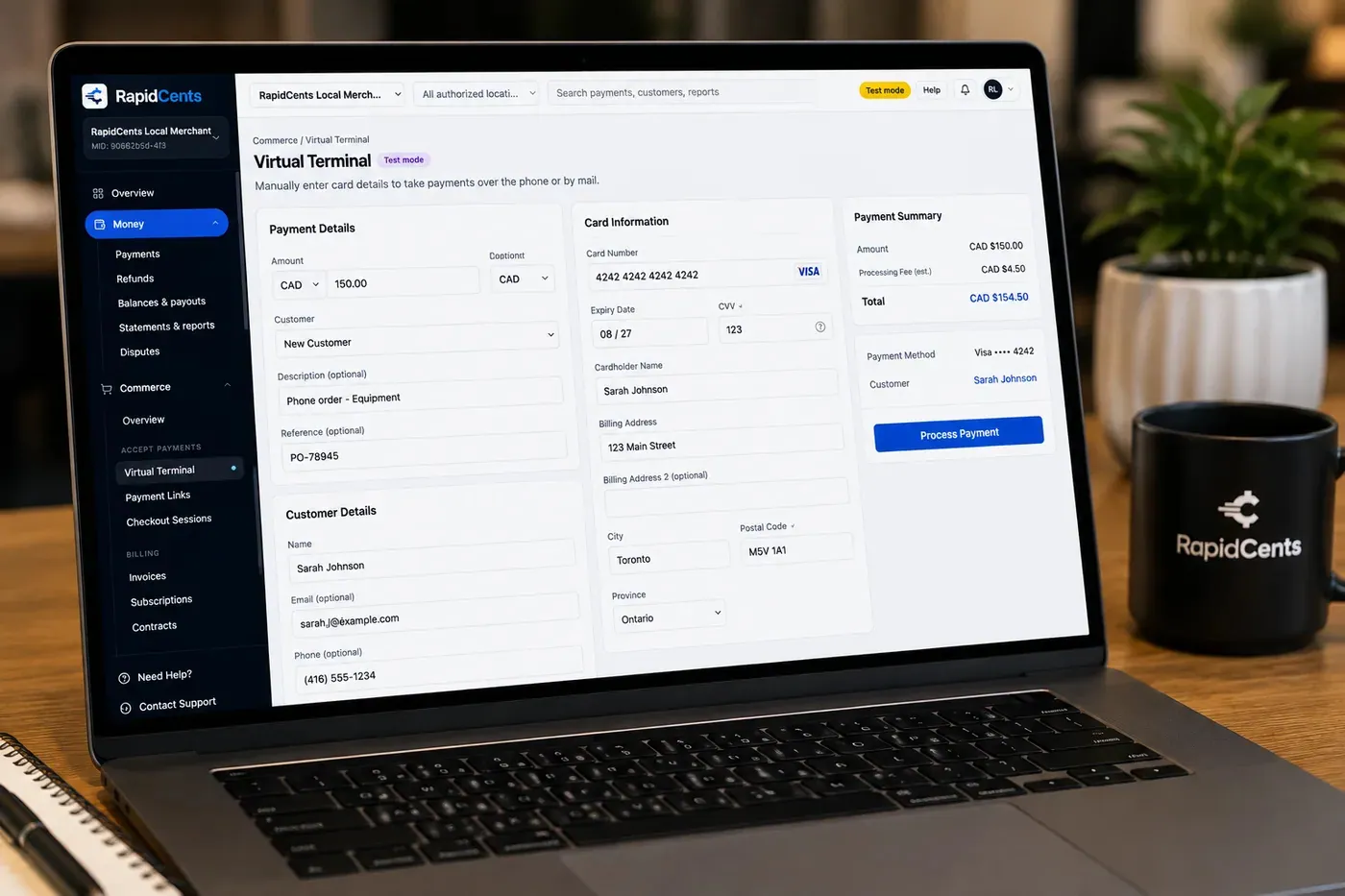
The RapidCents virtual terminal: payment details, card number, expiry and CVV keyed by hand on the left, with a payment summary on the right showing the amount, the estimated processing fee and a Process Payment button. Virtual Terminal
The RapidCents virtual terminal lets authorized staff enter mail-order and telephone-order payments through a…
Explore
A merchant reviews RapidCents reports for volume, mix and payouts, with the terminal that took the sales on the desk. Reporting
RapidCents reporting delivers customizable transaction, settlement and fee reports with CSV and PDF export…
Explore


What does TMS payment integration mean when matching freight payments?
TMS payment integration means a payment taken through RapidCents lands on the right load in your transportation management system (TMS). RapidCents integrates with many major platforms through APPIE and RapidBridge, and a settlement export your billing team posts covers any TMS where a direct route does not fit. Either way, one reference on every invoice and link keeps matching reliable.
One reference across invoice, link and report
Choose one reference, such as the load number, and put it on the invoice, the payment link and any COD note. RapidCents Reporting gives billing transaction, settlement and fee reports with CSV or PDF export, and it can send them by scheduled email. Billing compares each line with open items in the TMS and posts matches to the load.
What to settle with the TMS vendor first
Ask your TMS vendor which payment events your version records, whether it accepts a payment taken on an outside gateway, and which import format or API it offers. If your developer or the vendor can call a REST API, Payment Gateway offers authorize, capture, void, refund and tokenize calls plus webhooks. Your RapidCents representative will walk you through the route that fits.
Unmatched, split and refunded payments
A payment with no reference goes on a holding list, and billing asks the shipper which load it settles. One payment can cover several loads, so billing splits it across invoices by hand or by import. Post a refund or void against the same load, so the balance reopens and the next report agrees with the books.
One $11,400 payment covering three loads
Say a 3PL's customer pays $11,400 through one link that covers three loads. Billing exports the settlement report, splits the payment across the three load numbers in the TMS and marks them paid. A separate payment with no reference stays on the holding list until the customer says which load it covers.
Compare fees using your real freight payment mix
With RapidCents, credit card processing for freight and logistics companies is priced as interchange-plus: interchange passes through at cost, plus your RapidCents markup set out in your Fee Schedule, plus fees for equipment or services if they apply. Your card mix, average freight bill and how cards are taken drive the total, so compare on your own numbers.
Card type and how the card is taken
Interchange is set by the card networks and varies with card type (debit, credit, premium, commercial) and with how the card is taken: a card tapped or inserted at a payment terminal is priced differently from one keyed on the Virtual Terminal or paid through a link. Many freight COD card payments are keyed or paid by link, so they fall on the keyed side of that difference.
Large freight bills and mixed card types
A freight bill is often a large ticket, and the shipper may pay with a corporate or commercial card, which the networks price differently from a consumer debit card. With interchange-plus, interchange passes through at cost, separate from your RapidCents markup. Ask for a quote based on a sample freight bill, not a headline figure.
What to bring to a comparison
Bring recent processing statements, your card mix, your average freight bill, the split between invoice links, COD and in-person payments, and your refund and chargeback volume. Upload a statement to Fee Check to see interchange separated from markup, then ask for a written quote. RapidCents is month to month, with no fixed term.
Equipment, service fees and card fee lines
Equipment and service fees apply only where you use that equipment or service, such as a payment terminal for a yard office. If you plan to add a card fee line to freight bills, ask your RapidCents representative how that works on your account, and check the card network rules and any local rules first.
Check McLeod Software compatibility and payment data flow
RapidCents integrates with many major platforms through APPIE and RapidBridge. Whether your team runs McLeod Software, Trimble TMW, Rose Rocket, Truckstop or Descartes, the right option depends on your vendor and version, and your RapidCents representative will walk you through it. Payment data runs from the invoice and reference in your software, through a RapidCents payment, back to your books.
McLeod Software
McLeod Software is transportation management software that trucking carriers and brokerages use for dispatch, billing and receivables. Tell your RapidCents representative which edition and version you run, and they will show you how payments, references and settlement reports connect to it, whether through an integration, a payment link or an export.
Trimble TMW
Trimble TMW is transportation management software for carriers, covering orders, dispatch and billing. Tell your RapidCents representative which product and version you run and how your team records customer payments today, and they will set up the route that suits your billing flow.
Rose Rocket
Rose Rocket is cloud transportation management software for brokers, carriers and 3PLs. Tell your RapidCents representative which plan you run, and they will walk you through how payments reach your records, by integration, import or export, whichever suits your billing team.
Truckstop
Truckstop is a freight marketplace and load board where brokers post loads and carriers find them. Booking a load is not the same as invoicing and collecting it, so your billing flow runs alongside it: RapidCents invoices the shipper, collects by link or card, and your team posts the result. Your representative will map it with you.
Descartes
Descartes offers logistics software for routing, shipment visibility, customs filing and transportation management. Which Descartes product you run decides where invoices and payments live, so tell your RapidCents representative the product and version, and they will show you whether payments move by integration, import or a link.
Payment options for freight and logistics companies by country
The payment options open to a freight and logistics company depend on the country of its merchant account. RapidCents serves merchants in Canada and the United States, and your RapidCents representative will set out the card brands, bank payments and settlement currency on your account, so you can promise a method to a shipper with confidence.
Cards are the common starting point
Credit and debit cards can pay a freight bill through an invoice link, a COD payment at the dock or a phone payment keyed on the Virtual Terminal. Your RapidCents representative will list the card brands your account accepts.
Bank payments differ by country
Which bank payment suits a large freight balance, and what authorization the payer must give, depends on the country of your merchant account. Ask your RapidCents representative which bank payment options your account carries, and treat a bank payment as unpaid until it settles.
Settlement currency and shippers abroad
Settlement currency follows the country of your merchant account. A shipper that pays from another country may use a card or bank that sits elsewhere, so settle the method with your RapidCents representative before you offer it to a cross-border shipper.
How to switch payment processors and reconcile freight deposits
Switching payment processors for a freight business means listing what is outstanding, testing the new flow, running both accounts for a short time and then reconciling every deposit to the ledger. Once your account is approved, plan the cutover away from your busiest billing days and keep the old account open until open invoices clear.
List what is outstanding
Write down stored card authorizations, scheduled charges, open invoices with payment links, refunds in progress and every transaction reference you rely on. Export payment history from the old processor before that account closes. Moving stored cards between processors needs both providers to agree, and your customers' authorizations must cover the move, so plan on asking for them again if they do not.
Test, then run both accounts
Before moving live traffic, run a test sale, a COD link, an invoice payment and a refund on the new account, and check that your load reference shows on the transaction and in the settlement report. Then bill new loads through RapidCents while open invoices finish on the old processor, so no shipper pays through a link that has stopped working.
Map references and reconcile deposits
Map each payment reference to the field your TMS uses, then reconcile every deposit to the ledger with settlement and fee reports. RapidCents connects settled transactions, fees and refunds to QuickBooks Online and Xero, while larger ERPs such as SAP and NetSuite import settlement files. Your RapidCents representative will walk you through the setup.
Decide who owns each record
Your TMS owns the load, the rate and the proof of delivery. RapidCents holds the payment, refund and dispute record. Billing owns the match between them, and finance owns the bank reconciliation. Naming each owner before the cutover keeps a disputed card charge from stalling on whose paperwork it is.
Payment questions from freight and logistics companies
What is the best payment processor for freight and logistics companies?
A carrier, a broker and a 3PL collect money in different ways, so judge a processor on your own billing flow: invoice links, COD card payments, the route into your TMS, support and reconciliation reports, plus total cost on your own card mix. Upload a statement to RapidCents Fee Check to see interchange separated from markup, and your RapidCents representative will give you a written quote on that same mix.
How much does credit card processing cost for freight and logistics companies?
The cost depends on your card mix, your average freight bill and how each card is taken, so no single figure fits every company. RapidCents prices on interchange-plus: interchange passes through at cost, plus your RapidCents markup as set out in your Fee Schedule, plus fees for equipment or services where they apply. Upload a recent processing statement to Fee Check, or request an itemized quote, to see your own breakdown.
Does RapidCents work with McLeod Software and other freight software?
RapidCents integrates with many major platforms through APPIE and RapidBridge, so most freight teams keep the software they run today. The right option depends on your McLeod Software edition and version. Tell your RapidCents representative which one you run, and they will walk you through it. Where a direct route does not fit, a freight bill can be paid through a RapidCents payment link or the Virtual Terminal, and your billing team posts the payment and reconciles with settlement reports.
How can freight and logistics companies switch processors without losing payment history?
Export payment history from the old processor before that account closes, and treat stored cards as a separate task. List every stored card authorization, scheduled charge, open invoice, refund in progress and transaction reference. Stored cards move only if both providers agree; otherwise plan for customers to authorize their cards again. Test a sale, a COD link and a refund on the new account, then run both accounts for a short period.
Which payment options can freight and logistics companies use, and what depends on the country?
The payment options a freight and logistics company can use depend on the country of its merchant account. Cards are the common starting point for invoice links, COD payments and phone payments, while bank payments and settlement currency differ by country. RapidCents serves merchants in Canada and the United States, and your RapidCents representative will set out the methods on your account before you quote one to a shipper.
How can we collect a freight invoice with its bill of lading reference?
Put the bill of lading number in the invoice reference and send the invoice with a payment link, so the shipper's accounts payable pays against that reference. The payment lands in your settlement report, and billing matches it to the load. A failed payment leaves the invoice open for a resend, and the signed bill of lading and proof of delivery stay in your TMS as dispute evidence.
How can we take a COD card payment before release?
Send the consignee a payment link by SMS or email, or have the office key the card on the Virtual Terminal, and release the freight once the payment is approved. Make sure the person paying is allowed to use that card. If the card declines, the load stays on the truck until another card or payer is found. Write the COD amount and payment reference on the bill of lading and keep the receipt with the delivery paperwork.
How can we invoice accessorial and fuel surcharge balances?
Invoice each accessorial charge, such as detention, lumper fees or a truck-ordered-not-used fee, as its own line linked to the original load, and send the fuel surcharge balance the same way with a payment link. Agree the charges in the rate confirmation first, because a card on file in the Secure Card Vault can be charged only for amounts the shipper has authorized. Keep the supporting paperwork for any dispute.
How can we match freight payments to TMS records?
Use one reference, such as the load number or PRO number, on every invoice and payment link, then compare your RapidCents settlement export with the open items in your TMS. Billing posts each match to its load and parks any payment without a reference for follow-up. Your RapidCents representative will walk you through the option that fits your TMS, whether an integration or an export-and-post step.
How can we collect large B2B balances by card or bank payment?
Invoice the balance with a payment link for a card payment, and ask your RapidCents representative how bank payments work on your account for larger amounts. Large balances raise two questions: whether the payer's card limit covers the amount, and which card type the payer uses, because interchange varies by card type. If the link allows partial payments, a large balance can be paid in parts against the same invoice.
What MCC is used for freight and logistics companies?
MCC 4214 is commonly associated with motor freight carriers, trucking and local delivery businesses. Your RapidCents representative will set the right merchant category with you based on what your business actually sells, whether that is hauling freight, arranging loads as a broker or storing goods.
Industries with the same invoice-first billing
B2B & Wholesale suppliers, Staffing Agencies, IT & Managed Services and Security Guard Services also invoice after the work is done and collect large balances, so the same invoice-link and reconciliation steps carry over, each with its own exceptions.
Law Firms
RapidCents helps law firms collect retainers by payment link, send invoices with a link…
Accounting Firms
Charge monthly bookkeeping and payroll fees on a schedule, collect tax preparation…
Professional Services
Charge monthly retainers, send branded invoice links and collect milestone balances from…
B2B & Wholesale
Collect net-terms invoices by payment link with the PO number attached, take commercial…
Insurance
Collect down payments at binding, monthly installments and agency fees by payment link…
Real Estate
Collect application fees, service fees and keyed deposits by payment link or Virtual…
Property Management
Collect rent by card and bank payment, set up recurring autopay, invoice maintenance…
Marketing Agencies
Collect monthly retainers, milestone invoices and ad spend reimbursements from one client…
Take the next step
See what your freight card payments really cost
Upload a recent processing statement to Fee Check to see interchange separated from markup. Then compare how COD cards, invoice links and large balances are priced.
- No obligation
- Payment specialists, not a call centre
- Secure statement upload



