


Payment processing for marketing agencies: retainers and projects
Payment processing for marketing agencies means collecting a monthly retainer, milestone invoices and reimbursed media spend through the right channel for each. We charge retainers with Recurring Payments, invoice milestones with Invoicing, send Payment Links for deposits and mid-cycle ad buys, and keep each authorized card on a Customer Profile.

- PCI DSS Level 1
- SOC 2 Type II
- All major cards: Visa, Mastercard, Amex, Discover, UnionPay, Diners Club & PIN Debit
- Interchange-plus available
- Specialist onboarding support
How marketing agencies get paid
Marketing agencies get paid through four jobs: a monthly retainer, milestone invoices, deposits before production, and reimbursed media spend. Each has a different trigger, so each uses the collection method that fits it rather than one checkout for everything.
Monthly retainer
The client's accounts payable contact or founder agrees to a fixed monthly fee. A stored card on a Customer Profile is charged on the same date through Recurring Payments. If a charge fails, the agency is notified, retries and updates the card, and finance sees the result in settlement reports.
Milestone invoices
When the client signs off on a phase such as brand strategy, a campaign launch or a website build, the agency sends a branded invoice with a payment link. The client pays by card or bank payment, and the invoice status moves from sent to paid for the account manager.
Production deposit
Before a shoot, a print run or a development sprint begins, the agency requests a deposit by payment link sent by email or text message. The client pays on a phone or laptop, and the deposit is recorded against the project so production can be scheduled.
Reimbursed ad spend
Media budgets move month to month. When a client signs off on an ad buy, the agency bills the amount as its own line or its own link, separate from the retainer, so the reimbursement is easy to match to the platform invoice and refund if the campaign is cut.
How does agency retainer payment processing work?
Agency retainer payment processing charges a client's authorized card on the same date each month through Recurring Payments. The card sits on a Customer Profile, a receipt goes to the client, and finance reconciles each settled charge to the client account.
Run the retainer from the client profile
The account manager creates a Customer Profile, sends a Payment Link or Contracts & eSignatures request, and the client enters the card once. Recurring Payments then charges the agreed retainer each month, and a receipt goes to the client's accounts payable contact.
Set up authorization and terms first
A stored card needs the client's authorization, and a recurring charge needs agreement on the amount, the date and how to cancel. Put those terms in the statement of work, note who holds the card, and record any change in scope that would alter the monthly amount.
A $4,500 retainer and a declined card
Say a six-person agency charges a $4,500 retainer on the first of the month and the card is declined. Automated retries run, the client gets a notice, and an Account Updater may refresh an expired card. If the scope is cut, a partial refund returns to the same card.
How does marketing agency recurring billing handle milestones and expenses?
Marketing agency recurring billing keeps the fixed retainer apart from milestone fees and reimbursed expenses. Each charge gets its own invoice line or Payment Link with a project reference, so a client who disputes one pass-through cost does not put the whole monthly retainer in question.
Split the fixed fee from variable charges
The retainer runs on a schedule. Milestones are invoiced when the client signs off on a phase, and media spend or stock licensing is billed as a reimbursement with the vendor invoice attached. Separate references let finance trace each amount to a statement of work.
Charge the stored card only as agreed
Charging a variable amount to a card on file needs the client's agreement on what may be billed and when. Many agencies send a Payment Link for each ad buy so the client sees the exact amount, and the profile then keeps the card for the next agreed charge.
A $12,000 launch and $3,000 of paid social
Say a client signs off on a $12,000 launch milestone and $3,000 of paid social spend. The agency sends two invoices, and the client pays the milestone but disputes the media line. The platform invoice supports the reimbursement, and the milestone stays settled.
RapidCents products for marketing agencies
These products cover the agency billing cycle: Recurring Payments for the retainer, Invoicing for milestones, Payment Links for deposits and ad buys, and Customer Profiles to keep each client's authorized card and history together.
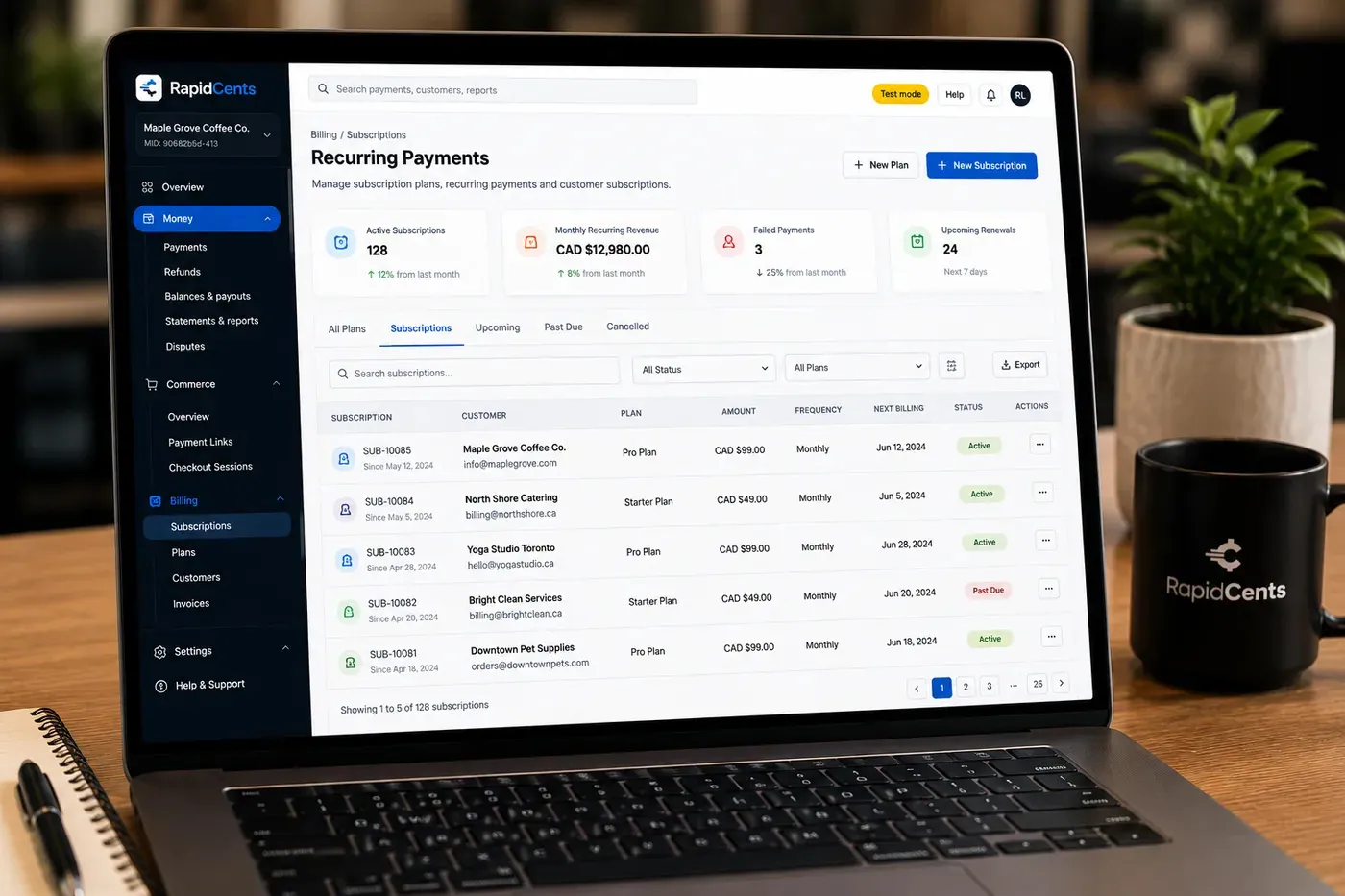
The RapidCents recurring payments screen showing active subscriptions, monthly recurring revenue, failed payments and upcoming renewals, above a list of subscriptions with their plan, amount, frequency and next billing date. Recurring Payments
RapidCents recurring payments manage subscription plans, membership renewals and installment schedules with…
Explore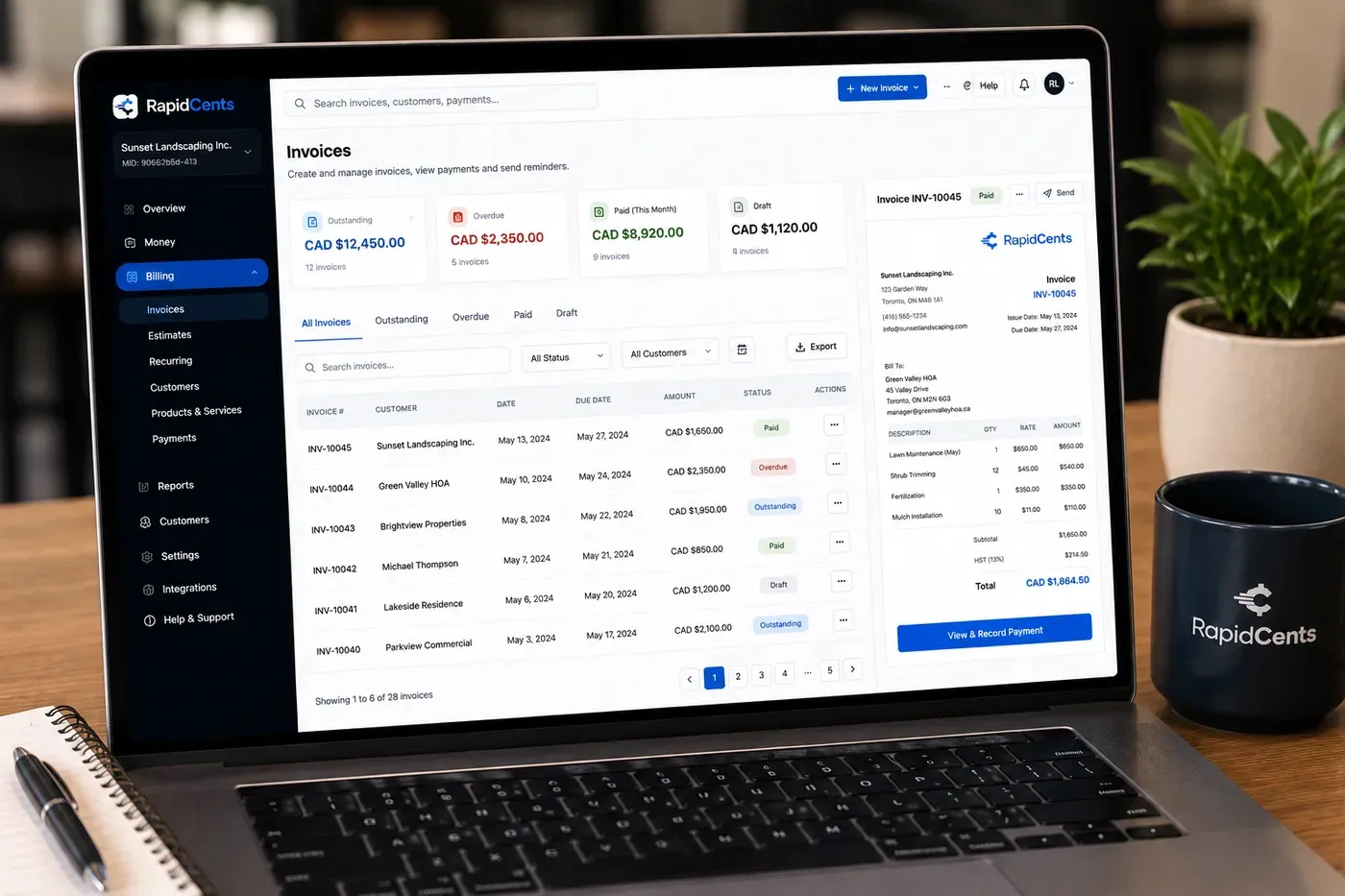
The RapidCents invoices screen: outstanding, overdue, paid and draft totals across the top, the invoice list below them, and a preview of one invoice on the right with its line items and a View & Record Payment button. Invoicing
RapidCents invoicing helps professional services, contractors and B2B suppliers create branded invoices…
Explore
The RapidCents payment links screen listing created links with their amount, status, click count and whether they have been paid, beside a phone showing the branded page a customer opens to pay $2,500.00. Payment Links
RapidCents payment links let staff generate branded pay-by-link URLs for invoices, deposits, balances and…
Explore
A RapidCents customer profile holds saved cards and invoices, so a return visit can be charged without re-keying the card. Customer Profiles
A customer profile ties together transactions, stored payment methods, subscriptions and disputes so staff…
Explore


How do agency client invoice payments reach the right project?
Agency client invoice payments reach the right project when every invoice carries a client, project and purchase order reference that follows the payment into reports. Invoicing and Payment Links keep that reference attached, so finance can match a settled payment to a job without searching email.
Carry the project reference with the payment
Create the invoice with the client name, project code and purchase order number the client's procurement team expects. The Payment Link inherits the invoice, and Reporting shows the transaction with that reference when finance exports settlement data for the books.
Choose card or bank payment for large invoices
Larger retainers and annual commitments often pay better by bank payment because card costs rise with ticket size. Ask the client's finance team which they prefer, and get written authorization before you debit a bank account.
An $8,000 invoice paid in two parts
Say a client's finance team pays one $8,000 invoice in two parts, a card payment for half and a bank payment for the balance. Both link to the same invoice and project reference, and a later refund targets the correct part.
Compare fees using your real payment mix
Payment processing fees for marketing agencies depend on the card types clients present, the ticket size, and whether cards are keyed, linked or stored. We price every account on interchange-plus: interchange at cost, your RapidCents markup set out in your Fee Schedule, and fees for equipment or services, if applicable. It is month to month, with no fixed term.
What drives the cost for an agency
Agencies mostly take card-not-present payments, and many clients pay with commercial or corporate cards. Interchange varies with the card type and how the card is taken. A few large invoices and many small reimbursements produce different mixes, so compare them by line.
What to bring to a comparison
Gather your last few processing statements, your split of cards and bank payments, average retainer and invoice size, how many payments are keyed or sent by link, and your refund and chargeback volume. A quote is only comparable when it covers the same mix.
Run a Fee Check on your statement
Upload a processing statement to Fee Check to see interchange separated from markup. Then set it beside the Fee Schedule for your RapidCents account, line by line, and ask for any terms you want in writing before you decide to change processors.
Harvest, Productive, Scoro and your accounting software
RapidBridge works with Harvest, so clients can pay by card inside the time-tracking and invoicing tool you already use, without changing it. For other project software, RapidCents integrates with many major platforms through APPIE and RapidBridge, and settled transactions, fees and refunds flow to QuickBooks Online and Xero.
Harvest
RapidBridge works with Harvest, so your team keeps tracking time and sending invoices there while clients pay by card through RapidCents. You do not change how Harvest works, and each payment posts against the invoice that is already open.
Productive and Scoro
Productive and Scoro manage projects, budgets and client billing. RapidCents integrates with many major platforms through APPIE and RapidBridge. The right option depends on your software vendor and version, and your RapidCents representative will walk you through it.
QuickBooks Online and Xero
RapidCents connects settled transactions, fees and refunds to QuickBooks Online and Xero, so deposits, fees and refunds land in the right accounts. SAP and NetSuite import settlement files.
Payment options for marketing agencies by country
RapidCents serves merchants in Canada and the United States. The payment methods, bank-payment options and settlement currency a marketing agency can use depend on the country of its merchant account, and your RapidCents representative will walk you through them.
Cards come first
Credit and debit cards taken by payment link, invoice or virtual terminal are the usual starting point for agency client payments, with in-person acceptance for workshops and events.
Bank payments and currency vary
Bank payment options, the currency of settlement and the authorization form for debits depend on the country of your account. Talk to your RapidCents representative about which methods suit your agency before you quote a client.
Switching, reconciliation and answers for buyers
An agency can switch processors without losing payment history by listing what exists today, testing the new flow, and running both in parallel before moving live traffic. Once your account is approved, your RapidCents representative helps you plan the overlap, and reconciliation then matches each deposit to client invoices and the ledger.
Inventory before you move
List every stored card and its authorization, each recurring retainer and its schedule, open invoices, pending refunds and project references. Ask both providers whether stored cards can move. If they cannot, ask clients to authorize again.
Test, then run in parallel
Run a sale, a refund and a deposit through the new setup before real client billing moves. Keep the old processor for scheduled retainers until the new schedule is running cleanly. A short overlap avoids a missed month while finance compares results.
Reconcile deposits to the ledger
Map the payment reference to the project in your operational software, then match the deposit to the invoice, the fee and any refund in the accounting file. Review the first settlement closely, and keep a note of anything that does not tie out.
Payment questions from marketing agencies
What is the best payment processor for marketing agencies?
The best processor is the one that fits your workflow, so compare on that. Look at how it handles retainers, milestone invoices and reimbursed spend, the total cost across your real card mix, software fit, support and reconciliation. Ask each provider for an itemized written quote and compare line by line. We will show you the flow and give you a written quote for your agency.
How much does credit card processing cost for marketing agencies?
The cost depends on your card mix, ticket size and channels, so there is no one figure. We price every account on interchange-plus: interchange at cost, your RapidCents markup set out in your Fee Schedule, and fees for equipment or services, if applicable. It is month to month with no fixed term. Run a Fee Check on a statement to see interchange separately from markup.
Does RapidCents work with Harvest and other agency software?
Yes. RapidBridge works with Harvest, so clients can pay a Harvest invoice by card through RapidCents while your team keeps working in Harvest. For Productive, Scoro and other tools, RapidCents integrates with many major platforms through APPIE and RapidBridge. The right option depends on your vendor and version; your RapidCents representative will walk you through it.
How can marketing agencies switch processors without losing payment history?
List stored cards and authorizations, retainer schedules, open invoices, refunds and project references before you move. Keep your reports and exports from the old processor. Test a sale, a refund and a deposit on the new one, then run both in parallel. Whether stored cards can move depends on both providers, so if they cannot, ask clients for fresh authorization.
Which payment options are available to marketing agencies?
Marketing agencies can generally accept credit and debit cards by link, invoice, phone or terminal, and can add bank payments for larger retainers. The settlement currency and bank options depend on the country of your merchant account. RapidCents serves merchants in Canada and the United States, and your representative will walk you through what fits.
How can we collect a monthly retainer automatically?
Store the client's authorized card on a Customer Profile and schedule the charge with Recurring Payments. Agree the amount, the date and the cancellation terms in writing first. If a charge fails, retries and notices run, and an Account Updater may refresh the card. Finance then reconciles each settled charge to the client account.
How can we bill milestones and reimbursed expenses separately?
Send each as its own invoice or Payment Link with a project reference, apart from the retainer. Milestones are billed when the client signs off on a phase, and reimbursements go out with the vendor invoice attached. If a client disputes one line, the others remain settled.
How can we request a deposit before production starts?
Send a Payment Link by email or text message for the agreed deposit, or attach it to an invoice or a signed statement of work. The client pays on any device, and the deposit is recorded against the project. Set the refund terms in the statement of work, because a cancelled shoot or sprint may need a partial refund.
How can we match a payment to a specific client project?
Put the client, project code and purchase order number on every invoice or Payment Link. That reference follows the payment into Reporting, so finance can match a settled deposit to a job. Your operational software stays the system of record for the project, and your accounting software holds the ledger.
How can we compare card payments with bank payments for large retainers?
Compare the total cost of each at your typical retainer size, the client's preference, authorization needs and how failures are handled. Card payments give faster confirmation and a dispute path for the client, while a bank payment suits a large, predictable amount. Get the client's authorization in writing before any bank debit.
What MCC is used for marketing agencies?
MCC 7311 is commonly associated with advertising services and agencies. Your onboarding contact sets the right merchant category based on what your agency actually sells. If you also resell media, print or software, tell them so the full business is described accurately.
Related industries
Law firms, accounting firms, IT and managed services and other professional businesses share retainers, milestone invoices and project references. The same Recurring Payments, Invoicing and Payment Links flows apply to them.
Law Firms
RapidCents helps law firms collect retainers by payment link, send invoices with a link…
Accounting Firms
Charge monthly bookkeeping and payroll fees on a schedule, collect tax preparation…
Professional Services
Charge monthly retainers, send branded invoice links and collect milestone balances from…
B2B & Wholesale
Collect net-terms invoices by payment link with the PO number attached, take commercial…
Insurance
Collect down payments at binding, monthly installments and agency fees by payment link…
Real Estate
Collect application fees, service fees and keyed deposits by payment link or Virtual…
Property Management
Collect rent by card and bank payment, set up recurring autopay, invoice maintenance…
Freight & Logistics
RapidCents helps carriers, brokers and 3PLs invoice shippers, collect by payment link…
Take the next step
See what your agency pays to take retainers and invoices
Upload a recent processing statement to Fee Check and see interchange separated from your current markup, then compare it with the Fee Schedule for your RapidCents account.
- No obligation
- Payment specialists, not a call centre
- Secure statement upload



