


Plumbing payment processing for emergency calls, deposits and invoices
Plumbing payment processing means taking cards where the work happens. Tap to Pay on a supported phone or a mobile terminal with LTE and Wi-Fi covers emergency calls and after-hours jobs, while payment links and invoicing cover deposits and final balances. RapidBridge works with ServiceTitan, Jobber and Housecall Pro, so payments post to the job you already have open.

- PCI DSS Level 1
- SOC 2 Type II
- All major cards: Visa, Mastercard, Amex, Discover, UnionPay, Diners Club & PIN Debit
- Interchange-plus available
- Specialist onboarding support
How plumbing contractors get paid
Plumbing contractors get paid six ways: on the spot after an emergency call, by deposit before a bigger job, by invoice link, by phone from the truck, at the shop counter, and on recurring maintenance plans. Each RapidCents payment can carry the job number as its reference, so the office can match it.
Emergency plumber card payments
A homeowner, a tenant's landlord or a property manager pays when the technician finishes a call-out for a burst pipe or a dead water heater. The card is taken with Tap to Pay or a mobile terminal; an absent payer gets a payment link. Finance gets the receipt and transaction record.
Plumbing job deposit payments
A homeowner or builder pays when a quote for a repipe or a bathroom remodel is accepted, before fixtures or special-order parts are bought. The deposit goes by payment link or at signing. If the scope changes once the walls are open, send a separate link for the added amount. The payment is tied to the job number.
Plumbing invoice payment links
A customer on a finished job, or a property manager, restaurant or builder on account, pays from an invoice with a payment link sent by email, SMS or QR code. If a purchase order number is required, put it on the invoice. The invoice status moves from draft to paid.
Mobile payments for plumbers
Whoever is standing at the job pays once the technician's price is approved. Tap to Pay turns a supported iPhone or Android phone into the terminal, with nothing extra in the truck. If the phone is dead or the customer wants to insert a card, the mobile terminal covers it. The receipt goes out by email.
Plumber credit card machine
Plan for two devices: a battery-powered mobile terminal with LTE and Wi-Fi in each truck, and a countertop terminal for walk-in customers buying parts. A basement with no signal is the case to watch: the technician steps upstairs or joins the customer's Wi-Fi. Both devices appear in your transaction reports.
Plumbing maintenance billing
A homeowner or restaurant on an annual plan, such as a water heater flush or backflow testing, pays on the agreed schedule. You set up Recurring Payments only after the customer agrees to the amount, timing and cancellation terms. An expired card is the common failure, and automated retries and Account Updater address it.
How does emergency call out collection work for plumbing contractors?
Emergency call out collection works when the technician takes payment at the end of the visit, after the customer approves the final price. These emergency plumber card payments use Tap to Pay or a mobile terminal, and a receipt is emailed before the truck leaves.
How the call-out runs from dispatch to receipt
The dispatcher books the call and records any call-out charge. The technician finds the fault and prices the repair. Once the customer approves the total, the technician enters it on the phone or terminal, the customer taps a card, and a receipt goes out by email.
What to set up before the first call
Tell the customer the call-out charge at dispatch, because the repair price is often unknown until the pipe is open. Train technicians to read the total aloud before the card is presented. If you want a card kept on file for follow-up work, ask first: a stored card needs the customer's authorization.
What goes wrong and how to handle it
A declined card means a second card, or a payment link the customer opens after calling their bank. A repair that fails days later can be refunded to the original card if that is your policy. If the customer questions the charge, the receipt and work order show the amount, date, job number and work done.
A burst supply line at 9 p.m., paid before the truck leaves
Say a technician shuts off the water to a burst supply line and prices the repair at $640 once the wall is open. The homeowner approves and taps a card on the technician's phone, and the receipt arrives by email. Next morning the office matches the $640 payment to the work order.
How do plumbing contractors manage deposit and final invoice allocation?
Deposit and final invoice allocation means taking plumbing job deposit payments when the customer accepts the quote, recording each against the job number, and invoicing only the remaining balance at the end. The job number lets your office add the two payments back together.
How the deposit and the final bill connect
Once the customer accepts the quote, a payment link by email, SMS or QR code, or a quote signed in Contracts & eSignatures with the deposit taken at signing, collects the deposit. After the work, a branded invoice for the remaining balance goes out with its own payment link, and Invoicing tracks it from draft to paid.
Terms to agree before you take the deposit
Put in writing what the deposit covers, such as permits, fixtures or special-order parts, and what happens on cancellation. Local rules on deposits for home work differ, and card processing does not check them. To charge the balance to the same card later, the customer must authorize that stored card, with amount, timing and cancellation agreed.
What goes wrong with deposits and final bills
A scope change, such as rotted framing found behind a wall, needs its own payment link for the added amount, not a quiet change to the first. A customer who cancels after fixtures are ordered gets the refund your written terms allow, to the original card, and the record shows the deposit and the refund.
A whole-house repipe, paid in two payments
Say a whole-house repipe is quoted at $9,000. The homeowner signs and pays a $2,500 deposit by link. On completion the office invoices the remaining $6,500. Both payments carry the same job number, so finance adds them to $9,000 and the ledger shows one job with two receipts.
RapidCents products for plumbing contractors
Tap to Pay and mobile terminals take the card at the job, payment links carry deposits and balances to a customer's phone, and Invoicing tracks each plumbing invoice from draft to paid.

A café worker holds a phone running RapidCents Tap to Pay, showing an $18.75 sale and the contactless symbol, while a customer holds a Visa card to the screen. No separate card reader is present. Tap to Pay
RapidCents Tap to Pay turns supported iPhones and Android devices into contactless payment terminals without…
Explore
The RapidCents payment links screen listing created links with their amount, status, click count and whether they have been paid, beside a phone showing the branded page a customer opens to pay $2,500.00. Payment Links
RapidCents payment links let staff generate branded pay-by-link URLs for invoices, deposits, balances and…
Explore
The RapidCents invoices screen: outstanding, overdue, paid and draft totals across the top, the invoice list below them, and a preview of one invoice on the right with its line items and a View & Record Payment button. Invoicing
RapidCents invoicing helps professional services, contractors and B2B suppliers create branded invoices…
Explore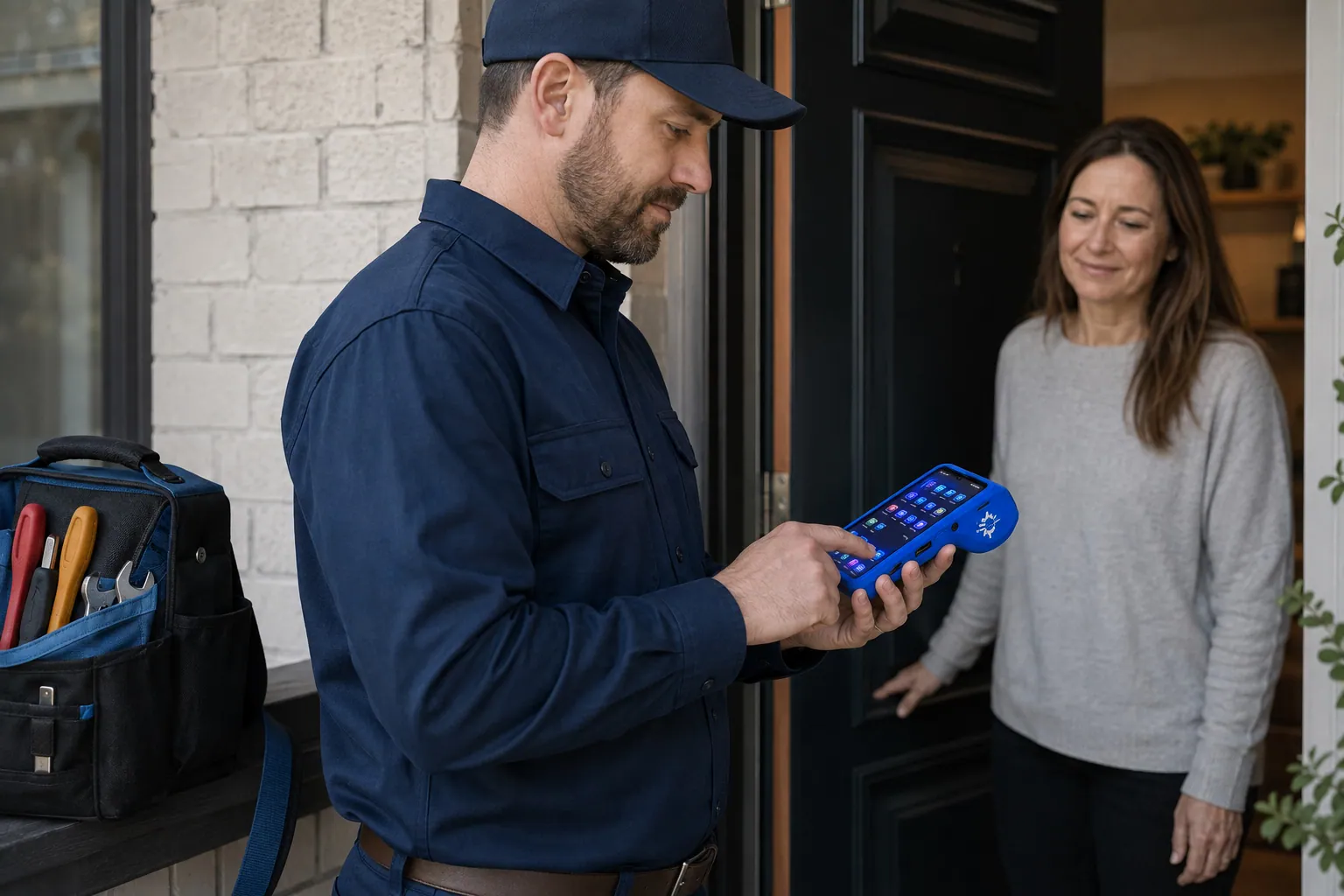
A staff member takes a card payment on a RapidCents handheld terminal, with the same sale appearing on the dashboard. Mobile Terminals
RapidCents mobile terminals are battery-powered wireless devices with LTE and Wi-Fi so staff accept payments…
Explore


How does after hours mobile checkout work for plumbers?
After hours mobile checkout is how mobile payments for plumbers work at night: the on-call technician takes payment from a phone or mobile terminal at the job, and the dispatcher sends a payment link when the payer is somewhere else. The office reviews the night's payments the next morning.
How the on-call kit works
Each on-call technician carries a supported phone with Tap to Pay and, where you add one, a charged mobile terminal with LTE and Wi-Fi as the backup. The phone takes contactless cards; the terminal also reads a chip. Your RapidCents representative can tell you which phone models support Tap to Pay.
What to set up first
Decide who may take payments and who may issue refunds, because no one in the office is there to approve them at night. Virtual Terminal has role permissions and an audit log for keyed payments. Test a small sale and refund on every device before it goes into a truck.
What to do when the payer is not at the job
When the payer is not at the job, the dispatcher can send a payment link by SMS or email, or key the card into Virtual Terminal with address and security code checks. A keyed or remote payment is not card-present, so keep a record of the payer's approval of the amount.
A main-line blockage at 1 a.m., paid from the landlord's couch
Say an on-call technician clears a main-line blockage at 1 a.m. and the job comes to $395. The tenant is not the account holder, so the dispatcher sends a payment link by SMS to the landlord, who approves the amount and pays from home. The office closes the work order in the morning.
How do plumbing contractors compare processing fees and total operating cost?
Plumbing contractors compare processing fees by pricing each type of payment separately, then adding equipment, monthly and dispute costs. RapidCents shows interchange and markup as separate lines, because one combined figure hides which part the card networks set and which part the provider adds.
What moves the cost of a plumbing card mix
A plumbing card mix has four layers: tapped or inserted call-out payments, keyed phone payments for an absent landlord, deposit and invoice payments by link, and large commercial invoices. The card networks set interchange by card type (debit, credit, premium or commercial) and by how the card is taken, so each layer is priced differently.
What interchange-plus means on your Fee Schedule
We price every account on interchange-plus. A plumbing account pays interchange at cost, and your Fee Schedule sets out the RapidCents markup and any fees for equipment or services. Compare quotes line by line, the card networks' part against the provider's part. Pricing is month to month, with no fixed term.
What to bring, and what else to price
Bring recent statements, your split between debit, credit and commercial cards, average tickets for call-outs, deposits and final invoices, your mix of tapped, keyed and linked payments, and refund and chargeback volume. Then price terminals, monthly fees and dispute charges. Upload a recent plumbing statement to Fee Check to see interchange separated from markup.
Does RapidCents work with ServiceTitan and other plumbing software?
RapidCents integrates with many major platforms through APPIE and RapidBridge, and RapidBridge works with ServiceTitan, Jobber, Housecall Pro, FieldEdge and Service Fusion, so a card payment posts against the job you already have open. The exact option depends on your software vendor and version; your RapidCents representative will walk you through it.
ServiceTitan
ServiceTitan is field service software where a plumbing company books the call, prices the work and raises the invoice. RapidBridge works with it, so a RapidCents payment posts against the job you already have open, and your representative will show you how receipts and ledger entries follow.
Jobber
Jobber handles quotes, scheduling and invoices for smaller service crews. RapidBridge works with Jobber, so a RapidCents payment lands on the invoice you already have open instead of a second entry. Your representative will walk you through setup for your plan and version.
Housecall Pro
Housecall Pro runs estimates, dispatch and invoices from the technician's phone. RapidBridge works with Housecall Pro, so a card taken through RapidCents is recorded on the job the technician is standing in. Your representative will show you how it fits your plan.
FieldEdge
FieldEdge supports dispatch and service agreements for plumbing, heating and cooling shops. RapidBridge works with FieldEdge, so payments post to the work you already track there. If maintenance plans live in FieldEdge, your representative will show you how recurring charges on a stored card fit in.
Service Fusion
Service Fusion covers dispatch, scheduling and invoicing for service crews. RapidBridge works with Service Fusion, so card payments post against the job and invoice you already have open. Your representative will explain which option suits your setup and what your ledger receives.
Payment options for plumbing contractors by country
Payment options for plumbing contractors depend on the country of the merchant account. RapidCents serves merchants in Canada and the United States, and the card types, bank-payment options and settlement currency enabled for you follow your country and account.
Cards at the job
Credit and debit cards on a mobile terminal or a Tap to Pay phone are the usual way to take payment on a call-out. Which card types and brands each device accepts depends on your country and account, and your RapidCents representative will walk you through them.
Bank payments for commercial accounts
Bank payments for property managers and builders on account depend on the options available in your country, and may not be enabled on every account. Ask your RapidCents representative which bank-payment options exist for you, and keep the payer's authorization on file.
Settlement currency and local rules
Funds from plumbing jobs settle in the currency of your merchant account, which follows your country. Local rules on deposits, cancellation and tax for home work differ, and card processing does not check them, so check yours with your own lawyer or accountant.
How do plumbing contractors switch providers and keep their job records?
Plumbing contractors switch providers safely by listing everything that depends on the old one, testing a sale, a refund and a deposit on the new setup, and reconciling each deposit to the ledger before the old account closes. Stored cards and saved agreements move only if both providers agree.
Inventory what depends on the old provider
List stored cards and maintenance agreements, open deposit links and unpaid invoices, refunds in progress, and every terminal and phone that takes payments. Note which job software reads payment data. Once your account is approved, your RapidCents representative walks you through the move. Saved card details move only through a migration both providers agree to; otherwise customers authorize their cards again.
Test the new flow, then train technicians
Run a test sale, a refund, a deposit by payment link and a final invoice payment on the new setup, and check each receipt and report. Run old and new side by side for a short period if you need to. Then set who may refund, show technicians how to take payments, and remove the old provider's apps and saved logins from phones and trucks.
Reconcile deposits to your ledger
Plumbing payment reconciliation means matching each deposit to the jobs it paid. Enter the work order number as the payment reference, then use settlement and fee reports, exported as CSV or PDF. RapidCents connects settled transactions, fees and refunds to QuickBooks Online and Xero, and your representative will show you how to map them.
Payment questions from plumbing contractors
How should plumbing contractors handle emergency call out collection?
Collect at the end of the visit, after the customer approves the price, with a device that works away from the shop. RapidCents offers Tap to Pay on a supported phone and mobile terminals with LTE and Wi-Fi for this. Refunds go back to the original card, and the receipt and work order answer any dispute.
How should plumbing contractors handle deposit and final invoice allocation?
Take the deposit when the customer accepts the quote, record it against the job number, then invoice only the remaining balance. RapidCents sends payment links by SMS, email or QR code, shows each payment separately with your reference, and refunds to the original card. Allocation happens in your job software or ledger, and your RapidCents representative will show you how payment data reaches it.
How should plumbing contractors handle after hours mobile checkout?
Give each on-call technician a device that works from the truck, plus a way to charge a payer who is not on site. With RapidCents, that means Tap to Pay on a supported phone or a mobile terminal with LTE and Wi-Fi, and payment links or the Virtual Terminal for remote payers. Role permissions set who can take payments and issue refunds at night.
How should plumbing contractors handle technician receipts?
A technician's receipt should reach the customer before the truck leaves, by email from the device at the job. Make sure it shows your business name, the date, the amount and a reference you can tie to the work order. The receipt records the payment; your invoice and job software keep the itemized parts, work and warranty terms.
Do payment options for plumbing contractors depend on the country of the merchant account?
Yes. The payment methods, bank-payment options and settlement currency available to a plumbing contractor depend on the country where the merchant account is held. RapidCents serves merchants in Canada and the United States, and your RapidCents representative will walk you through which methods and devices are enabled on your account before you start.
How should plumbing contractors handle commercial customer balances?
Send each property manager, restaurant or builder an invoice with a payment link and their purchase order or work order number, then track status from draft to paid. For new-build work, invoice at rough-in and again at trim-out. Commercial customers may pay by corporate card or, where enabled on your account, by bank payment, so price those separately from a debit tap at a driveway.
Which payment processor is best for plumbing contractors, and what should you compare?
No single processor is best for every plumbing company, so compare on your own payment mix. Ask for written quotes that separate interchange from markup and list equipment, monthly and dispute charges. Then compare devices for the truck, deposit and invoice tools, reconciliation reports, night support and software fit. RapidCents offers these tools, and Fee Check shows interchange apart from markup on an uploaded statement.
What fees should plumbing contractors expect for in-person and online card payments?
Expect interchange, a provider markup and, where they apply, equipment or service fees. With RapidCents interchange-plus pricing, interchange passes through at cost and your Fee Schedule sets out the markup and any equipment or service fees. Interchange differs between tapped or inserted payments and keyed or online ones. Pricing is month to month, with no fixed term.
Can you use RapidCents with ServiceTitan or Jobber?
Yes. RapidBridge works with ServiceTitan, Jobber, Housecall Pro, FieldEdge and Service Fusion, so a card payment posts against the job or invoice you already have open without changing your software. RapidCents integrates with many major platforms through APPIE and RapidBridge, and the right option depends on your software vendor and version. Your RapidCents representative will walk you through it.
How can plumbing contractors reduce payment disputes and protect stored card details?
Reduce disputes by getting the customer's approval of the price before charging and sending a receipt at once. Keep the approval for any remote payment on record. Protect stored cards by using the Secure Card Vault instead of work orders or phones, limiting who can refund, and storing a card only with the customer's authorization. Evidence supports your case, but the issuing bank decides the outcome.
How can plumbing contractors switch payment providers without losing billing records?
Switch without losing records by listing what depends on the old provider first: stored cards, maintenance agreements, open deposit links, unpaid invoices, terminals and software connections. Export your transaction history, test a sale, a refund and a deposit on the new setup, then run both for a short overlap. Stored card details move only if both providers agree; otherwise customers authorize their cards again.
What MCC is used for plumbing contractors?
MCC 1711 is commonly associated with plumbing contractors. RapidCents sets the correct merchant category during onboarding, based on what your business actually sells, so describe every service you offer, such as emergency repairs, installations, maintenance plans and any parts you sell.
Related trade and home service industries
HVAC contractors, electricians, roofing contractors and other trades share these collection moments: a charge at the end of a service call, a deposit before materials are ordered and a final invoice by payment link.
HVAC Contractors
RapidCents lets you take the equipment deposit at the kitchen table, collect the balance…
Electricians
Take a materials deposit before the order goes in, get change orders approved and paid…
Construction Contractors
RapidCents helps construction contractors bill draws, collect released retainage and…
Home Services
Card payments for the work your crews finish in customers' homes: tap at the door…
Landscaping
RapidCents handles spring deposits by payment link, monthly maintenance on autopay…
Cleaning Services
RapidCents helps cleaning businesses collect recurring cleans from a card on file, deep…
Roofing Contractors
Take the deposit that orders the shingles, bill the balance at tear-off and completion…
Painting Contractors
Collect the deposit when the estimate is accepted, the balance at the walkthrough and…
Take the next step
See what your plumbing business pays to take cards
Upload a recent processing statement to Fee Check and see interchange separated from markup, so you can compare a written quote against your own mix of emergency calls, deposits and final invoices.
- No obligation
- Payment specialists, not a call centre
- Secure statement upload



