


Appliance repair payment processing for service technicians
Appliance repair payment processing lets a technician collect a diagnostic fee at the door, a deposit on ordered parts and the final balance after the repair. RapidCents supports these jobs with Tap to Pay, mobile terminals, Payment Links and Invoicing, with each receipt tied to the work order, and your dispatch software stays in place.

- PCI DSS Level 1
- SOC 2 Type II
- All major cards: Visa, Mastercard, Amex, Discover, UnionPay, Diners Club & PIN Debit
- Interchange-plus available
- Specialist onboarding support
How appliance repair businesses get paid
An appliance repair business collects money in four distinct moments: the diagnostic fee at the door, a deposit on ordered parts, the balance after the repair, and the split between a warranty payer and the homeowner. Appliance technician card payments cover all four.
Diagnostic fee at the door
The customer who booked the visit pays the diagnostic fee when the technician arrives. The dispatcher quotes it, and the technician takes a tap or chip payment on a mobile terminal or phone. If the customer is not home, a payment link covers it. Finance gets a receipt tied to the work order.
Parts deposit on an ordered part
The customer pays a deposit when a part must be ordered. The dispatcher sends a payment link or keys the card on the Virtual Terminal. If the part is backordered or wrong, the refund terms you agreed apply. Finance gets a receipt carrying the part number and work order.
Final balance after the repair
The customer pays the remaining parts and work once the appliance runs. The technician taps a card, or the office emails an invoice with a payment link. The deposit and any diagnostic credit come off the total. Finance sees the invoice marked paid with receipts that match.
Warranty payer and homeowner
A warranty company may cover part of a job while the homeowner pays a deductible or extras. Split the invoice so each payer's amount sits on its own line, and take the homeowner's portion by card. Finance gets one record per payer, and the warranty claim itself stays in your own process.
How do you collect the diagnostic fee at the first visit?
You collect the diagnostic fee by taking the card at the door before the technician opens the machine, then recording whether the fee is credited toward the repair. Tap to Pay on the technician's phone or a mobile terminal handles it on the spot, and the receipt reaches the customer before any work begins.
How the visit runs
The dispatcher books the call, quotes the fee and the customer agrees on the phone. At the door, the technician taps or inserts the card on a mobile terminal, or uses Tap to Pay on a supported phone, then sends the receipt by text or email. The work order shows the fee as paid.
Set the fee terms first
Decide whether the diagnostic fee is credited toward the repair, and tell the customer when booking so the charge at the door is no surprise. If the owner is not home, send a payment link by SMS instead.
Declines, refunds and a dryer that will not heat
If a card declines, ask for another card or send a payment link. If the customer cancels at the door, refund under the terms you quoted. Say a technician diagnoses a dryer that will not heat and taps a $95 fee; the dispatcher notes it as a credit against the repair.
How do you take parts deposits and handle backorders?
You take a parts deposit when a part must be ordered, using a payment link or a card keyed on the Virtual Terminal, and you tie it to the part number and work order. Appliance parts deposit payments need clear terms for delays, wrong parts and cancellations before you charge.
How the deposit runs
The technician finds a failed control board, quotes the part and the repair, and the dispatcher sends a Payment Link for the deposit by SMS or email. The customer pays from their phone, and the receipt references the part number and work order so the money matches the order.
Agree the backorder terms
Agree in writing what happens if the part is backordered, arrives wrong or the customer cancels. Say whether the deposit is refundable, partly refundable or applied to a restocking charge. Store the card for the final balance only if the customer authorizes it, and note the authorization on the work order.
A $240 compressor on order
Say a customer needs a $240 compressor ordered for a refrigerator and pays the deposit by link that evening. The part is delayed, so the dispatcher messages a new date. If the customer cancels, the deposit goes back to the same card under the terms agreed at booking.
RapidCents products for appliance repair
These products cover the door, the phone and the invoice: Tap to Pay and mobile terminals for the appliance repair mobile card reader job, Payment Links for deposits, and Invoicing for the final balance.

A café worker holds a phone running RapidCents Tap to Pay, showing an $18.75 sale and the contactless symbol, while a customer holds a Visa card to the screen. No separate card reader is present. Tap to Pay
RapidCents Tap to Pay turns supported iPhones and Android devices into contactless payment terminals without…
Explore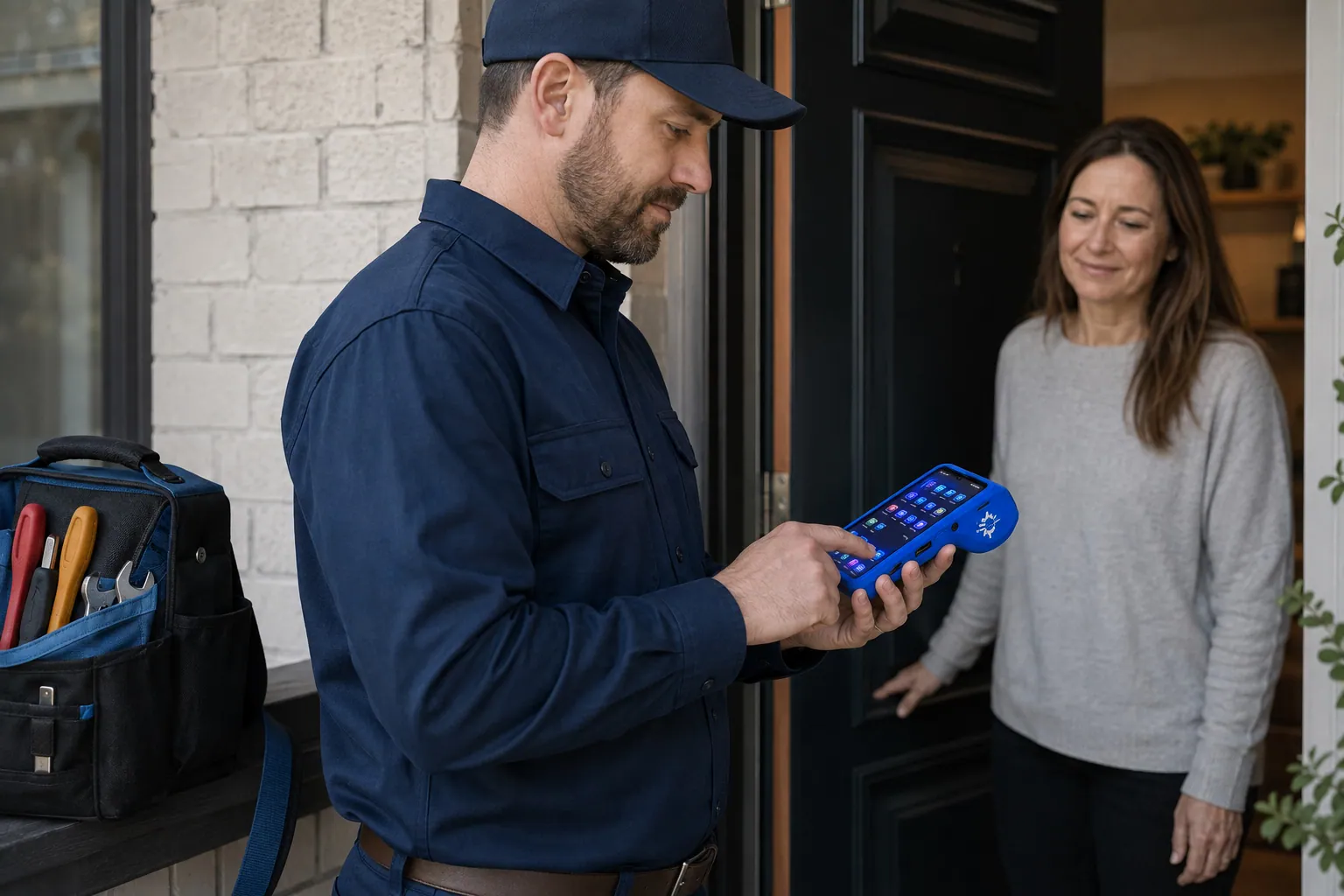
A staff member takes a card payment on a RapidCents handheld terminal, with the same sale appearing on the dashboard. Mobile Terminals
RapidCents mobile terminals are battery-powered wireless devices with LTE and Wi-Fi so staff accept payments…
Explore
The RapidCents invoices screen: outstanding, overdue, paid and draft totals across the top, the invoice list below them, and a preview of one invoice on the right with its line items and a View & Record Payment button. Invoicing
RapidCents invoicing helps professional services, contractors and B2B suppliers create branded invoices…
Explore
The RapidCents payment links screen listing created links with their amount, status, click count and whether they have been paid, beside a phone showing the branded page a customer opens to pay $2,500.00. Payment Links
RapidCents payment links let staff generate branded pay-by-link URLs for invoices, deposits, balances and…
Explore


How do you collect the parts and work balance on the return visit?
On the return visit, the technician installs the part, tests the appliance and collects the balance of parts and work minus the deposit and any diagnostic credit. A mobile terminal or Tap to Pay takes the card on site, or an invoice with a payment link follows if the customer is not home.
How the balance runs
Before leaving, the technician confirms the appliance runs and the dispatcher closes the work order. Invoicing creates a branded invoice listing the deposit already paid and the remaining balance. With appliance repair invoice payment links, the customer pays by tap, chip or link, and the status changes from sent to paid.
Warranty payer versus homeowner
When a warranty company covers part of the job, split the invoice. Its portion follows its own terms outside card payment, while the homeowner pays any deductible or uncovered items by card. Keep each payer's amounts on separate lines so receipts and reports match.
A $320 repair and a disputed line
Say a $320 repair has a $95 diagnostic credit and a $100 deposit, leaving $125. The technician taps the card, and a week later the customer disputes one line of the work. Keep the work order notes, signed approval and receipt together so you can answer the dispute.
How do you compare processing fees and total operating cost?
Your card costs depend on card type, how the card is taken and how many keyed or remote payments you run. RapidCents prices on interchange-plus: interchange passes through at cost, plus your RapidCents markup in your Fee Schedule and fees for equipment or services, if applicable. It is month to month, with no fixed term.
What drives cost on repair calls
Cards tapped or inserted at the door usually carry different interchange than keyed or link payments, and debit, credit, premium and commercial cards differ too. A shop that sends many payment links will see a different mix than one that mostly taps at the door.
What to bring to a comparison
Bring recent processing statements, your split between door payments, links and phone orders, the average ticket for diagnostic fees and repair balances, and your refund and chargeback volume. Your real payment mix is the only fair basis for comparing quotes.
Compare in writing with Fee Check
Upload a statement to Fee Check to see interchange separated from markup. Then ask every provider for a written quote listing markup, equipment fees, monthly charges and any contract term, so you compare total operating cost rather than one headline number.
Which dispatch and accounting software works with RapidCents?
RapidCents integrates with many major platforms through APPIE and RapidBridge, so your repair jobs can be paid inside the dispatch software you already run. Settled transactions, fees and refunds go to QuickBooks Online and Xero, while SAP and NetSuite import settlement files. Your RapidCents representative explains the option for your vendor and version.
Workiz and Rossware ServiceDesk
Both run dispatch and work orders. RapidBridge works with Workiz, so a card payment posts against the work order you already have open. For Rossware ServiceDesk, tell your RapidCents representative your edition, and they will show you how payments connect, whether by connector, payment link or export and import.
ServiceTitan, Jobber and Housecall Pro
RapidBridge works with ServiceTitan, Jobber and Housecall Pro, so a card payment posts against the job you already have open, without changing the software. Your RapidCents representative will walk you through how amounts, receipts and refunds reach the job record for your plan.
QuickBooks Online, Xero, SAP and NetSuite
RapidCents connects settled transactions, fees and refunds to QuickBooks Online and Xero, and SAP and NetSuite import settlement files. Have your bookkeeper check that diagnostic fees, deposits and balances land in the right accounts; your RapidCents representative will walk you through the setup.
Payment options for appliance repair by country
RapidCents serves merchants in Canada and the United States. Which payment methods, bank-payment options and settlement currency apply to an appliance repair business depends on the country of the merchant account, and your RapidCents representative will show you what is enabled on yours.
Methods depend on your account country
Card types, local debit networks and bank payments differ by country. Your RapidCents representative will show you which of these are enabled on your account before you promise a method to a customer.
Settlement and receipts
The currency you are paid in and the tax lines you show on a receipt follow your account country. Your RapidCents representative and your accountant can walk you through both before you set up invoices.
What is the checklist for setup, switching and reconciliation?
Once your account is approved, switch in this order: list open work, stored cards and terminals, test a sale, refund and deposit on the new setup, run both providers briefly if needed, then reconcile deposits to your ledger. Do not move live jobs until the test payments match your records.
Take inventory first
List open deposits, unpaid balances, parts waiting on a return visit, cards stored with customer authorization, and every terminal and phone in use. Stored card details may need both providers to agree on a migration, so do not assume they transfer.
Test before live jobs
Run a tap sale, a payment link, a refund and a deposit through the new setup. Check that each receipt carries the work order number and that the amounts match your dispatch software and your ledger entry before any technician uses it at a customer's door.
Reconcile by technician
Run both providers in parallel for a short period if volume allows. Map each payment reference to its work order, then reconcile deposits to the ledger by technician, so a disputed diagnostic fee or deposit can be traced from its receipt.
Payment questions from appliance repair businesses
How should an appliance repair business handle the diagnostic fee at the first visit?
Take it at the door before work begins, by tap or chip on a mobile terminal or with Tap to Pay, and tell the customer at booking whether it is credited toward the repair. Send the receipt right away and attach it to the work order. A customer who cancels at the door gets a refund as agreed.
How should an appliance repair business handle parts deposits and backorders?
Collect the deposit by Payment Link or on the Virtual Terminal when the part is ordered, and write the refund terms for delays, wrong parts and cancellations before you charge. Record the part number on the receipt. Use a stored card for the final balance only if the customer authorizes it and agrees to the amount and timing.
How should an appliance repair business handle the balance on the return visit?
Take the balance on site by tap or chip, or send an invoice with a Payment Link, after subtracting the deposit and any diagnostic credit. List parts and work separately on the invoice, with the deposit shown as paid. This leaves one clear receipt that matches the work order and your ledger.
How should an appliance repair business handle a warranty payer and a homeowner?
Split the invoice by payer, so the homeowner's deductible or uncovered items are charged to their card and the warranty company's portion follows its own process. RapidCents records the card payment only, and the warranty claim stays in your dispatch software or paperwork. Keep each payer's amounts, receipts and authorizations on separate lines.
Which payment options can an appliance repair business offer in each country?
It depends on the country of your merchant account. RapidCents serves merchants in Canada and the United States, and the card networks, bank-payment options and settlement currency differ between them. Your RapidCents representative will show you which methods are enabled on your account, so you can match your invoices, receipts and customer quotes to that list.
Which payment processor suits appliance repair businesses, and what should we compare?
Choose the provider whose written quote fits your real payment mix, not the one with the loudest headline number. Compare markup, equipment fees, monthly charges, contract term, reporting, support and dispatch software options, using the same sample month for each. RapidCents quotes on interchange-plus, and Fee Check shows interchange separately from markup.
What fees should appliance repair businesses expect for in-person and online card payments?
Expect interchange, which varies with card type and how the card is taken, plus your RapidCents markup in your Fee Schedule and fees for equipment or services, if applicable. Door payments by tap differ from keyed or link payments. Request a written quote using your statements. RapidCents is month to month, with no fixed term.
Can we use RapidCents with Workiz or Rossware ServiceDesk?
Yes. RapidBridge works with Workiz, and RapidCents integrates with many major platforms through APPIE and RapidBridge, so most shops keep the software they run today. The right option depends on your vendor and version, so tell your RapidCents representative whether you use Workiz or Rossware ServiceDesk, and they will show you how payments connect. For accounting, settled transactions, fees and refunds go to QuickBooks Online and Xero.
How can appliance repair businesses reduce payment disputes and protect stored card details?
Agree the fee, deposit and refund terms with the customer before you charge, and send a receipt each time. Limit staff access with Virtual Terminal role permissions, and keep cards in tokenized storage only with the customer's authorization. Keep the work order, signed approval and receipt together as evidence. No provider can promise a dispute outcome.
How can appliance repair businesses switch payment providers without losing billing records?
Take inventory first and test before you move live jobs. List open deposits, unpaid balances, terminals, dispatch software links and stored cards. Run a sale, a refund and a deposit on the new setup and reconcile them. Stored card details may need both providers to agree to a migration, so do not assume they move.
What MCC is used for appliance repair?
MCC 7623 is commonly associated with appliance repair businesses. RapidCents sets the correct merchant category during onboarding, based on what your business actually sells and services. If you also sell appliances or parts at retail, tell your RapidCents representative so the category and your account reflect your full mix of work.
Related industries
HVAC, plumbing, electrical and other home service trades share the same door-step diagnostic fee, parts deposit and return-visit balance, so their payment workflows borrow from each other.
HVAC Contractors
RapidCents lets you take the equipment deposit at the kitchen table, collect the balance…
Plumbing Contractors
Take the card at the job with Tap to Pay or a mobile terminal, send deposit links before…
Electricians
Take a materials deposit before the order goes in, get change orders approved and paid…
Construction Contractors
RapidCents helps construction contractors bill draws, collect released retainage and…
Home Services
Card payments for the work your crews finish in customers' homes: tap at the door…
Landscaping
RapidCents handles spring deposits by payment link, monthly maintenance on autopay…
Cleaning Services
RapidCents helps cleaning businesses collect recurring cleans from a card on file, deep…
Roofing Contractors
Take the deposit that orders the shingles, bill the balance at tear-off and completion…
Take the next step
See what your repair calls really cost to process
Upload a recent processing statement to Fee Check and see interchange separated from markup, then compare it with your mix of door payments, links and invoices.
- No obligation
- Payment specialists, not a call centre
- Secure statement upload



