Payment processing for hotels: deposits, incidental holds and folio checkout
Payment processing for hotels covers three moments in a stay: a deposit or stored card at booking, an incidental preauthorization at check-in, and the final capture when the folio closes at checkout. RapidCents handles them with Payment Links, the Virtual Terminal and terminals, and integrates with many major platforms through APPIE and RapidBridge.

- PCI DSS Level 1
- SOC 2 Type II
- All major cards: Visa, Mastercard, Amex, Discover, UnionPay, Diners Club & PIN Debit
- Interchange-plus available
- Specialist onboarding support
How hotels get paid
Hotels get paid in six recurring ways: advance deposits before arrival, incidental holds at check-in, folio settlement at checkout, virtual cards from online travel agencies, no-show and late cancellation charges, and invoices for groups and direct-bill accounts. Each has its own payer and trigger, and each needs a reference that lets the night audit and finance tie the money back to a reservation or folio.
Advance deposits before arrival
The guest, or a planner booking several rooms, pays ahead when the rate or dates call for it: a non-refundable rate, a peak weekend, a group block. Hotel advance deposit payment links let the reservations team request the deposit by email or SMS instead of taking card numbers over the phone. Refunds follow your cancellation policy. Put the confirmation number on each link so finance can apply the deposit to the right folio.
Incidental holds at check-in
At arrival, the front desk places a preauthorization on the guest's card for the room balance still owed plus an incidental allowance, usually by tap or chip on a desk terminal. Nothing is charged yet; the hold only reserves funds until checkout. If a card declines, ask for another card before handing over the keys. The authorization code goes on the folio for the checkout capture.
Folio settlement at checkout
When the guest leaves, you capture the folio total against the hold, or the guest pays with another card. The total covers room, taxes and any restaurant, spa or parking charges posted during the stay. If you find a charge after departure, such as a minibar count, put it on the card only when the signed registration card allows charges after departure. Finance matches each capture to its folio number.
Virtual cards from online travel agencies
When an online travel agency (OTA) collects the guest's money, it pays you with a single-use virtual card loaded with the amount it owes for the stay. Hotel virtual credit card processing means keying that card as a card-not-present payment in the Virtual Terminal or your PMS, within the dates and amount the agency sets. Early or oversized charges usually decline, and finance matches each payment to the OTA confirmation number.
No-show and late cancellation charges
When a guest with a card-held reservation does not arrive, or cancels inside the policy window, you charge the stored card what your policy set out at booking, often the first night and taxes, from the Virtual Terminal or your PMS. Before charging, make sure the guest saw that policy and authorized the card to be stored. These charges attract disputes, so keep the confirmation and the policy wording with each transaction.
Direct-bill and group invoices
Companies with negotiated rates, tour operators and sports teams often pay after the stay, against an invoice drawn from a master folio or the city ledger. RapidCents Invoicing sends a branded invoice with a payment link, and bank payment may be available depending on your country. If a group pays in parts or disputes a line, put the invoice number on every payment so accounts receivable can follow it.
How do incidental holds work from check-in to checkout?
A hotel incidental preauthorization reserves money on the guest's card at check-in, and only the final folio total is charged at checkout. The desk authorizes the expected room balance plus an incidental allowance, and authorizes more if the folio outgrows the hold. When the folio is captured, the unused part of the hold is released, but the guest's bank decides how quickly that money shows as available again.
How a stay runs with RapidCents
The guest taps or inserts a card on a RapidCents Payment Terminal at the desk, or the PMS requests the authorization through its gateway connection. The approval code is recorded against the reservation. Restaurant, bar and parking charges post to the folio during the stay. At departure, the desk captures the folio total against the hold and gives the guest the itemized folio with the card receipt.
Set the hold policy before the first arrival
Decide how the hold is sized, for example the room and taxes for the stay plus a nightly incidental allowance. Print that rule on the registration card, with the guest's consent to charges found after departure, and have the guest sign it. Decide who may override the hold, accept a debit card for incidentals or release a hold early, and limit those rights through user permissions. Your RapidCents representative will show you preauthorization, capture and void on the exact terminal or PMS setup you will use.
Debit cards and the guest's available balance
A hold on a debit card reduces the money the guest can spend from their bank account until it is released, and the guest's bank, not the hotel, controls that release after checkout. Tell debit users the hold amount at check-in, keep it close to the expected folio, and capture the final amount at departure rather than days later, so the guest's bank can match the charge to the hold and release the rest.
When the stay changes
An extension, an upgrade or a large room-service bill can push the folio past the hold. Authorize the extra amount before it is spent, as an increase to the original hold or as a second authorization, depending on your setup. If the guest leaves early, capture only what the folio shows; if nothing is owed, void the authorization. Long stays need interim captures, because an authorization does not stay valid indefinitely; your representative will tell you how long yours lasts.
Disputes after the stay
Late charges, no-shows and guests who say they never stayed are common sources of hotel disputes. Keep the registration card, the itemized folio, the booking confirmation with its policy, and the check-in and checkout times with each transaction. For remote bookings, use AVS and CVV in the Virtual Terminal and 3D Secure online where applicable; Disputes and Chargeback Protection tracks alerts, evidence and response deadlines.
A three-night stay, start to finish
Say a guest books two nights on a refundable rate, and the hotel stores the card with the guest's authorization through Payment Tokenization. At check-in the guest taps the card, and the desk authorizes both nights, taxes and a nightly incidental allowance. On the second day the guest adds a night, so the desk authorizes that night before it is used. At checkout the desk captures the folio total, and the unused part of the hold is released.
Hotel payment processing with Fusebox: gateway and PMS requirements
You can run Fusebox payments with RapidCents. Fusebox is Elavon's payment gateway for hospitality, and RapidCents supports tracking, refunds and reporting of Fusebox transactions in the RapidCents dashboard. Fusebox sits between your PMS and card processing; it is not the PMS itself. Your RapidCents representative walks you through the setup for your PMS, its version and your Fusebox configuration, and tests it with you before live payments move.
What Fusebox does in a hotel
Fusebox is a hotel payment gateway from Elavon: it carries authorization, capture and refund requests from hotel systems to card processing, and properties use it to preauthorize cards for reservations and handle deposits. Your PMS stays the record of the reservation, the folio and the night audit. RapidCents adds tracking, refunds and reporting for those transactions in its dashboard.
What to bring to your setup call
Give your RapidCents representative your PMS name and version, how that PMS connects to Fusebox today, and the terminals used at the desk and in outlets. They will walk you through a preauthorization, a capture, a refund and a deposit on your configuration before go-live, so your team has seen every payment type work on your own property before guests depend on it.
Where the payment record lives
Reservations, folios and the night audit stay in your PMS. The transaction, its approval code, any refund and the settlement stay in RapidCents reporting. Matching the two needs a shared reference, ideally the reservation or folio number, so your representative will show you which reference fields come through on your configuration and check that they appear in the settlement report.
What goes wrong and how it is handled
Besides ordinary declines, plan for configuration problems: a PMS version your connection does not cover, a desk terminal that does not fit the setup, or references that never reach the report. When an authorization cannot go through the PMS, staff need a fallback, such as taking the hold on a standalone RapidCents terminal, posting it to the folio by hand and flagging it for the night audit.
Hotels that do not use Fusebox
Fusebox is one route, not a requirement. A property without it can run RapidCents Payment Terminals at the desk, the Virtual Terminal for phone bookings and Payment Links for deposits beside the PMS, or connect through the Payment Gateway API where the PMS vendor supports it. Many hotels start with terminals and links, then connect the PMS later.
A 90-room hotel already on Fusebox
Say a 90-room hotel already sends card payments from its PMS through Fusebox and wants its transactions, refunds and reports in RapidCents. The team runs a preauthorization, capture, refund and deposit in a test window with your representative. Live traffic moves once the references match the night audit, and the previous merchant account stays open to refund the deposits it took.
RapidCents products for hotels
The Payment Gateway carries online deposits and stored cards where your booking flow or gateway connects, the Virtual Terminal takes phone-booking payments and OTA virtual cards, Payment Terminals cover the front desk and outlets, and Multi-Location gives each property its own merchant ID, permissions and roll-up reporting.
A payment-gateway integration desk: API response on screen, RapidCents terminal ready for a test sale. Payment Gateway
The RapidCents payment gateway exposes REST endpoints for authorize, capture, void, refund and tokenize…
Explore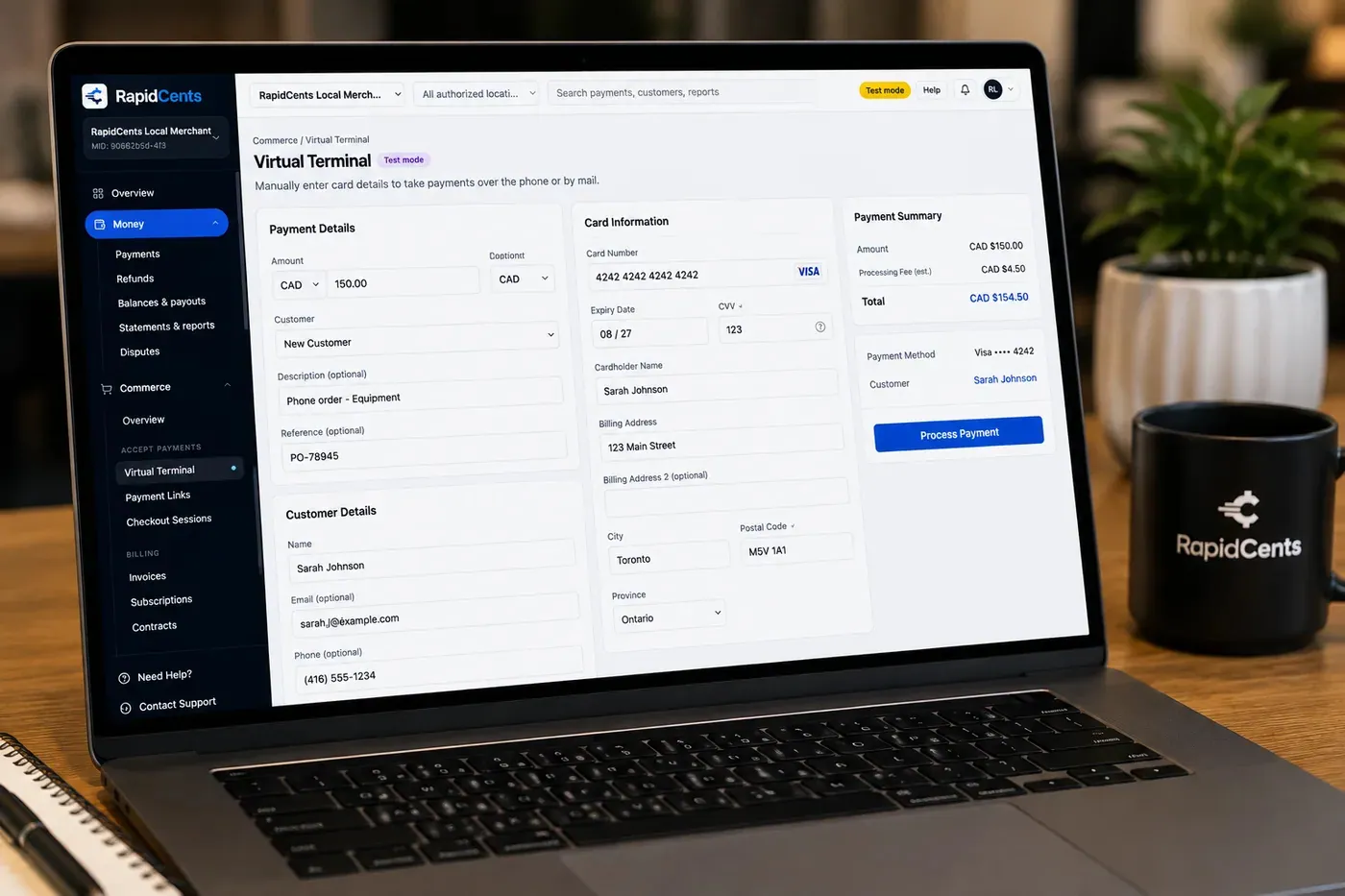
The RapidCents virtual terminal: payment details, card number, expiry and CVV keyed by hand on the left, with a payment summary on the right showing the amount, the estimated processing fee and a Process Payment button. Virtual Terminal
The RapidCents virtual terminal lets authorized staff enter mail-order and telephone-order payments through a…
Explore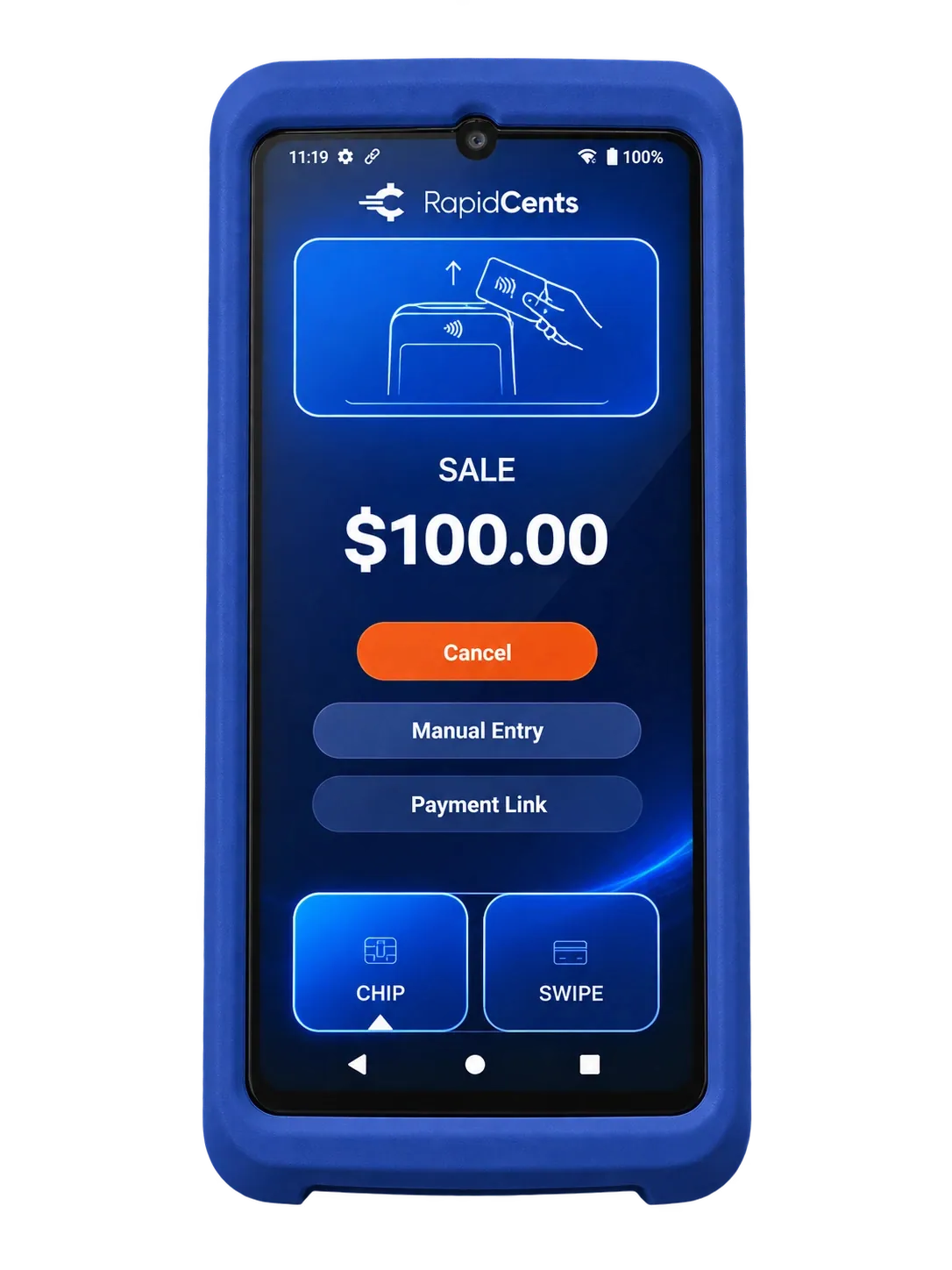
The RapidCents Rivo Go standing upright in its blue silicone case, showing the full-touch sale screen a customer reads across the counter. Payment Terminals
RapidCents payment terminals cover countertop, mobile and smart form factors so you can accept chip…
Explore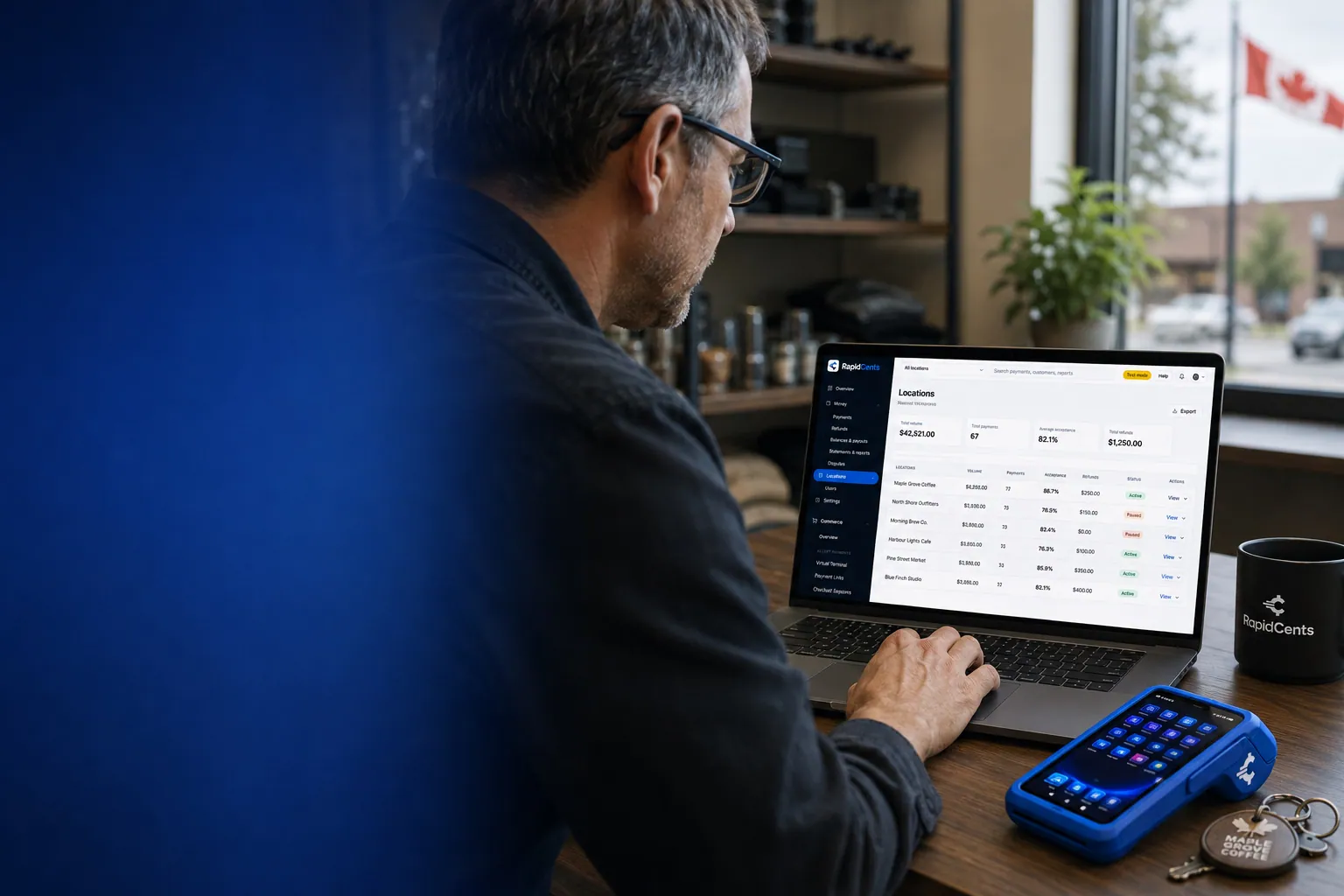
One RapidCents account comparing sales across locations, with a terminal representing the store-level capture. Multi-Location
RapidCents multi-location tools organize stores, franchises and regions in a hierarchy with location-level…
Explore


What does hotel folio payment integration involve?
Hotel folio payment integration means every card payment, hold and refund lands on the right guest folio in your PMS without being keyed twice. With a gateway or API connection, the transaction posts to the folio with its reference. Without one, staff take payment on a standalone terminal or link and post it to the folio by hand, which works but adds a step the night audit must check.
Integrated or standalone at the front desk
An integrated setup sends the amount from the PMS to the payment device and writes the approval back to the folio, so the desk never retypes totals. A standalone setup puts a RapidCents terminal or the Virtual Terminal beside the PMS: quicker to start, but each payment is entered twice and a mistyped amount surfaces only at night audit. Your representative will show you which fits your PMS.
Routing charges to the right folio
Many stays need more than one folio: an OTA virtual card pays the room while the guest's card covers incidentals, or an employer pays the room and the employee pays meals. When someone other than the guest pays, send that cardholder a payment link instead of collecting an emailed authorization form with card digits, so the card never sits in an inbox. Take a separate hold or payment for each folio.
Outlet charges and room posting
Restaurant, bar, spa and parking charges either post to the room through your POS-to-PMS interface or are paid on the spot. A room charge waits on the folio until checkout. An outlet payment is charged at the table or counter, so it must not also be posted to the room, or the guest pays twice. By the pool, a Rivo terminal with an active SIM can move the sale onto cellular when the Wi-Fi does not reach.
Refunds and adjustments after checkout
When a guest questions a charge after checkout, such as a minibar item, adjust the folio in the PMS and refund the same amount to the original card. With a connected PMS the refund can start from the PMS; without one, refund it in RapidCents and note the transaction ID on the folio. Refunding to a different card leaves the original charge open to a dispute.
Night audit against the card report
The night audit closes the business day in the PMS, and its card totals should match the RapidCents transaction report for the same cut-off time. Common causes of a difference are a standalone payment never posted, a refund done in one system only, or mismatched cut-off times. Know the settlement cut-off on your account and clear differences daily rather than at month end.
A wedding block of 20 rooms
Say a couple books a block of 20 rooms and a Saturday reception. The planner signs the contract and pays the first deposit through Contracts & eSignatures, and a payment link collects the second deposit a month before arrival. Rooms and the banquet route to a master folio, while each guest leaves a card for incidentals on their own folio. After the event, Invoicing sends the master folio balance, and every payment carries the group's folio number for the night audit and accounts receivable.
What drives hotel credit card processing fees?
Hotel credit card processing fees depend mostly on your guests' card types and on how each card is taken: tapped at the desk, keyed for a phone booking or charged online. RapidCents prices on interchange-plus: interchange on each deposit, capture and folio payment is set by the card networks and passes through at cost, plus your RapidCents markup shown in your Fee Schedule, and fees for equipment or services, if applicable. The agreement is month to month with no fixed term.
Your guests' card mix
Hotel guests often pay with premium rewards and corporate cards, which usually carry higher interchange than standard consumer debit. Virtual cards from online travel agencies are commercial cards with their own interchange categories, and cards issued abroad are priced differently again. Your own statements show the real split, and it can shift by season as your mix of leisure, business and international guests changes.
How each payment is taken
A card tapped or inserted at the front desk usually qualifies for lower interchange than the same card keyed for a phone booking, entered on a booking page or charged from an OTA extranet. Because hotels take many payments without the card present, the split between desk, online, phone and virtual-card payments matters as much as the card types themselves.
Holds, voids, refunds and disputes
One stay can involve several transactions: a hold at check-in, another when the stay is extended, a void when a guest cancels, a refund for a deposit. Your Fee Schedule sets out how authorizations, voids, refunds and chargebacks are charged. Count your dispute volume too, since no-show and late-charge disputes also cost staff time and, when lost, the revenue itself.
Total cost beyond processing
Add up everything the payment setup costs: desk and outlet terminals, any equipment or service fees in your Fee Schedule, gateway or PMS payment-interface fees charged by other vendors, and the hours spent posting standalone payments and chasing differences at night audit. If you rent terminals today, check the remaining term and return conditions before you switch.
Settlement by property
With Multi-Location, each property can settle under its own merchant ID, so bank deposits arrive hotel by hotel, with transaction, settlement and fee reports for each property and a roll-up for the group. Deposit timing depends on your account and your bank, so plan cash flow on the schedule set out in your agreement.
What to bring for a like-for-like comparison
Bring three recent processing statements for each property, your split between desk, online, phone and OTA virtual-card payments, your average folio, and your refund and chargeback counts. Upload a statement to Fee Check to see interchange separated from markup, then compare written quotes for hotel merchant services on that same card mix rather than on a headline number.
Software compatibility: OPERA Cloud, Cloudbeds, Mews, Stayntouch and roommaster
RapidCents integrates with many major platforms through APPIE and RapidBridge, and the right option depends on your PMS, its edition and your country. Your RapidCents representative walks you through the route for each system: a gateway such as Fusebox, an API connection to the RapidCents Payment Gateway, a terminal or payment link beside the PMS with manual folio posting, or a settlement export you import. Each route changes how much your staff key by hand.
OPERA Cloud
OPERA Cloud is Oracle's cloud PMS for reservations, folios and the night audit. If your property already routes cards from OPERA Cloud through Fusebox, tell your RapidCents representative your OPERA Cloud version and they will walk you through the setup, including a hold, a capture and a refund tested before you go live. If it does not, they will show you which other route fits your edition.
Cloudbeds
Cloudbeds combines a PMS, booking engine and channel manager, and also offers its own payment service, Cloudbeds Payments. RapidBridge works with Cloudbeds, so a RapidCents card payment posts inside the system you already use, without changing it. Your RapidCents representative will walk you through the setup for your plan and country, with payment links and terminals beside the PMS wherever you want them.
Mews
Mews is a cloud PMS that offers its own payment product, Mews Payments. RapidBridge works with Mews, so RapidCents payments run inside the software your team already knows. Your RapidCents representative will walk you through how incidental preauthorizations and stored cards are handled for your Mews edition and country, and how it fits beside Mews Payments if you use both.
Stayntouch
Stayntouch is a cloud PMS with mobile and self-service check-in options, so guests may enter card details on a phone or kiosk instead of at a desk terminal. That makes advance deposits and stored-card authorization the key questions. RapidCents integrates with many major platforms through APPIE and RapidBridge; your representative will walk you through the best route for your Stayntouch setup.
roommaster
roommaster is an all-in-one hotel PMS covering reservations, folios and the night audit. RapidCents integrates with many major platforms through APPIE and RapidBridge, and the right option depends on your roommaster version and how it charges OTA virtual cards. Your RapidCents representative will walk you through it, and RapidCents terminals and payment links work beside the PMS from day one.
Accounting: QuickBooks Online, Xero and larger ERPs
After the PMS, payment data flows to the back office. For hotels on QuickBooks Online or Xero, RapidCents connects settled transactions, fees and refunds to those ledgers; hotel groups running SAP or NetSuite import settlement files. Decide whether revenue is booked from the PMS with only deposits and fees coming from RapidCents, and your representative will set up the mapping to match.
Hotel payment options by country
The payment methods a hotel can offer depend on the country of its merchant account. RapidCents serves merchants in Canada and the United States: card acceptance at the desk, online booking payments, payment links and invoices are the common core, while the debit network, bank-payment options and settlement currency follow the account's country. Your representative will show you what your account offers.
Cards issued abroad
Visa, Mastercard and American Express cards issued in other countries can be accepted at the desk and online, and cross-border cards sit in their own interchange categories. If guests ask to pay in their home currency, your RapidCents representative will walk you through the International Payments options on your account before you offer it at the desk.
Bank payments and settlement currency
Group, corporate and direct-bill invoices can often be paid by bank transfer, but which bank-payment methods exist, and the currency your deposits settle in, depend on the country of your merchant account. Check both before you put payment instructions on a group contract or invoice.
Taxes stay in the PMS
Accommodation and tourism taxes differ by location and are calculated by your PMS, not by card processing. The payment record carries the folio total that includes them, and filing and remitting stay with your accounting team and advisers.
How do you switch a hotel's payment processor without disrupting arrivals?
Switch a hotel's payment processor in planned stages, not all at once. List every stored card, open deposit and future charge on the old account, and test holds, captures, refunds and deposit links on the new setup. Then move new bookings and arrivals first while the old account finishes what it started, and reconcile both accounts against the night audit every day until the old one has nothing left to settle, refund or dispute.
Take inventory before anything moves
List the cards stored on future reservations, advance deposits not yet applied, refunds still owed, open group master folios, unpaid direct-bill invoices, OTA virtual cards not yet charged and any long-stay billing schedules agreed with guests. Note which system holds each one. Once your account is approved, that list sets your cut-over date and what the old account must still handle. A franchised hotel should also check what its brand standards say about payment providers.
Saved cards and old deposits
Card tokens stored on future reservations stay with the provider that created them, so they move only if both providers agree on a supported migration; plan as if they will not. For future reservations that relied on a stored card, take a deposit by payment link before arrival, or take a new card at check-in. Keep the old account open until every deposit it took has been applied or refunded to the original card.
Test before arrivals depend on it
On each PMS and terminal combination you use, run a preauthorization, a capture, a void, a refund, a deposit by payment link and a keyed card-not-present payment. Check that each transaction shows its reservation or folio reference in RapidCents reporting before live traffic moves, and give front desk and night audit staff the new steps in writing.
Permissions and refunds after go-live
Decide who can refund, void, key a card or release a hold, and set those rights per user before go-live; the Virtual Terminal records each action in an audit log you can export. Refunds of payments taken on the new account go back through RapidCents to the original card, while refunds of older deposits stay with the previous processor.
Reconcile until the old account is empty
During the overlap, compare each business day's PMS card totals with both providers' settlement reports and the bank deposits, keeping fees, refunds and chargebacks as separate lines. Chargebacks can arrive months after a stay, so close the old account only when nothing is left to settle or refund and its dispute window has passed.
Rolling out across several properties
For a hotel group, move one property first and confirm its night audit ties out through a full month-end close before the others follow. Multi-Location gives each hotel its own merchant ID and permissions, and roll-up reporting lets the head office compare deposits, refunds and disputes across properties.
Payment questions from hotels
What should a hotel compare before choosing a payment processor?
Compare how each provider handles your real stay cycle, not a headline price. Look at how it connects to your PMS, edition and country; a live demonstration of a hold, capture, void and refund, on Fusebox if you use it; how OTA virtual cards and advance deposits are taken; how pricing is built and whether there is a fixed term; settlement reporting by property; dispute tools; and, if you are franchised, what the brand allows. The best credit card processing for hotels is whichever setup passes those checks for your property, so compare written quotes against your own statements.
How much does payment processing cost for a hotel?
Hotel payment processing costs depend on your guests' card types and how each card is taken, so no single figure fits every hotel. With RapidCents you pay interchange at cost, which varies with the card type and with whether it is tapped at the desk, keyed for a phone booking or charged online, plus your RapidCents markup shown in your Fee Schedule, and fees for equipment or services, if applicable. The agreement is month to month. A high share of premium, corporate, virtual or foreign-issued cards and remote bookings raises interchange. Upload a recent statement from your property to Fee Check to see your own split.
Does RapidCents support Fusebox for my hotel and PMS?
Yes. RapidCents supports Fusebox, Elavon's payment gateway for hospitality, with payment tracking, refunds and reporting in the RapidCents dashboard. Fusebox is a gateway, not a PMS, so the setup depends on your PMS and version. Tell your RapidCents representative which PMS you run and how it connects to Fusebox today, and they will walk you through it, including a test of each payment type before you go live.
How does hotel payment processing with Fusebox work day to day?
Front desk staff keep working in the PMS while Fusebox carries each payment request to card processing. The desk or booking flow asks for a preauthorization, capture or refund, the PMS sends it through Fusebox, and the result returns to the folio. The transaction also appears in the RapidCents dashboard for tracking, refunds and reporting, and the guest sees an ordinary card payment. Before go-live, your representative tests each payment type on your configuration with you and agrees a fallback for when the gateway is unreachable, such as a standalone terminal with manual folio posting.
How do hotel payment options differ between Canada and the United States?
The local debit network, the bank-payment method for group and corporate invoices and the settlement currency differ between Canada and the United States, because each follows the country of your merchant account. Card acceptance works much the same in both: credit and debit cards at the desk, card-not-present payments for bookings and OTA virtual cards, and payment links for deposits. Your RapidCents representative will set up the methods that fit your property.
What setup is needed for hotel folio payment integration?
You need a connection between your PMS and the payment side, through a gateway such as Fusebox or an API integration, and desk terminals that fit it. Then map payment types and reference fields so each transaction carries the reservation or folio number, decide how holds, deposits and refunds post, and set staff permissions. Your representative walks you through each step. Until the connection is live, payments run on standalone RapidCents terminals or payment links, and staff enter them on the folio themselves.
How should a hotel manage incidental preauthorizations?
Write one hold policy and apply it the same way on every shift. Set how the hold is sized, who may change or release it and who may accept debit for incidentals; record the approval code against the reservation; and authorize more before an extension or large charge exceeds the hold. When an authorization declines, ask for another card or take incidentals as a payment to refund at checkout, and note it on the reservation. At checkout, capture the folio total or void the hold if nothing is owed.
Can one platform handle advance deposit payment links and OTA virtual card payments?
Yes. RapidCents Payment Links collect advance deposits by email, SMS or QR code, and the Virtual Terminal charges OTA virtual cards as card-not-present payments, so both appear in the same RapidCents reports. With a connected PMS both post to the same reservation; without one, staff record each payment on the folio with the confirmation number. Charge each virtual card only within the dates and amount the travel agency allows.
How do we reconcile card payments and bank deposits for a hotel?
Reconcile card deposits in three steps: PMS to transactions, transactions to settlement, settlement to bank. First match the night audit's card totals to the RapidCents transaction report for the same cut-off, using the reservation or folio reference and the transaction ID. Then match each settled batch, with refunds, chargebacks and fees as separate lines, to the property's bank deposit. Reports export as CSV or PDF, and settled transactions, fees and refunds connect to QuickBooks Online or Xero; SAP and NetSuite import settlement files.
How do we switch payment providers without losing saved cards or disrupting Fusebox?
Assume saved cards will not move, and plan around your reservations. Tokens stay with the provider that issued them unless both providers agree to a supported migration, so ask guests with future stays for a deposit by payment link before arrival, or take a new card at check-in. If you use Fusebox, your representative walks you through the setup for your PMS version, tests every payment type with you, moves new bookings on a set date, and the old account stays open until its deposits, refunds and disputes are finished.
What MCC is used for hotels?
MCC 7011, lodging, is commonly associated with hotels, motels and resorts. During onboarding, RapidCents sets the right merchant category for your property based on what it actually sells, whether that is rooms alone or rooms with a restaurant, spa or shop. If an outlet runs as a separate business with its own sales, tell your representative and they will advise whether it should have its own merchant account.
Related hospitality industries
A hotel's restaurant, bar and banquet business runs on the same tabs, tips and event deposits as a stand-alone restaurant, bar or caterer, and campgrounds and RV parks take reservation deposits much like a hotel. Those industries go deeper on their own workflows, while for a hotel it all comes down to the stay, the folio and the PMS.
Restaurants
Close bills at the table, split them across cards, settle tips before staff clock out and…
Fast Food & QSR
Card payments for fast food and QSR operators: countertop and mobile terminals, Tap to…
Food Trucks
Mobile terminals with LTE and Wi-Fi for the window, Tap to Pay on a phone for the queue…
Catering
RapidCents helps caterers take the booking deposit by payment link, invoice the event…
Cafés & Bakeries
Take tap payments in the morning rush, collect deposits on cake and pickup orders, and…
Bars & Nightclubs
Open tabs on a held card, take payments on the floor with a handheld, adjust tips at…
Breweries & Wineries
Take cards at the taproom bar, the tasting room and the farmers market, bill wine and…
Ghost Kitchens
Take direct online orders, run several virtual brands off one line and read each brand's…
Take the next step
Check what your hotel pays before you compare quotes
Upload a recent processing statement from your property and Fee Check separates interchange from markup, so you can compare quotes on your real mix of desk payments, bookings, OTA virtual cards and refunds.
- No obligation
- Payment specialists, not a call centre
- Secure statement upload