Staged contract payments for solar installers
A solar contract is paid in stages: deposit, equipment, installation, commissioning, usually running alongside a financing or rebate application. RapidCents keeps the signed agreement and its schedule together with contracts and eSignatures, invoices each stage as it is reached, sends payment links for the smaller amounts, and takes the large ones by ACH or ACH so a five-figure milestone is not sitting on a card limit. Solar installers process under MCC 1731.

- PCI DSS Level 1
- SOC 2 Type II
- All major card brands: Visa · Mastercard · Amex · Discover · PIN debit
- Interchange-plus available
- Specialist onboarding support
Operational workflows
Roof assessed and the array sized in a proposal
Contract signed electronically with the deposit
Equipment and installation stages invoiced separately
Final stage released at commissioning
Payment challenges
Milestones stretched across months
Deposit, panels, install and commissioning are four separate collections on one contract, and each has to stay traceable to the same system.
Amounts above any card ceiling
A full array costs more than a homeowner can put on a card, so the equipment stage usually moves to a bank transfer.
Paperwork sitting between stages
Homeowners wait on a financing or rebate decision before funding the next milestone, leaving a signed contract with an unpaid stage in the middle.
Choose the right payment setup for Solar Installers
Choose solar installer payment processing
For Solar Installers, map the deposit, staged payments, and final balance, online checkout and remote payment, and the sale and reconciliation with business systems before choosing a setup. Select channels that match those moments, then confirm that the chosen solution genuinely covers each channel.
Payment hardware for Solar Installers
For Solar Installers, physical hardware may be secondary to the checkout flow. Prioritize gateway or payment-page requirements first, then add a terminal only when an in-person payment point is genuinely needed.
Compare payment processing fees
For Solar Installers, request a written fee breakdown covering deposits and final balances and online checkout and dispute handling. Compare the effective cost across the real card and channel mix; do not choose on a headline rate alone.
Set up or switch Solar Installers payments
To set up Solar Installers payments, document how payment data moves into business systems and the checkout, confirmation, and refund path, confirm compatibility before purchase, then test a real payment flow before going live.
Recommended products
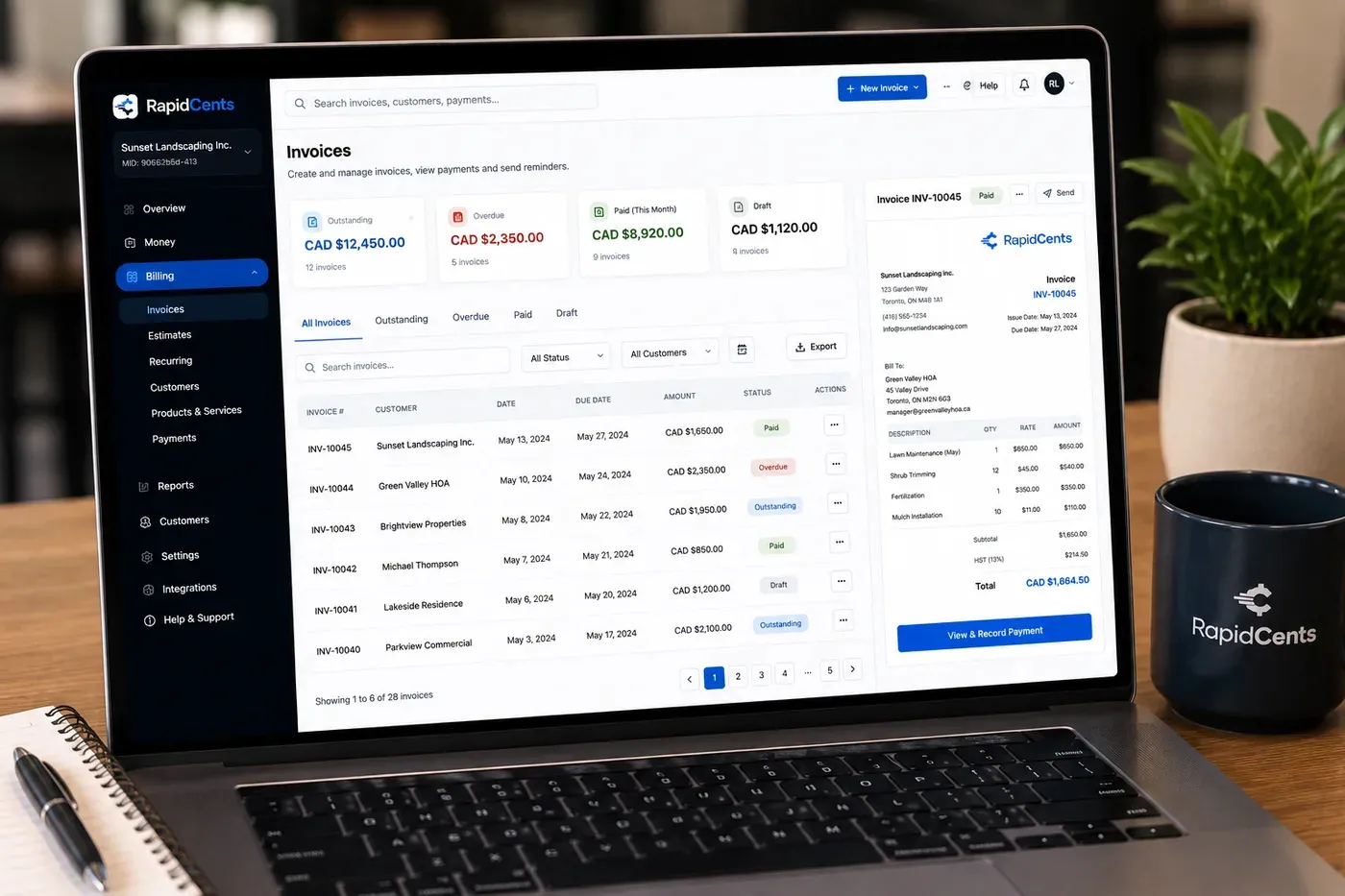
The RapidCents invoices screen: outstanding, overdue, paid and draft totals across the top, the invoice list below them, and a preview of one invoice on the right with its line items and a View & Record Payment button. Invoicing
RapidCents invoicing helps professional services, contractors and B2B suppliers create branded invoices…
Explore
The RapidCents payment links screen listing created links with their amount, status, click count and whether they have been paid, beside a phone showing the branded page a customer opens to pay $2,500.00. Payment Links
RapidCents payment links let staff generate branded pay-by-link URLs for invoices, deposits, balances and…
Explore
A merchant invoices a customer for bank debit through RapidCents, with card terminal capture available on the same desk. ACH / Bank Payments
Bank payments suit recurring and high-value invoices where card fees are the wrong tool. Collect directly…
Explore
A merchant sends a RapidCents contract for e-signature with payment attached, terminal ready for an in-person counterpart. Contracts & eSignatures
Quotes, service agreements and enrolment forms usually end in a payment. Send the document, capture the…
Explore


How this gets set up
Design signed with its payment schedule
The system design and its price are signed with contracts and eSignatures, and the stage schedule is part of the document the homeowner signs rather than a separate email.
Deposit releases the equipment order
A payment link covers the deposit, which is what lets the panels and inverter be ordered against the signed design.
Milestones invoiced, large balances by ACH
Equipment, installation and commissioning are invoiced as each is reached, and the big amounts settle by ACH or ACH so a five-figure stage is not sitting against a card limit.
Commissioning closes the contract
The final stage is billed once the array is energized and the utility and rebate paperwork is filed, so the last invoice matches the real completion date.
Integrations
Aurora Solar exports
Aurora Solar exports carry the system design, production estimate and proposal out as a file that the contract and its deposit are priced from; it is an export, not a live feed.
Jobber
Jobber schedules the crews and site visits, so the installation-stage invoice is raised against the same job the crew actually completed.
Sage
Sage is where settled milestones are recognized in the ledger, which is how a staged contract is spread across periods instead of landing as one sale.
Operations, security and going live
A contract read as a schedule
Reporting shows each contract's stages billed and still outstanding, so a job stalled between equipment and installation is visible before the quarter closes.
Bank payments for what a card cannot carry
Milestone amounts in the tens of thousands move by ACH or ACH, and reconciliation matches each bank credit to its milestone invoice rather than to a day's batch.
Lender money kept apart from yours
When a homeowner finances, what you invoice them directly changes; keeping the signed schedule and your invoices on one record separates what the customer owes you from what a lender pays.
Proven on one contract first
The eSignature template, the milestone invoices and the bank payment path are run end to end on a single job before the whole pipeline moves across.
Payment questions from Solar Installers
What should businesses compare when choosing solar installer payment processing for Solar Installers?
Compare solar installer payment processing against the real payment journey: the deposit, staged payments, and final balance, online checkout and remote payment, and the sale and reconciliation with business systems. Start with the required channels and hardware, then confirm compatibility and support before committing.
What payment hardware is practical for Solar Installers?
If Solar Installers sells primarily online, do not choose physical hardware before validating checkout. Add hardware only for a clearly defined in-person payment need.
Which payment channels are relevant for Solar Installers?
For Solar Installers, start with the deposit, staged payments, and final balance, online checkout and remote payment, and the sale and reconciliation with business systems. Keep only the channels that match those moments, then verify the complete customer flow before offering them.
How should payment processing fees be evaluated for Solar Installers?
For Solar Installers, compare costs related to deposits and final balances and online checkout and dispute handling using actual transactions. Request a written breakdown of fees and terms rather than relying on an advertised rate alone.
What should be confirmed before setting up payments for Solar Installers?
For Solar Installers, document how payment data moves into business systems and the checkout, confirmation, and refund path, verify the needed compatibility, and test the flow before going live. This exposes manual steps and exceptions before customers encounter them.
How should deposits and high-value payments be planned for Solar Installers?
Separate the deposit, staged payments, and final balance in the process. Confirm the authorization and refund rules that apply to the business before communicating terms to a customer.
What MCC category applies to Solar Installers?
MCC 1731 is commonly associated with Solar Installers. Our onboarding team confirms the correct category for your business.
Related industries
HVAC Contractors
HVAC companies collect estimate deposits, final job payments and maintenance plan billing…
Plumbing Contractors
Plumbers accept emergency call payments, job deposits and final invoices on-site with…
Electricians
Electrical contractors capture deposits before ordering materials and collect completion…
Construction Contractors
General contractors progress-bill milestones, retainage and change orders with secure B2B…
Home Services
Home service businesses collect payments in the field with Tap to Pay, payment links and…
Landscaping
Landscapers bill seasonal contracts, take spring deposits and accept on-site payments for…
Cleaning Services
Commercial and residential cleaners run recurring contracts, one-time deep cleans and…
Roofing Contractors
Roofers quote a job, take a deposit to schedule materials, then collect the balance on…
Take the next step
Talk to a RapidCents specialist
RapidCents Fee Check reads a processing statement and shows interchange separately from the markup. Upload a statement for an instant breakdown, or open a merchant account and start accepting payments on one account.
- No obligation
- Payment specialists, not a call centre
- Secure statement upload