


Payment processing for tattoo and piercing studios
Tattoo studio payment processing means taking a booking deposit before the session, collecting the balance when the work is done, and reporting each artist's takings separately. RapidCents sends deposits as payment links, accepts the balance by payment terminal or Tap to Pay, and records refunds and tips by transaction, so each sitting ties back to its artist.

- PCI DSS Level 1
- SOC 2 Type II
- All major cards: Visa, Mastercard, Amex, Discover, UnionPay, Diners Club & PIN Debit
- Interchange-plus available
- Specialist onboarding support
How tattoo and piercing studios get paid
A studio gets paid in four steps: a deposit that holds the session, a balance at the end of the sitting, a piece paid across several visits, and a record that shows what each artist took. Each step uses a different RapidCents tool.
Booking deposit
A client books a session and pays a deposit to hold the artist's time. Staff send a payment link by SMS or email, the client pays on a phone, and the studio keeps a receipt tied to the artist and date. If a client pays late, the slot stays open until the deposit lands.
Balance at the chair
When the sitting ends, the client pays what remains, plus any tip, at the counter. Tattoo artist card payments run on a tattoo shop credit card terminal or with Tap to Pay on a phone. If the design price changed during the session, the studio agrees the final amount with the client before charging.
Multi-session projects
A back piece or sleeve takes several visits. The studio agrees a schedule with the client, then collects a payment at each sitting or sends a link for each stage. If a client misses a visit, the policy they accepted at booking decides what happens to the deposit.
Artist and guest reporting
The owner needs to know what each resident or guest artist took in. Reporting groups transactions by artist, location and date, with refunds and fees shown separately. Finance exports the file at month end and matches it to commission and rent records.
How do tattoo studios take session booking deposits?
A tattoo studio takes a session booking deposit by sending the client a payment link when the date is agreed. Tattoo appointment deposit payments are made by card on the client's own phone, and the amount is recorded against the artist. Tattoo deposit payment links keep card details off chat threads and sticky notes.
How the deposit runs
Staff confirm the date, artist and design brief, then send a Payment Link by SMS or email. The client pays, both sides get a receipt, and the studio marks the slot held. If the client is in the shop, the same deposit can be taken on a terminal instead.
Set up the deposit terms first
Write the deposit policy where the client sees it before paying: the amount, whether it is non-refundable, what happens on rescheduling, and how it is applied to the final price. Keep a copy of the accepted terms with the booking so you can answer a later dispute.
A $600 forearm piece, deposit first
Say an artist quotes a forearm piece at $600 total and asks for a $100 deposit. The studio sends a link, the client pays, and the receipt is filed with the booking. On the day, the studio charges the remaining $500 plus any tip as a separate sale.
What are the rescheduling and refund rules for tattoo deposits?
Rescheduling and refund rules are set by your studio, not by the card networks. Write them down, show them before the deposit is paid, and apply them the same way every time. RapidCents then records a refund, a transfer to a new date or a forfeited deposit as a clear transaction.
Cover the usual cases
Decide in advance what happens when a client reschedules with notice, cancels, no-shows, or the artist cancels. Many studios move the deposit to the new date for the first change and keep it afterward. Whatever you choose, apply the rule the same way to every client.
Refunds and disputes
When a refund is due, issue it from the Merchant Dashboard against the original payment so the record matches. If a client disputes a deposit, you respond with the accepted terms, the booking and the receipt. Our dispute tools track the deadline and the evidence you send, and the card issuer decides the outcome.
A $150 deposit, moved once and then forfeited
Say a client pays a $150 deposit, then reschedules once with notice. The studio keeps the deposit on the booking and makes no new charge. When the client no-shows the second date, the studio follows its written policy and logs the forfeited deposit.
RapidCents products for tattoo and piercing studios
Piercing studio payments and tattoo sessions share these tools. They cover the deposit, the balance and the month-end record: Payment Links for booking deposits, Payment Terminals and Tap to Pay for the counter and the chair, and Reporting for artist-level reconciliation.

The RapidCents payment links screen listing created links with their amount, status, click count and whether they have been paid, beside a phone showing the branded page a customer opens to pay $2,500.00. Payment Links
RapidCents payment links let staff generate branded pay-by-link URLs for invoices, deposits, balances and…
Explore
A café worker holds a phone running RapidCents Tap to Pay, showing an $18.75 sale and the contactless symbol, while a customer holds a Visa card to the screen. No separate card reader is present. Tap to Pay
RapidCents Tap to Pay turns supported iPhones and Android devices into contactless payment terminals without…
Explore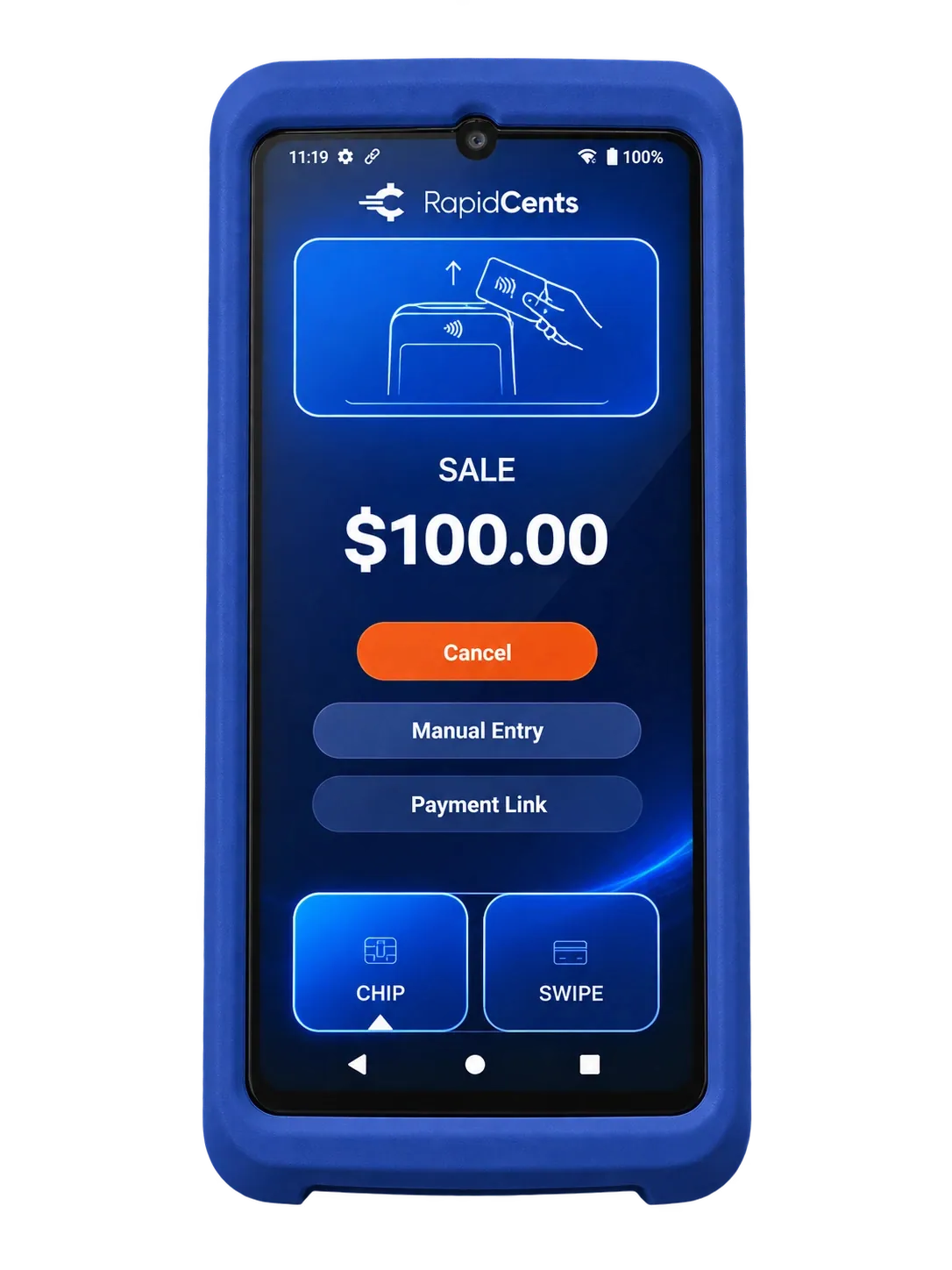
The RapidCents Rivo Go standing upright in its blue silicone case, showing the full-touch sale screen a customer reads across the counter. Payment Terminals
RapidCents payment terminals cover countertop, mobile and smart form factors so you can accept chip…
Explore
A merchant reviews RapidCents reports for volume, mix and payouts, with the terminal that took the sales on the desk. Reporting
RapidCents reporting delivers customizable transaction, settlement and fee reports with CSV and PDF export…
Explore


How do studios collect multi-session project balances?
A studio collects a multi-session project balance by agreeing a schedule with the client and charging at each sitting or by link at each stage. Tattoo session balance collection stays a plain collection schedule, never a loan.
Choose how each visit is paid
For a sleeve or back piece, most studios take payment at each sitting on a terminal. Where a client lives far away or books by stage, a payment link works instead. A card saved for later charges needs the client's authorization before you use it.
Handle changes and gaps
Pieces change size and clients skip months. Record any price change with the client before the next sitting, and keep a running balance in your booking software. If a charge is declined, contact the client for another card rather than retrying without telling them.
A $2,400 sleeve over four sittings
Say a $2,400 sleeve is agreed across four sittings of $600 each. The client taps a card at each visit and the balance falls. After the third sitting, the client pauses for a month, and the studio resumes the schedule at the next booking.
How do you compare tattoo studio processing fees and total cost?
Compare fees by pricing your real payment mix: how many deposits, balances and tips you take, by card type and channel. RapidCents prices on interchange-plus, with interchange at cost, your RapidCents markup in your Fee Schedule, and fees for equipment or services if applicable. It is month to month with no fixed term.
What drives the cost
Interchange varies with the card type (debit, credit, premium or commercial) and with how the card is taken. A tapped or inserted card is a different case from a keyed or online one, so a studio with many deposit links has a different mix than a walk-in shop.
What to bring for a comparison
Collect recent processing statements, your average ticket for deposits and balances, the split between in-person and link payments, and your refund and dispute volume. Upload a statement to Fee Check to see interchange separated from markup, then compare written quotes.
Equipment and services
Ask whether a terminal is bought or rented, whether any monthly or service fees apply, and what happens if you close or move the studio. Your Fee Schedule shows the markup and the fees that apply, and your RapidCents representative will go through it with you before you sign.
Which booking and accounting software works with RapidCents?
RapidCents integrates with many major platforms through APPIE and RapidBridge, and settled transactions, fees and refunds flow to QuickBooks Online and Xero. Which option fits your studio software depends on the vendor and version, and your RapidCents representative will walk you through it.
TattooPro and Tattoogenda
These tattoo-specific tools hold bookings, deposits and client records. Tell your RapidCents representative which one you run, and they will show you how payments connect, whether through APPIE and RapidBridge, a payment link or a file export, so deposits and balances land where your records are.
Porter, Booksy and Fresha
RapidBridge works with Fresha, so a card payment posts against the booking you already have open. Porter and Booksy may bundle their own payment option or name a gateway, and your RapidCents representative will explain how RapidCents sits inside or beside them for your version.
QuickBooks Online, Xero, SAP and NetSuite
Settled transactions, fees and refunds map to QuickBooks Online and Xero, and SAP and NetSuite import settlement files. Reporting exports CSV and PDF files for your bookkeeper, so month-end matching starts from clean records.
Payment options for tattoo and piercing studios by country
RapidCents serves merchants in Canada and the United States. Which card types, bank payment options and settlement currency a studio uses depends on the country of its merchant account. Your RapidCents representative walks you through what is enabled before you plan your deposit and balance flow.
Cards and links
Major card brands can be taken at the counter on a terminal or Tap to Pay, and online by payment link. Which brands and debit types are supported depends on your account.
Bank payments and settlement
Bank payment options for larger project balances differ by country, and so does the currency in which funds settle. Your RapidCents representative explains what is enabled on your account.
What is the checklist for switching payment providers?
Once your account is approved, switch in an orderly sequence: list what you have, test the new setup, run both for a short period, then reconcile. Do not move live traffic until a sale, a refund and a deposit all match your records. Stored card details need both providers to agree before they can move.
Inventory what you hold
List open deposits, clients with saved cards, recurring schedules, unpaid balances and every terminal. Note which booking tool sends payment links. Saved card details may need a vendor-controlled move, or the client may need to authorize the card again.
Test before you commit
Run a small sale, a refund and a deposit link on the new account and check that they land in your reports and bookkeeping. Keep the old setup running for a short period so a missed link or declined card does not stall a booking.
Reconcile each artist
Map payment references to artist, client and date. Compare the settlement report with your ledger, then check each artist's totals against commission or booth rent. Fix any gaps in the first month so your records stay clean.
Payment questions from tattoo and piercing studios
How should a tattoo studio handle session booking deposits?
Take the deposit by payment link when the date is agreed, and show the deposit terms before the client pays. The client pays on their phone, the studio receives a receipt, and the amount is recorded against the artist. Keep the accepted terms with the booking, say how the deposit applies to the final price, and refund through the original payment.
How should a studio handle rescheduling and refund rules?
Write the rules down and show them before the deposit is paid. Say what happens when a client reschedules with notice, cancels, no-shows, or when the artist cancels. Apply them the same way each time. RapidCents records each refund against the original payment, but it does not set your policy or decide who is owed a refund.
How can a studio collect multi-session project balances?
Agree a schedule with the client, then charge at each sitting on a terminal or send a payment link for each stage. A card saved for later charges needs the client's authorization covering amount, timing and cancellation. The schedule is a collection schedule, not a loan, and RapidCents does not lend to your clients.
How should a studio report guest artist payments?
Run each guest artist's sales through the same account and tag them by artist, so reports group takings by person and date. Refunds and fees show separately. Export the report for your bookkeeper and match it against the guest's agreed split or booth fee. Your RapidCents representative sets up artist-level tagging on your account.
Which payment options can a tattoo or piercing studio offer?
A studio can offer major cards at the counter and card payments by payment link for booking deposits. Bank payment options and the settlement currency depend on the country of your merchant account, since RapidCents serves merchants in Canada and the United States. Your RapidCents representative will walk you through what is enabled before you set your deposit policy.
How do studios reconcile artist commissions with card payments?
Match each settled transaction to the artist, then apply your commission or rent terms to the net amounts in the report. Reporting exports CSV and PDF files, and RapidCents maps settled transactions, fees and refunds to QuickBooks Online and Xero. Your RapidCents representative will show you how it fits your edition and bookkeeping.
Which payment processor suits tattoo and piercing studios, and what should we compare?
The right choice depends on your deposit flow, hardware, reporting and software. Compare written quotes on your real payment mix. Ask about interchange versus markup, equipment and service fees, artist-level reports, how refunds are handled, contract length and support. RapidCents prices on interchange-plus, month to month, and Fee Check reads your statement.
What fees should a tattoo studio expect for in-person and online card payments?
Expect interchange, which varies by card type and by how the card is taken, plus your RapidCents markup in your Fee Schedule, plus equipment or service fees if applicable. Keyed and online payments are priced differently from tapped or inserted ones. Upload a statement to Fee Check to see interchange separated from markup.
Can we use RapidCents with TattooPro or Tattoogenda?
RapidCents integrates with many major platforms through APPIE and RapidBridge. The right option for TattooPro or Tattoogenda depends on your vendor and version. Tell your RapidCents representative which one you use, and they will show you how deposits, balances and receipts connect, whether through a payment link, a file export or a direct connection.
How can a studio reduce payment disputes and protect stored card details?
Show the deposit and refund terms before payment, send receipts, and keep the booking and consent on record. Saved cards are kept as tokens in the Secure Card Vault, and you limit which staff can see or charge them. RapidCents offers dispute tools, but no outcome is promised.
How can a studio switch payment providers without losing billing records?
List open deposits, saved cards, unpaid balances and terminals, then test a sale, a refund and a deposit link on the new account. Run both setups together for a short period. Saved card details may need a vendor-controlled move or fresh client authorization, so ask both providers early.
What MCC is used for tattoo and piercing studios?
MCC 7299 is commonly associated with this type of business. Your RapidCents representative sets the correct merchant category during onboarding, based on what your studio actually sells, such as tattoo work, piercing and related services. If your studio also sells retail items, mention them so the category fits your whole mix.
Related industries
Salons, barbershops, medical spas and massage practices share the same deposit, appointment and tip workflows, so their payment setups can help you compare options.
Healthcare
Take visit payments at reception, send payment links for what insurance leaves unpaid and…
Dental Clinics
Take treatment plan deposits at the front desk or by text, run in-house installment plans…
Physio & Chiropractic
Collect visit fees and patient portions at the front desk or in the treatment room, sell…
Veterinary Clinics
Take deposits when owners sign surgery estimates, charge wellness plans monthly with…
Pharmacies
Collect the patient portion once your dispensing system has adjudicated the claim, ring…
Medical Spas
Collect treatment package deposits, bill monthly memberships and ring up retail at…
Optometry
Take exam fees and copays at checkout, deposits when frames and lenses go to the lab…
Gym & Fitness Studios
Bill monthly dues on stored cards, recover failed payments, sell class packs at the front…
Take the next step
See what your studio really pays for card processing
Upload a recent processing statement to Fee Check and see interchange separated from your markup, so you can compare deposit, balance and tip costs before you decide.
- No obligation
- Payment specialists, not a call centre
- Secure statement upload



